
Sinister Science: Eugenics, Nazism, and the Technocratic Rhetoric of the Human Betterment Foundation by Katherine Swift, San Diego State

One of the responsibilities of rhetoric is to point up the use of dyslogistic discourse in the creation of a climate of fear favorable to the scapegoating of targeted groups of people.  That technocratic rhetoric may be used toward such ends is pointed out by Steven Katz, who maintains that the focus on expediency in technical communication can create an “ethos of objectivity, logic, and narrow focus,”  with devastating effects on the people thus objectified (257).  Similarly, Kenneth Burke demonstrates how scapegoats can often serve larger political agendas and warns that a careful study of the rhetoric used to demonize them is necessary to avoid a repetition of the atrocity of genocide (“The Rhetoric of Hitler’s Battle”).
The term “genocide” was coined by Polish prosecutor Raphaël Lemkin during the Second World War to provide a legal term for the brutal race hygiene policies of the German Third Reich (Black 402).  Interestingly, Lemkin used the same root “gene” previously employed by Galton to form the English scientists’ term for technologies of human breeding that he dubbed  “eugenics,” or the science of the well-born.  Scientists such as Galton, Huxley, and Davenport would spawn an international forum for improving human heredity known as the “eugenics movement” in the early 20th century.   Based on the idea of the biologically determined nature of human beings, and the belief that, thus, race and mental hygiene could solve social problems, eugenic scientists set an inexorable course for the death camps of Nazi Germany.  This has been the subject of study among historians such as Stefan Kühl, Stephen Trombley, and Edwin Black, who highlight the political affinities and research exchanges of British and American eugenicists with their Nazi colleagues.

The historiography of the eugenics movement often breaks down into an argument between those historians insisting that eugenicists reformed the movement in response to Nazi atrocities and those who insist that eugenic discourses maintain discomforting rhetorical topoi from the past to the present. In one camp are historians such as Mark Haller, Carl Degler, and Daniel Kevles, who interpret the transformation of eugenic rhetoric during the 1920s and 30s as the decline of mainline (or hard-line) eugenics and the rise of reform eugenics, while in the other are historians skeptical of the notion of a fundamental change in eugenic ideology.  Barry Mehler, Garland Allen, and Alexandra Minna Stern have all been critical of the historiography which presents the defeat of Nazi race hygiene programs as the cause for the dichotomization of the movement into mainline and reform eugenics largely because it does not account for the continued prevalence of hereditarian orthodoxy in American public discourse.  Though historians may disagree on an interpretation of the changes in the eugenics movement, there can be little doubt that the rhetoric of the movement did, indeed, undergo an important alteration and it is this modification in rhetoric that is the subject of my paper.  I believe that the dispute over an interpretation of the intent of eugenicists can be resolved by applying a Burkean rhetorical analysis to the motives underlying the shift in eugenic discourse in the period leading up to the war.

Most would agree that the promotion of a responsible and principled discussion on the issues of our time requires a basic understanding of the rhetorical histories that have brought us to this point. How did the U.S. eugenics movement present national identification at a time of broad territorial expansion, massive immigration, and

historical confrontation with other races, religions, and cultures? What can we learn about the responsibilities of rhetoric through a rhetorical analysis of the eugenics movement?

The idea that Progressive Era eugenicists could refine and enhance humanity’s gene pool through the breeding in and winnowing out of pre-selected genetic traits was always controversial.  Eugenicists campaigned for policies of anti-miscegenation or the prohibition of inter-racial marriage in order to prevent what they viewed as the “race mongrelization” of the United States.   They were active in advocating immigration restriction quotas in order to prevent foreign germ plasm from flooding the country and bringing about the “race suicide” of “native” American WASPs.  They frequently set up fitter family contests at state fairs and tried to establish a preliminary genetic database on millions of Americans at Cold Spring Harbor, New York.  One of their most controversial social measures was the compulsory sexual sterilization of those of unsound mind or body.  In the case of California, eugenicists would be particularly active in attempting to curtail the reproductive capabilities of the alleged socially inadequate through state sterilization of the insane and feebleminded.  California’s Department of Institutions (currently the Department of Mental Health) enforced a stringent program of mental hygiene through mandatory sterilization of the mentally “unfit” with the backing of a Pasadena eugenics organization called the Human Betterment Foundation (HBF).

My examination of the responsibilities of rhetoric takes the technical papers of the HBF as its artifact for analysis in a study of a socio-epistemic rhetoric promoting American identification through mental hygiene and civic biology.  Eugenicists targeted specific groups as being particularly in need of race and mental hygiene and this dyslogistic discourse served to alienate, segregate, and demonize those unfortunates outside the mainstream.  Typically, these constituted the poor, the sick, immigrants, and criminals.  The archival papers of Ezra S. Gosney and the Human Betterment Foundation, as well as the records of the Historical Files on Biology Division at the archives of the California Institute of Technology, serve as the basis for my research.  Through them, I explore the gradual morphing of eugenic discourse over time as the HBF evolved from a hereditarian rhetoric predicated on strict biological determinism to a socio-scientific rhetoric that finally acknowledged sociological and psychological factors in human development.  The HBF would eventually give rise to three successor organizations focused on marital counseling, population control, and behavioral biology known respectively as the American Institute of Family Relations (AIFR), the Association for Voluntary Sterilization (AVS), and the Gosney Research Fund of Caltech.  However, due to the brevity of this paper, I will examine only the AVS in order to demonstrate one aspect of the HBF’s shift in discursive practices in the period leading up to the Second World War.

Founded by E. S. Gosney, a wealthy Pasadena businessman worried about dysgenic trends in California and the United States, the Human Betterment Foundation employed Paul B. Popenoe to study the problems associated with the differential fertility rate of the insane and feebleminded, and to advocate the compulsory sterilization of those responsible for “dumbing-down” the gene pool.  The HBF sought to quell criticisms of the opponents of sterilization by publishing authoritative, scientific reports demonstrating the benefits of sexual surgery for mental patients, their families, and society, and to encourage wider application of eugenic sterilization both at the state, national, and international level.  Significantly, while the national rate for state legislated sterilizations was about 60,000, California accounted for approximately 20,000 of these, or about one third of the national average.

The HBF undertook an ambitious study of the results of California’s experimental program in order to document the “physiological and mental effects of sexual sterilization” on mental patients (Harry H. Laughlin Papers, D-2-3:24).  It published the results in scientific and medical journals such as the Journal of the American Medical Association, the American Journal of Psychiatry, and the American Journal of Obstetrics and Gynecology.  A bound volume of its preliminary reports entitled Collected Papers on Eugenic Sterilization in California was published in 1930.  The HBF also published a more popular version “stripped of technicalities” for the general reading public entitled Sterilization for Human Betterment  (E.S. Gosney/HBF Papers, Box 1.6).

The latter was to be used by Hitler’s Third Reich to buttress and expand upon Germany’s nascent race hygiene programs.  In a letter to Dr. K. Burchardi from Dr. G. Gyssling of the German Consulate in Los Angeles dated March 24, 1936, Gyssling praised Sterilization for Human Betterment and the work of Gosney and Popenoe.

It is my honour and gives me great pleasure to inform you, that, when my Government passed its National Hygiene Legislation, it was well aware of the work which had been done already in this field in the United States.  The books published by such eminent authorities as Mr. E. S. Gosney and
Dr. Popenoe, particularly their Sterilization for Human Betterment, and the experiences made by such outstanding organizations as “The [American] Institute of Family Relations” and  “The Human Betterment Foundation” have been very well known in Germany and have proved to be a valuable contribution to the considerations which led to the legislation in question  (E.S. Gosney/HBF Papers, Box 8.13) (The legislation in question was a precursor to the Nuremberg Laws and the genocidal Action T4 program).

For their part, Gosney and Popenoe, along with other U.S. eugenicists similarly feted, basked in the praise of the German Reich and continued to defend its developing racial hygiene policies in eugenic journals and newsletters, not beginning to exhibit any degree of caution on the subject until shortly before the outbreak of WWII.

The technical reports of the HBF maintained that sterilization was therapeutic for the patient and prophylactic for society. The HBF insisted that sterilization was neither mutilation nor punishment and sought to dispel the widespread notion that sterilization inhibited the sex drive or, conversely, increased sexual promiscuity. It estimated that about 10 million Americans could produce “eugenically undesirable children” and that it would take a single generation of vigorous sterilization to reduce incidences of mental abnormality by as much as 36%.  Yet, other scientists objected to the notion of a so-called “submerged 10th” of the American population and pointed out that according to eugenicists’ own estimates on recessive genes, about 89% of feebleminded children actually had normal parents (Kevles 165).  The latter assertion became the bane of the HBF’s existence.  New advances in molecular biology soon brought a better understanding of the pleiotropic/polygenic nature of genetic transmission effectively destroying the premise of strict hereditarian eugenicists and sending the movement into a tailspin.

Faced with an ideological crisis compounded by Nazi eugenic atrocities, leaders of the movement began seeking an alternative outlet for their beleaguered social reform agendas.  The traditional eugenic historiography suggesting that eugenics either “declined” or “reformed” in this period misses the deliberate modification of eugenic rhetorical tactics as eugenicists strove to regain their former scientific ethos.  Many historians have not paid enough attention to the rhetorical adaptability of eugenicists, a feature contributing significantly to the movement’s ideological resilience in the face of widespread criticism. Indeed, the use of conscious rhetorical tactics endowed hereditarian ideologues with a near protean ability to re-invent their basic premises. In a memorandum assessing the eugenic conundrum for “the Rockefeller interests” in May, 1933, Osborn argued that the “‘rediscovery of Mendel…and the marvelous development of a science of genetics in the succeeding years distracted attention from the social and psychological studies necessary for a broader base in eugenics’” (qtd. in Mehler, A History 117).  Realizing that they could no longer qualify eugenic social improvement based on strict genetic determinism, eugenicists turned instead to the human sciences as the new platform for social improvement. This move was partly facilitated by the Rockefeller Foundation’s “Science of Man” initiative at research schools such as Caltech, which sought to make “a strategic attack on the problems of human behavior” through the study of a wide variety of medical and natural sciences under the general rubric of psychobiology (Kay 46).

Yet, the incorporation of a more psychobiological perspective in eugenic ideology did not significantly change the underlying goals and pursuits of eugenicists (Mehler, 119).  Where once eugenicists had railed against immigrants and the perils of race mongrelization, they would now rail against the immigrants’ inability to assimilate American customs and attitudes and the overarching threat posed to American cultural hegemony. Former eugenic arguments favoring genetic integrity would now just as strongly advocate cultural integrity (98). Similarly, eugenic sterilization campaigns switched tactile emphasis from the benefits to society in limiting dysgenic births to the benefits to the individual in practicing reproductive choice through vasectomies, salpingectomies, and birth control  (279).

While the traditional eugenic historiography suggests that it was a reformist change of heart that inspired eugenicists to embrace the cause of population control and family planning, it seems more likely that eugenicists employed yet another deliberate rhetorical tack in order to reestablish the movement on a broader socio-scientific basis.  Eugenicists who had formerly fought for compulsory sterilization switched instead to supporting voluntary sterilization as the more politically expedient of the two. Overtime, eugenicists would merge their original sterilization campaign with the birth control movement and found the earliest population control and family planning clinics in the U.S.  “As Henry Fairchild, president of the AES, remarked in 1940, eugenics and birth control ‘have come to such a thorough understanding and have drawn so close together as to be almost indistinguishable’” (Kline 132).

The HBF had maintained correspondence with a variety of like-minded sterilization organizations through the years, one of which was the New Jersey Sterilization League.  When Gosney passed away in 1942, many of the HBF’s sterilization articles and reports were turned over to the League, which tried to establish a more national base when it changed its name to the Sterilization League for Human Betterment.  However, former members of the HBF protested the League’s new name, so it was changed instead to Birthright, Inc.  (AVS – SWHA).  Notwithstanding the brief skirmish over names, many of Gosney’s associates found their way to the HBF’s successor organization in the ensuing years.

The transfer of records, staff, and membership from the HBF to Birthright, Inc. is indicative of the tactical move to reformulate compulsory sterilization as voluntary sterilization and, ultimately, a palatable form of birth control. In 1964, Birthright became the Association for Voluntary Sterilization (AVS), a name it would stick with for the next twenty years. Starting in the 80s, the organization went through another succession of name changes, becoming, first, the Association for Voluntary Surgical Contraception and, finally, EngenderHealth (Valone, “Foundations” 41).  These more recent name changes are indicative of the widening scope of socio-scientific population control and family planning programs as they have moved successively from the national to the international level. They are also indicative of the sterilization movement’s relationship with national and international government bureaucracies in the form of NGOs.

In 1974, Henry Kissinger wrote the summary for National Security Study Memorandum 200 (NSSM 200), in which population growth in developing countries was identified as a concern to “U.S. security and overseas interests” (Wikipedia.org;

search on NSSM 200).  Two years prior to that, the U.S. Agency for International Development (USAID – one of the recipients of NSSM 200) made a grant to AVS to increase access to voluntary sterilization through the dissemination of its programs and services abroad (AVS – SWHA).  In its current incarnation as EngenderHealth, this NGO continues to work in Bangladesh to reduce poverty via fertility-control, one of thirteen countries whose population growth has been identified as a U.S. security interest.  The fact that non-white and indigent people seem again to be the targets of U.S. sterilization programs is in itself telling, especially in light of the rhetorical elasticity of the HBF’s eugenic ideology from the past to the present.   (Valone notes that the United Nations presented the Population Award to EngenderHealth in 2002.) (Valone 41 – 42)

Burke warns against the peddling of social improvement schemes that “provide a non-economic interpretation of economic ills” for being, in essence, “snake-oil” (Burke,

“The Rhetoric of Hitler’s Battle” 219).  The continued eugenic focus on the birth rate of minorities and the poor is an instance of this. By employing the scene/act ratio of the dramatist pentad, it becomes clear that one of the underlying motives of eugenicists’ is to deflect attention from historical and economic realities (scene) by insisting that the real source of the problem lies in the fecund instincts of the underclass (agent) (Burke, A Grammar 17).  Eugenicists rely on a simplistic Malthusian paradigm dictating that the proliferation of the poor and the non-white lies at the root of world poverty, thus diverting scrutiny from the socio-economic order into which they are born in the first place.  Burke observes that this is essentially an argument of convenience, for in attacking a group of people as the cause of economic misery, it leaves the attacker in the advantageous position of controlling the sum of economic resources, having once reduced (or eliminated) the offending population (“The Rhetoric of Hitler’s Battle 219).

What is more, Burke claims that by failing to distinguish dialectical realities at the crux of social relations, those who would sell snake-oil as a social panaceum only aggravate the condition.   Burke states that “…emotional trickeries that shift our criticism from the accurate locus of our trouble” are never a solution “since the factors pressing toward calamity remain” (230).  By diverting attention away from pre-existing political and economic realities, eugenicists successfully disguise social control as social improvement.

My analysis of the rhetorical history of the HBF undermines the notion of a “reform” eugenics succeeding “mainline” eugenics by demonstrating, instead, the rhetorical transition from a discredited hereditarian eugenics to an authoritarian socio-scientific eugenics.  The HBF’s transmutation from eugenic sterilization to voluntary sterilization is indicative of this new rhetorical strategy of post-WWII eugenicists as they adapted to the prevailing ethos, pathos, and logos of a war-weary public and sought to regain their credibility as technocratic experts for the public good.  Furthermore, the narrative history of the HBF greatly complicates the current discussion that takes for granted the idea that family planning, genetic counseling, and population control are all aspects of social “progressivism.”  The rhetorical history of the HBF reveals that what some historians have insisted is the post WWII transformation from mainline to reform eugenics is, in fact, the conscious rhetorical and ideological transition from hereditarian to socio-scientific eugenics in order to maintain the viability of a eugenic technocracy in the face of the discredited science of its former political initiatives.

Burke cautions against the rise of “sinister science” in fascist regimes where universal principles of scientific clarity and fairness are subsumed to the exigencies of national security (A Rhetoric of Motives 35).   The technocratic topoi linking EngenderHealth, the Human Betterment Foundation, and Nazi race hygiene programs suggests a rhetoric of motives that begs for broader explication especially in current debate over fertility control and limits to population growth.   After all, just whose population is on the table in such discussions? As has been said many times already, those who don’t know history are doomed to repeat it.  Without the countervailing balance of an informed and responsible public rhetoric, the long shadow of eugenics will continue to cast a sinister pall over ethical considerations in genetics, medicine, and the human sciences.

Past and Present in the Songs of Scott H. Biram by William Schraufnagel, San Diego State University

I. Introduction

The question of “public memory” is immediately troubled by a paradox, for strictly speaking, “memory” is a private affair. What each of us understands by the trope of “memory” is based on observations of our own psychological workings. These alone seem to me complex enough, as anyone might attest who has attempted to think, write, or speak about his or her own memories. If we hypothetically imagine a “public” and then ascribe to such a vague body its own capacity for “memory,” the problem stretches even further, to the point of bewilderment. Can any event be “remembered” by a “public”? Literally speaking, it cannot. Psychological memory has a purely physical, bodily element that renders it a uniquely individual phenomenon. But is it worthwhile to talk of “public memory”? If we give ourselves over to symbols, language, metaphor, and communication, then yes. A memory can only become “public” if it is symbolized, that is, socialized through an act of language.

To get at the difficult riddle of “public memory,” then, I propose an approach grounded in rhetorical pragmatism, the analysis of symbols of the past and present. Any private “memory” always maintains a wavering tension between the regions of language (symbols) and non-linguistic (non-symbolic) sensation. But the non-linguistic is meaningless to the “public.” By “linguistic,” I here mean every physical expression of the human body that is interpreted—every gesture, posture, sound and movement that passes between individuals—in addition to words uttered. This forms the basis for my definition of “symbol,” and I will use the terms “linguistic,” “symbolic,” “social,” and “public” interchangeably. For me, a symbol is that which passes between individuals, and must be the starting point for any conception of “public” memory. What is the purpose of these symbols? The symbol most conducive to “memory” we might guess to be “narrative.” If we tell (symbolize) one of our memories of an actual event, we must provide a context, a sequence of events, and a sense of the time elapsed between then and now. The narrative of any memory, to say “it happened,” is thus a symbol not only of the past, but for the present. In fact we might say that present needs precede our narratives of the past, although we know that the actual past, whatever it was, came before our stories of it. Doubtless my own needs at present drive the present analysis, but I will leave those implied rather than stated.

The symbols I wish to study are songs of the past and present, performed by contemporary musician Scott H. Biram. Each of these songs is a “narrative” in its own right; we might even speak metaphorically of each song as a distinct “public memory.” Using Kenneth Burke’s term “identification” and Gregory Clark’s recent study of United States National Parks, I will argue that Biram himself, along with the multiple personae in his songs, offers a potent “symbol for identification” to our cultural moment. The four songs to be analyzed appear on an album entitled Lo-Fi Mojo, published (made “public”) in 2003. The first three are renditions of older songs from the American blues/folk tradition, and the fourth is a Biram original, written in the same tradition.

II. “The White House Blues” and “The Sinking of the Titanic”

Events become “historical” when they become “public,” talked about, discussed, symbolized. John Bodnar distinguishes between “official” and “vernacular” versions of public memory. “Official” culture, according to Bodnar, promotes a unified, timeless, sacred narrative, “ideal rather than complex or ambiguous.” It seeks to reinforce existing power structures and maintain the status quo. On the other hand, “vernacular” culture is comprised of many voices, often conflicting, and emphasizes “views of reality derived from firsthand experience in small-scale communities” (13-14). Bodnar’s focus is on commemoration and so his “symbols” of public memory are necessarily blends of “official” and “vernacular” elements, forums “in which various parts of the social structure exchange views” (15). My focus in what follows will not be on the exchange between views. Rather I will read two of Biram’s “historical” songs as explicitly (and exclusively) “vernacular” attempts to usurp the public memory of “historical” events from any possible “official” rendition. Whether they succeed in this attempt is left indeterminate.

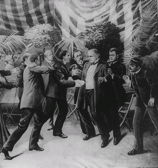
U.S. President William McKinley was assassinated on September 6, 1901, in Buffalo, NY. There have been many versions of a song called “The White House Blues” performed since then, by many different musicians. President McKinleyA quick Internet search will reveal different lyrics in different versions. These musicological differences do not interest me so much as the song’s depiction of the “historical” event of a president’s assassination, and Biram’s depiction in particular:

McKinley hollered, McKinley squalled,

Doc says “McKinley, I can’t find that ball”

In Buffalo, in Buffalo

As the title of the song suggests, the cadence of the stanza is from the blues. The President “hollers” and “squalls,” certainly not verbs accustomed to “official” presidential discourse. And the specificity of the lyric allows to see, even feel the bullet inside the man’s body. We are not surprised to find basic confirmation on-line (Wikipedia) [1] that the actual President McKinley did, in fact, die of complications from a bullet wound—a bullet that was not successfully removed. Whatever claim to authority made by an “official” history or public symbol of this assassination (including variously, for example: the funeral/gravesite, entries in textbooks, the electrocution of the murderer, monetary inheritance to family, continuation of governing policies and/or transfer of power; all of these more or less “official public memories” of the President’s death), the “vernacular” song excludes from its rendition. The song’s exclusive claim to authority as a “historical” symbol (or “public memory”) asserts itself with almost Shakespearean intensity:

Roosevelt’s in the White House, he’s doing his best,

McKinley’s in the graveyard, he’s taking ever rest.

He’s gonna be gone, a long time.

Roosevelt’s in the White House, he’s drinking from a silver cup,

McKinley’s in the graveyard, he’ll never wake up,

It’ll be a long, long time.

The silver cup is a symbol of authority and power; the song assigns it to Roosevelt, McKinley’s successor, and so reserves the real power for itself-as-song, itself-as-symbol of “public memory,” as cultural authority. By adapting and performing the song, Biram joins himself (“identifies”) with others who have performed it. More importantly, he absorbs the perspective of the song, the point of view from which the story is told as shaped through the various personalities of past musicians.

At this point in cultural history, we are likely to encounter McKinley’s assassination first through a song like “The White House Blues” and then develop an interest in the historical details. Or if we remember the fact from high school or have a particular interest in American history, we never will have encountered the event so vividly presented. At least, after hearing the song, we are unlikely to forget this particular “narrative” depiction when thinking of the death of William McKinley. Insofar as that holds true, the song becomes a very real part of our “public memory” and can inform any larger “historical” narrative we tell of the United States and ourselves in it. Insofar as the song “contaminates” our “super-narrative,” it succeeds in its attempted usurpation. Ironically, it may even come to function as an individual’s privately held “official” memory, or the “official” narrative of a “vernacular” community, or quasi-“officially” to a would-be imitator. But my use of Bodnar’s terms has drifted from their source. This discussion will be continued later on, when we consider “identification” in greater depth.

If “The White House Blues” attempts to usurp a “political” narrative of public history, a song called “Titanic” claims authority, darkly, as an “economic” treatise of sorts. Like “The White House Blues,” it is a folk song ascribed to an anonymous or composite author. I contacted Biram by e-mail and asked him where he first heard the song, and he replied that it was either Son House or Mance Lipscomb, he could not remember. I did manage to locate a recording entitled “The Sinking of the Titanic” by Lipscomb, with the same lyrics as Biram sings, on the album Live at the 1966 Berkeley Blues Festival (co-recorded with Clifton Chenier and Lightning Hopkins). I only emphasize these details in order to illustrate the diffusion and composite nature of authorship, the workings of creative borrowing and adaptation that form a “vernacular” tradition of public memory.

The song’s “economic” stance might best be summed up in its final ironic stanza. The Titanic was a kind of “ultimate” symbol of economic power, and its demise is symbolized by the song as a cosmic revenge against that symbol. If the passing of the “silver cup” has a touch of the Shakespearean Kings about it, the “Titanic” echoes the Book of Job:

You know Jacob Astor was a millionaire

Plenty of money to spare!

Boat was sinking, and he couldn’t pay his fare

God moves

God moves

God moves on the water, lord

The people got to run and pray.

“God” usurps economic power over dollars, and the stock market is rendered minor next to the dark waves of the ocean. I have mentioned the importance, in these “historical” songs, of the “perspective” or point of view established by the song. A successful performer of the song, like Biram, identifies with this perspective and makes the perspective available to listeners. No moment in “The White House Blues” matches the pathos achieved by the singer/narrator’s (symbolic) perspective on the sinking ship:

The Titanic was sinking,

They sent lifeboats all around,

They said, “Save the women and the children,”

You gotta watch your man go down.

They said, “Look out over that ocean,”

You gotta watch your man go down.

More of us are likely to have encountered the story of the ship Titanic, sunk April 14, 1912, than of McKinley’s assassination in 1902. Yet no form of “public memory” concerning the Titanic has affected me so deeply and complexly as the thought of being a woman or child on a lifeboat, huddling in the cold, watching my father or husband sink to his death. As tremendous as the suffering is allowed to be, the song balances empathy with a curse. God moving on the water affirms the dark power of the song and “fate,” which after all is just a symbolic reduction of the song. The luxury ship is punished as a caprice, along with the decadence it represents. In contrast to any narrative that would portray the Titanic in purely sentimental tones, purely as “tragedy,” there is a grim sense of justice about Biram’s rendition. As with “The White House Blues,” the power of the song to usurp the “memory” of the “historic” event will vary from listener to listener.

III. “Identification” in Kenneth Burke and Gregory Clark

So far comments have been made about the “perspectives” or “points of view” established by songs upon particular “historical” events. We have considered two American blues/folk songs of anonymous/composite authorship performed by Scott H. Biram, labeled simply “traditional,” that adopt “vernacular” stances seeking to usurp cultural authority and pre-empt “official” narratives of these events. But so far the “points of view” in the songs have lurked in the background. The “narrators” within these songs are shadowy, “generic” story-tellers, shifting and “universal” like an ancient Greek Chorus. The remaining two songs to be presented are more “personalized,” with narrative “perspectives” grounded in coherent human figures. The two selected are intended to represent the many other personae in Biram’s songs beyond the scope of this paper. Before I continue my analysis, however, I must develop a theoretical angle already introduced to assist my way. I have used the words “identify” and “identification” at scattered moments thus far, anticipating the following explication, and my final argument will likewise depend on the trope of “identification.”

Kenneth Burke argues in A Rhetoric of Motives (1950) that “Identification is compensatory to division. If men were not apart from one another, there would be no need for the rhetorician to proclaim their unity” (22). Yet he also argues that the principle of “identification” transcends division because it “logically” precedes it and, in a way, “contains” it. As Burke phrases this, “there would be no strife in absolute separateness, since opponents can join battle only through a mediatory ground that makes their communication possible, thus providing the first condition necessary for their interchange of blows” (25). Here the trope of “combat” stands in for all rhetorical “symbols” or symbolic interchanges. For Burke, even symbolic acts of slaying, exclusion, and annulment involve aspects of “identification,” because the “the killing of something is the changing of it, and the statement of the thing’s nature before and after the change is an identifying of it” (20).

For examples, let us briefly consider the “identifications” at work in “The White House Blues” and “Titanic.” Both “narratives” or “public memories” portray actual death and killing, and both adopt a stance towards these events that attempts, more or less, to “kill” (or usurp, overwhelm, replace, “swallow up,” etc.) narratives that would sterilize these events for the sake of “official” simplicity and “sacredness.” There is a different kind of sacredness at work in these old songs, and it does not aim, on the face of it, for “social unity.” But this discussion would be impossible if  singers had not engaged in some respect with the institutions of the U.S. Presidency and the Titanic. As Burke might say, the “ground” for the songs’ attempted usurpation is a fundamental “identification” with American civic discourse and with a society who’s “interests” (including “investments” of public “identity”) may include the White House and/or “memories” of the famous ship.

These examples of “identification” through usurpation and exclusion are obscure, however, like the narrative viewpoints in the songs themselves. Burke’s rhetorical project in general “considers the ways in which individuals are at odds with one another, or become identified with groups more or less at odds with one another” (22). The forms or “symbols” of identification in “The White House Blues” and “Titanic” are obscure because the songs’ individuals are obscure, the loci of observation within the songs are fleeting and rough-hewn. In competing with all possible “official” stories of “historic” catastrophes, the songs adopt an archaic, “timeless” character that Bodnar might even be tempted to classify as quasi-“official.”

Contemporary rhetorician Gregory Clark focuses on “symbolic landscapes” as forms for “identification” by which Americans “transcend” their differences and join into community. This experience Clark calls a “public experience of collective identity” (71). He refers specifically to the United States National Park system, and claims that such places as Yellowstone and the Grand Canyon binds Americans together for a common purpose and identity. Insofar as such “identities” include narratives about the past (which we suspect they must, invariably), Clark’s National Parks would qualify as “symbols” of public memory under our definition. And he is correct in recognizing that “communion” is a “profound individual identification with a collective—they [i.e., we] all need” (77). Clark usefully shows how many people who would naturally be “divided” instead become “unified” by mutual “identification” with a common symbol, which symbol then constitutes an “identity.” In this, Clark has given us as good a Burkean definition of the rhetorical symbol that is “public memory” as we are likely to find.

Yet we think that Clark is not being dialectical enough. From the Burkean standpoint, Clark tends to over-stress “unification” and de-stress its complement “division.” In his eagerness to account for American “communion,” he neglects the Burkean admonishment that individuals “become identified with groups more or less at odds with one another.” The rhetoric of Clark’s National Parks overcomes the common differences in favor of common likenesses. In the Bodnarian dialectic, Clark’s rhetoric of “transcendence” tilts his analysis towards “official” biases, adopting tones of simplicity and unambiguousness. This has somewhat the opposite effect of “vernacular” attempts at usurpation: it serves to dampen, erase, or “move beyond” the discordant elements in our society. This is not so bad as it seems. We do not reject Clark by any means, but rather dialectically attempt our own Clarkian analysis beginning with a break from Clark, a conscious choice to strengthen the voice of discord, a haunt of otherness.

IV. “Pastures of Plenty” and “Truck Driver”

The mysterious narrative “points of view” in the anonymous folk songs and the rugged landscapes of National Parks now must sharpen into specific persons. We are discussing symbols of the past and present and individuals’ “identification” with those symbols in the formation of “public memory.” Since we are persons, one might guess that we “identify” best with other persons. But I wish to be more Burkean than Clarkean in emphasizing the dialectic of unity and division—so that one is never totally free from the other. That is to say, if we “identify” with a person or persona (as a “character” in a song), we ambiguously join and divide with them, there is a bit of struggle necessarily involved. And when we “identify” with a group, it is a group against other groups. In the back of our minds, we remember that as language-users, as animals, as organisms, etc. we all belong to groups-of-groups. But we also realize that the more we generalize, the more we specify. For example: we may argue that the most general “identification” each of us can assert in an “ecological” sense is that of organism; that we have in common even with insects and flowers. But that label so thoroughly strips the vocabulary for social motives that the word “organism” becomes precisely the word for our physical body-matter, our pains and our weaknesses, and “ultimately” each of our own, incommunicable deaths.

When we identify ourselves with (or as) “characters,” I believe we are at our most social, rhetorical, “public.” The strongest “identifications” I can imagine for public purposes are symbolic portrayals of human beings. Woody Guthrie wrote a song called “Pastures of Plenty” from the point of view of an archetypal migrant worker, and Biram performs a version of it. There is a famous stanza that Bob Dylan alluded to in his tribute “Song to Woody,” and Guthrie combines the “vernacular” stance with its own kind of “symbolic landscape”:

I worked in your orchards of peaches and prunes

I slept on the ground in the light of your moon

At the edge of your city, you seen us and then

We come with the dust and we go with the wind.

The rhetorical work of “identification” in this stanza is done by the pronouns. The singer Biram identifies himself with the main character of the song, the migrant worker. Biram himself is a migrant worker as a traveling musician, so the “identification” has a corresponding basis in the patterns of actual life. “I worked in your orchards” sets up the basic dichotomy of I/you for the rest of the song.

The distinction between the two halves is economic. The self is defined by a division between ownership and labor. The worker “sleeps on the ground” and projects his “alienation” such that the owner owns even the moon. Strangely enough, this may be the closest point of “unification” between the worker and boss. Both “free” in their solitude, their relationship is purely idealized. When the worker looks at the moon and sees his boss, he never more profoundly “identifies” with him. The point of contact, collision, confrontation, and dispersal comes when the owner sees the worker and the worker sees the owner. The narrator of the song comes to the “edge of your city.” Here is the seat of power where reside banks, courts, and the private homes of the governors. No sooner has this “edge” been “bridged” by the gaze across it—Bodnar would this an “intersection” between “official” and “vernacular” cultures—than the worker disappears.

Guthrie’s vicissitudes of “identification” are highly dialectical. Splitting from “identification” with his boss/owner, the worker “identifies” with the land itself, the “dust and the wind.” This is an attempt at imaginative usurpation, akin to that of the “historical” songs already discussed. Guthrie (and Biram, “vicariously” through identification with Guthrie as performer of his song) deepens and amplifies his worker/narrator’s “identification” with the landscape. We might present this stanza alongside Clark’s study as a contrast:

California, Arizona, I’ll make all your crops

And it’s north up to Oregon, to gather your hops

Dig the beets from your ground, cut the grapes from your vine,

To set on your table, your light sparkling wine

The worker identifies himself with the states of the Union with echoes of Walt Whitman. More pertinent to rhetoric, Guthrie/Biram maintain a strict distinction between “I” and “you.” It is a dichotomy implicit in “The White House Blues” and “Titanic,” but made explicit here. The class distinction is clarified by the final line, in which the worker/servant brings the literal “fruits of his labor” for the owner’s (“your”) light-hearted pleasure.

This song performs the same “vernacular” attempt at usurpation of “official” public memory. In this case it seeks to undermine narratives that would assert “rights of ownership” based on monetary/financial grounds. The voice of the song claims priority and authority as a more authentic “owner” of the land. Contrast this position briefly with Clark’s analysis of the U.S. National Parks. Clark’s “symbolic landscapes” are sanctioned by the state, carved and bordered. Guthrie’s landscapes are worked: “It’s a mighty hard row that my poor hands have hoed.” Guthrie makes a claim on the soil and the sustenance of his “other,” his factional opponent. He does it with that same accommodating yet fiercely partisan air of the other songs analyzed so far. It is no stretch to say that Biram “identifies” with these figures—musicians of the past and the “characters” in their songs.

Our own “identification” with these songs, singers, and characters may vary among us, but insofar as we “identify” with them we commit ourselves to (or “invest” ourselves in) the principles of faction and conflict. We need not work in fields to experience such identifications. As Guthrie’s shift from field-worker to table-servant implies, the center of the “identification” is an economic relationship. Listening to the song, we may even find that we have more in common. But the “perspective” of the song argues in favor of the worker. Whoever we are, it admonishes us that value originates in labor and throws doubt upon the authority of money, of ownership justified on financial grounds.

My argument is that Scott H. Biram, the traveling singer, is a dialectical “symbol for identification” and makes dialectical “symbols for identification.” One of the strongest examples is his cover of Woody Guthrie’s “Pastures of Plenty.” With this and other interpretations of older blues/folk songs, Biram identifies himself with the tradition, and so becomes part of that tradition. I have focused so far on symbols of the past—but what is their use for the present? How does Biram adapt the stances, viewpoints, and lessons of the tradition for present needs? I near the end of my analysis, and there is much to be said on this question—more than I can begin to address, for now—but I will finish with a brief “beginning” of that exploration. Biram’s original songs are varied, but most maintain essential connections between work, land, and a somewhat “spiritual” assertion of “vernacular” culture against “official” culture (justified by work and “identification” with the land).

Many of Biram’s own songs are told from the point of view of a contemporary truck driver. This “perspective” is developed in many directions in his newest songs, but I will select his first attempt at symbolically “characterizing” the truck driver, in a song aptly named “Truck Driver.” Biram’s chorus in this song echoes of Guthrie’s “Pastures of Plenty”:


I’ve been to Detroit, LA,

New York, Mississipp-I-A

Grand Canyon, Hoover Dam,

East Texas, and Viet-Nam,


Lord have mercy

Lord have mercy on a weary soul

Yeah I’m burning down this highway

And I’m pulling on a heavy load

There is freedom in “burning down this highway,” but the load is heavy. Also note the list of geographical locations as a way of identifying with the land-in-general. Finally, we can see how Biram’s song might encompass Clark’s analysis (via the Grand Canyon) and a recent event in American history (Vietnam) that may not be so widely “memorialized” in the musical tradition. I do not think Biram’s “Truck Driver” matches Guthrie’s migrant worker’s power of usurpation in “Pastures of Plenty,” but I think the debt and attempt to extend the traditional stance is clear. We might say that in songs like “Truck Driver” Biram forms a symbol of the present and for the future (as well, of course, as for the present). There is a past narrative to this symbol of the present, in the American musical tradition, as Biram emphasizes by recording the old songs. But the past-as-past must be obscured in order to portray the present, a lesson we might care to remember when attempting to symbolize the past for present purposes.


REFERENCES

Biram, Scott H. Lo-Fi Mojo. KnuckleSandwich Records, 2003.

Biram, Scott H. E-mail to the author. 16 April 2007.

Bodnar, John. Remaking America: Public Memory, Commemoration, and Patriotism in the Twentieth Century. Princeton: Princeton University Press, 1992.

Burke, Kenneth. A Rhetoric of Motives. Berkeley: University of California Press, 1969.

Clark, Gregory. Rhetorical Landscapes in America: Variations on a Theme from Kenneth

Burke. Columbia: University of South Carolina Press, 2004.

Chenier, Clifton, Mance Lipscomb, and Lightning Hopkins. Live at 1966 Berkeley Blues Festival. Arhoolie Records, 2000.

Dylan, Bob. Bob Dylan. Columbia Records, 1962.

Wikipedia – William McKinley. 16 May 2007. http://en.wikipedia.org/wiki/Mckinley


[1]Image: http://en.wikipedia.org/wiki/Image:McKinleyAssassination.jpg 15 May 2007: Drawing of the McKinley assassination from http://teachpol.tcnj.edu/amer_pol_hist/thumbnail261.html, public domain.

Big Brother Meets the “Alpha Mom”: Tensions in the Media Standardization of Motherhood by Lauren Lang, San Diego State University

On 26 January 2007, Today on NBC aired a segment as part of its series on “Today’s Woman” entitled “Cocktail Playdates for Moms.” The segment was ostensibly intended to provide a neutral report on what it identified as a growing trend: mothers who enjoyed a glass of wine or beer together while their children played. After a pointed introduction by Today host Meredith Vieira (in which she quipped that “whether you call it ‘tots and tonic,’ ‘cocktails and chaos,’ or ‘booze and babies’…it has got everyone buzzing”) the field correspondent spoke with several mothers who explained their rationale for drinking a glass of wine while parenting. But even as the mothers argued that enjoying one glass of wine was a constructive way to socialize and to claim an adult subject position, the segment framed this practice in a way that construed these women as irresponsible and selfish, suggesting that “good” mothers would never be tempted by alcohol. Both correspondent Janet Shamlian’s voiceover and the segment’s soundtrack provided commentary that transgressed the bounds of objectivity. “Call it the cocktail playdate,” Shamlian intoned: “the jungle gym, the sandbox…and a backyard bar.” The beats of hip-hop/club music resonated in the segment’s background, later switching to the upbeat Lambert, Hendricks, and Ross jazz tune “Gimme That Wine”; both songs implied that cocktail playdates are mere sips away from drunken revelry.

If these sorts of messages are being communicated by the Today show, currently the most-watched morning television program in the United States with a viewership of five to six million people (Kurtz), what does this suggest about the mass media’s relationship to the cultural constructions of motherhood that it promotes? By what avenues does the media serve to normalize our conceptions of power and gender, particularly in parenting contexts? While it would be impossible to trace the direct effects that the media has on women’s personal choices (especially because those choices are impacted by countless other contextual factors), the media’s specific strategies to pressure women to conform to hegemonic ideals should be more carefully examined. In this paper, I address the media’s perpetuation of the Alpha Mom subjectivity, a very specific and ultimately impossible standard to which mothers are encouraged to aspire. Informed both by ideals of “perfect” mothers from recent decades and rhetorical acts of resistance in the present, this subject position symbolizes the tension between the normalizing effects of the media on motherhood and femininity, and mothers’ personal or vernacular experiences. Examining the ways in which the Alpha Mom is framed and negotiated in mediated contexts provides a rich understanding of the key issues in contemporary motherhood.

While the term Alpha Mom was coined in 2004 as a branding strategy for the mothers’ television channel Alpha Mom TV on cable network Comcast On-Demand, it has since been used more broadly to describe the criteria for the “good” mother in contemporary society. A recent article in USA Today defines this new ideal as [an] educated, tech-savvy, Type A [mom] with a common goal: mommy excellence. She is a multitasker. She is kidcentric. She is hands-on. She may or may not work outside the home, but at home, she views motherhood as a job that can be mastered with diligent research….and—key for marketers—she is, as the label implies, a leader of the pack who influences how other moms spend (“Alpha Moms”).

While other researchers have not used the specific term to describe this ideal subject position, they have pinpointed the criteria that comprise it. Susan E. Chase and Mary F. Rogers describe the contemporary “good” mother as follows:

Above all, she is selfless. Her children come before herself and any other need or person or commitment, no matter what. She loves her children unconditionally yet she is careful not to smother them with her love and her own needs…She is ever present in her children’s lives when they are young, and when they get older she is home every day to greet them as they return from school. If she works outside the home, she arranges her job around her children so she can be there for them as much as possible, certainly whenever they are sick or unhappy. (30)

Susan J. Douglas and Meredith W. Michaels term the most recent trend in public representations of mothers the “new momism,” and define it as “the insistence that no woman is truly complete or fulfilled unless she has kids…and that to be a remotely decent mother, a woman has to devote her entire physical, psychological, emotional, and intellectual being, 24/7, to her children” (4).

To understand the sophisticated and nuanced standards by which mothers are judged and normalized in American culture, it is worthwhile to examine the constructions of motherhood from decades past that serve to inform these contemporary ideals. Some of the primary visions of the “ideal” mother in our public consciousness likely find their beginning in portrayals of the nuclear family of the 1950s. Betty Friedan famously provides example after example of fictionalized media representations of what she terms “happy housewife heroines” (33), June-Cleaveresque wives and mothers who cultivate their feminine beauty and exist solely for acts of subservience to their husbands and children, and who adhere to the belief that “the highest value and the only commitment for women is the fulfillment of their own femininity…in sexual passivity, male domination, and nurturing maternal love” (43). The result, in Friedan’s account, was the “problem that has no name,” the great lack of purpose in the lives of American women in the 1950’s that literally drove them insane. Even though the “ideal” mother was in fact very different from actual women in this time period, this ideology presented a model to which they felt they should aspire; not surprisingly, the “perfect mother” was a fiction then—and she remains a fiction now, even as she helps to inform contemporary motherhood.

As the Women’s Liberation movement came to the forefront in the 1960s and its immediate results eased into the 70s and 80s, more women entered the workforce with the result that the media’s face of motherhood in these decades changed significantly—a result of women’s backlash, perhaps, to the “perfect mother” (Douglas and Michaels 42). The ideal of this era was embodied by the Supermom subjectivity, a full-time working woman who could still attend to her children’s every need (Kantrowitz 46-47), somehow able to find enough time to assume two full-time jobs. This stereotype eventually fell out of favor as well; Barbara Kantrowitz, in a 1986 Newsweek article, notes that “the myth of Supermom is fading fast—doomed by anger, guilt and exhaustion” and describes new trends in mothers’ work such as flex-time, home businesses, and leaving work for several years to return after children are older (47).

It may be in the return swing of this pendulum that the Soccer Mom, the most familiar ancestor of the contemporary “ideal” mother, was born (Douglas and Michaels 206). Research suggests that a combination of Supermom burnout, increased media focus on potential threats to children from both inside and outside the home, and political emphasis on reviving family values (Coontz 95) resulted in a trend of affluent, suburban mothers choosing to work only part-time or less. Women were confronted with a media onslaught of stories about razor blades in Halloween candy; children molested, abducted, or killed by caregivers; and all sorts of manifestations of bad mothers, such as crack mothers, murdering mothers, and so on (Douglas and Michaels 85, 141), all of which exercised a profound pathetic appeal to mothers’ sense of fear and guilt about not spending more time at home. Douglas and Michaels note that ideal mothers in 1980s media were “exemplified by…the educated, authoritative, highly organized woman who read every childcare book published… and juggled work and family” (151). A mother who often worked full-time could not likely conform to these rigorous standards, and so many mothers felt pressure to choose between their children and their jobs—and past constructions of motherhood made it perfectly clear that they belonged at home.

I have traced the genealogy of publicly constructed and memorialized mothers through the past several decades because they have greatly informed representations of the “ideal” mother in the present-day. Today’s Alpha Mom may be newly technologically adept, but she also is a composite of the past fifty years’ worth of unrealistic standards—and thus just as much a fiction as her predecessors. The fact that the Alpha Mom is still considered most “at home” in a domestic sphere in which she strives for perfection reflects ideals of the 1950s and 1960s; the fact that she is expected to multitask—entertaining and educating children, maintaining domestic splendor, texting on her Blackberry, and possibly working outside the home—evokes the Supermom of the 1970s and 1980s; her fastidious attention to and sacrifice for her children, to the eradication of her own independence and individuality, maintains expectations of the 1990s Soccer Mom. It is as if society chose the most difficult, most demanding aspects of each past cultural model and channeled them into a new identity for contemporary mothers—and one just as impossible to achieve.

But even as American popular culture has constructed a purely fictional archetype of the “ideal mother,” the pressures women feel to conform to this standard are neither imaginary nor inconsequential. The ideals catalogued above have been communicated and imposed largely through the mass media, ranging from women’s magazines in the mid twentieth century (Friedan 44) to television and the Internet today. The prevalence of the media in our everyday lives—and our dependence upon it—suggests that it has incredible influence upon our actions, our opinions, and ourselves; ultimately, we cannot escape exposure to ideologies so widely communicated. I contend that messages of motherhood conveyed by purportedly reputable news organizations have the potential to construct a convincing, compelling standard to which readers and viewers may feel pressure to aspire. This standard also appears inherent in the goals of media texts that focus on motherhood. These texts seem to take a persuasive, normalizing stance rather than neutrally informing the public of certain issues or trends. The USA Today story on Alpha Moms ends with two provoking questions: “Are you an Alpha Mom or are you related to one? What makes you or her an Alpha Mom” (“Alpha Moms”)? These questions seem to suggest that the reader should consider her own subjectivity and her own parenting style and compare it to that of the Alpha Mom. The existence or criteria for other “types” of mothers, however, are not discussed. The article suggests that if a woman is not an Alpha Mom, she might fall under the lesser categories of, perhaps, a Beta or Omega Mom, and to assume those subject positions would be undesirable. David Gauntlett argues that television, the Internet, and other media “provide numerous kinds of ‘guidance’…. in the myriad suggestions of living which they imply. We lap up this material because the social construction of identity today is the knowing social construction of identity. Your life is your project—there is no escape. The media provides some of the tools which can be used in this work” (249). Applying Gauntlett’s lens here indicates that texts such as this Alpha Mom article possess a subtle, manipulative power to privilege certain standards of living, behaving, and even becoming—and that the media does not hesitate to normalize motherhood via this power.

One rhetorical device that encourages women to construct their identities in accordance with social norms is the “bad mother” trope. The “bad mother” is a stigmatized and demonized character that ultimately fails her children and society at large. Ranging from the most criticized, such as mothers in nontraditional families, poor teen mothers, or drug addicted pregnant women (Chase and Rogers 31, 35, 41), to mothers who work and thus neglect their children, to mothers who stay at home and thus smother their children (Tincknell 27), this trope appears consistently in mass media. The “bad mother” operates rhetorically by presenting an undesirable option for motherhood—and implying that if the audience member would like to avoid this pitfall, she would do well to abide by the media’s standards. But this common trope is actually part of a larger fallacy of false dilemma; offering an undesirable choice and an “ideal” choice for good motherhood argues falsely that there is only one way—the standardized way, the “institution”—to parent well. Thus a woman who drinks wine at a playdate is cast as a bad mother, while the Alpha Mom that “does it all” is cast as ideal. Douglas and Michaels describe the rhetorical significance of such media arguments as constructing a “maternal panopticon” (171). Mothers are consistently held to fickle, impossible standards, and the consequences for failing are severe—ranging from cultural disapproval and hostility to criminalization. In standardizing motherhood, the media has crafted good mothers and bad—and suggested that “bad” mothers should be scrutinized, rehabilitated, legislated against, and ultimately reviled. The existent research in this field suggests that the media exerts tremendous power in normalizing what mothers feel they should do and who they should be. Ultimately, the “good” mother seems like a feasible ideal to which women aspire because the media leaves them with no other options but failure.

But even as the media exerts such power, it is also worthwhile to question if and how media texts resonate on a bottom-up level, with what Paul Nesbitt-Larking terms the “expectations of the everyday” (85). Much of the media’s rhetorical success is contingent upon contextual factors such as preexisting audience ideologies and cultural norms; effective media arguments draw upon and may even originate from these shared ideologies, “thus reproducing dominant ideas and ideals” (99). The Today show segment with which I began this paper may help to reinforce certain standards of behaving—but it is quite possible that the rhetorical effect of this segment lies in its manipulation of (and appeal to) cultural values that the audience may find compelling. Today may have been preying on certain contextual factors, such as fears of mothers like Britney Spears, who allegedly abuse alcohol and provide substandard care for their children, or such as cultural hegemonies that dictate that mothers should not imbibe alcohol while parenting. The suggestion that cultural ideals inform the media while the media serve to replicate those same cultural ideals may be relevant to the various incarnations of ideal motherhood in the past half-century—and the Alpha Mom subjectivity as the media offers it today. This subject position is a composite of decades worth of cultural constructions of what “good” means. The media, serving as the primary vehicle for relaying these constructions, may have helped to construct the Alpha Mom based on this synthesis of cultural values that have informed what qualities mothers should possess, such as selflessness, Type-A personalities, child-centric attention, drive for success, and so on. The communication and normalization of all of these values at once results in standards that are impossible to meet.

While the recognition of oppressive and inaccurate ideals of motherhood is well documented in academic discourse, the symbolic subversion and negotiation of these standards are a potentially rich area for further rhetorical study. In their text, Douglas and Michaels champion the difficult work of what they term rebellious mothering, which deliberately challenges the Alpha Mom ideals by affirming that good parenting, individualism, and nontraditional views of motherhood are not mutually exclusive (13). The Internet serves as a particularly apt venue for the expression of these subversive ideas and ideals. Rhetors are able to create and contribute to arguments that have the potential to reach a wide audience, but are mostly spared the bureaucratic difficulties associated with publishing in print or television media. Thus the “rebellious mothering” work that has been accomplished on the Internet has largely assumed a personal, politically bottom-up format. These acts of resistance are more specifically undertaken in the blogosphere, particularly in the work of blogging mothers, or “mommybloggers.” Using such strategies as irreverent and often profane language, sarcasm and humor, and identity construction, these women attempt to readily acknowledge and negotiate the trials and tribulations of parenting—a potentially important rhetorical aim, given the hegemonic discourse touting the Alpha Mom. While these women challenge some of the Alpha Mom’s criteria for existence, they also negotiate their own identities in relation to this new standard; several popular bloggers in this genre, such as Armstrong, write regular columns for Alpha Mom TV. Providing an ideal setting for women who are attempting to negotiate the different subjectivities they assume—whether those of woman, writer, mother, social adult, wife, etc.—blogs may enable women to resist and/or negotiate the pressures exerted by media constructions of motherhood.

I will provide a brief case study here to illustrate one of the ways in which “mommybloggers” (and mothers in general) may respond to impossible ideals. Following the Today Show segment on “cocktail playdates,” host Meredith Vieira interviewed Dr. Janet Taylor, a clinical psychologist, and Melissa Summers, author of the parenting blog Suburban Bliss. Having previously posted about this topic on Suburban Bliss, in the interview Summers reiterates her claims that mothers are adults and should not be obligated to drink juice boxes like children. She explains that at most these women are having one to two drinks in a controlled environment, and that this activity might actually benefit their children by showing them how adults handle alcohol responsibly. In her original post on the topic, Summers suggested that other mothers who disapprove of this aspect of her lifestyle are likely not people she would claim for friends or allies: “[I]f a beer freaks you out then you’re probably not going to like the fact that I am depressed and am on and off medication. You’re also not going to like the fact that sometimes? I don’t like my kids and I think they’re being whiney brats and I want to put them to bed at 3pm or sell them on Ebay” (“The hair”).

Summers was ultimately disappointed with the Today Show segment; she felt that Vieira was biased and had disregarded her points. A few days after the interview, she expressed her disappointment that Vieira had pointedly asked her if she would allow a babysitter to drink while watching her children, using her blog as a space to share how she would have really liked to respond:

Meredith is it possible that you’ve never had a drink in front of your kids because your kids are with an actual babysitter? Who you pay? To watch your children for a set amount of time? Meredith, is it possible that mothering is not a job for me. That it’s a role I have and one I take seriously. I also play the role of a wife and an actual person who enjoys socializing with her friends like anyone else who enjoys drinking as a social activity. Sometimes I play these roles AT THE SAME TIME…. Next week on The Today Show…. Matt Lauer asks, “Gee Whiz, Why Do Mothers Feel Like They Have To Be Perfect All The Time” (“I can’t”)?

The rhetorical stance Summers takes in the debate over alcohol and childrearing supports her representation of an identity that challenges traditional ideologies of motherhood. By reserving the right to enjoy a glass of wine while supervising her children for the reason that she is an adult and not a child specifically contradicts what Douglas and Michaels claim as the central tenet of the “new momism”: that mothers adopt the subject positions of their children. Because motherhood is not a “job” but a subjectivity, Summers suggests that it must be integrated, along with others, into her identity. To become a true Alpha Mom, however, would leave no space for these other subjectivities to develop. In our exploration of “ideal” representations, it is also important to note Summers’s point as to the idea that mothers feel they have to be perfect. In this barbed remark, she implies that mothers feel the pressure of perfection because these are the expectations impressed by the media specifically and society in general. This assertion reveals Summers’s consciousness of the Alpha Mom criteria imposed upon her and her attempt to contest them by engaging in activities that promote her status as an independent adult. For many readers, Summers will provide a representation of a successful mother who does not adhere to Alpha Mom standards—and will validate them as they explore the options available to become truly good mothers.

I argue ultimately that motherhood is a key site for feminist action, precisely because it resonates so fully with our cultural values and expectations and is a mediated construct where sexism remains prevalent. Natalie Fixmer and Julia T. Wood note that third-wave feminists “aim to weave structural changes wrought by the second wave into material, concrete life and all of its ‘tiny, everyday’ moments” (243). This bottom-up, embodied political resistance as it occurs in the “local” arena of the blogosphere may potentially provide rich material for rhetorical study; women searching for their own brand of motherhood amid the Alpha Mom phenomenon have much to resist—but also much to discover.

REFERENCES

“Alpha Moms Leap to Top of Trendsetters.” USA Today 27 March 2007, sec. Money.

Chase, Susan E. and Mary F. Rogers. Mothers and Children: Feminist Analyses and Personal Narratives. New Brunswick: Rutgers UP 2001.

“Cocktail Playdates for Moms.” Narr. Janet Shamlian. Today. NBC. 26 January 2007.

Coontz, Stephanie. The Way We Never Were: American Families and the Nostagia Trap. 2000 ed. New York: Basic Books, 2000.

Douglas, Susan J., and Meredith W. Michaels. The Mommy Myth: The Idealization of Motherhood and How It Has Undermined All Women. New York: Free Press, 2004.

Fixmer, Natalie and Julia T. Wood. “The Personal is Still Political: Embodied Politics in Third Wave Feminism.” Women’s Studies in Communication, 28.2 (Fall 2005): 235-257.

Friedan, Betty. The Feminine Mystique. 2001 ed. New York: Norton, 2001.

Horkheimer, Max and Theodor W. Adorno. Dialectic of Enlightenment. Trans. John Cumming. 1972 ed.  New York: Herder and Herder, 1972.

Kantrowitz, Barbara. “A Mother’s Choice.” Newsweek 31 March 1986: 46-51.

Kurtz, Howard. “Vieira Adjusts to the View at ‘Today’.” The Washington Post 9 April 2007: C01.

Nesbitt-Larking, Paul. Politics, Society, and the Media. Peterborough: Broadview Press, 2001.

Summers, Melissa. “I Can’t Help It. I Have to Start Even Though My Head Is Throbbing from No Sleep.”  2007. Suburban Bliss.  (27 January 2007). 14 May 2007. <http://www.suburbanbliss.net/suburbanbliss/2007/01/i_cant_help_it_.html>.

—. “The Hair Is the Best, That’s All That Matters. Right?”  2006. Suburban Bliss.  (10 November 2006). 14 May 2007. <http://www.suburbanbliss.net/suburbanbliss/2006/11/the_hair_is_the.html>.

Tincknell, Estella. Mediating the Family: Gender, Culture and Representation. New York: Oxford UP, 2005.

The Sinister Science of the Human Betterment Foundation and a Rhetoric of Motives by Katherine Swift, San Diego State

This is a graduate student submission to the 7th Triennial Conference of the Kenneth Burke Society.

My research was conducted at the Institute Archives of the California Institute of Technology in Pasadena where I examined the original documents of E. S. Gosney and the Human Betterment Foundation, and the Historical Files on Biology Division. Caltech is the holder of Gosney’s effects since, as founder of the Human Betterment Foundation, he had its real estate holdings transferred to the university’s biology department in 1942, making Caltech an endowment worth more than $470,000. This money was used to create the Gosney Research Fund, which provided scholarships to students in Caltech’s biology and biochemistry departments with a focus on behavioral biology.  The Human Betterment Foundation Papers (or HBF) represent an original eugenic archive that offers a rare look into California’s sterilization program and the dialectics of the nature-versus-nurture debate in eugenic rhetoric. Burke’s idea of identification and the embodied symbolicity of the scapegoat form the basis for an exploration of a rhetoric of motives in eugenic technocracies premised on social improvement through social control.

Interestingly, the same root word “gene” used in the creation of the word “genocide” (Black, 402) was previously employed by Francis Galton to form the term for technologies of human breeding he dubbed “eugenics,” or the science of the well-born.  Scientistis such as Galton, Huxley and Davenport spawned an international forum for improving human heredity known as the “eugenics movement” at the turn of the 19th century. Premised on the biologically determined nature of human beings, and the belief that, thus, race and mental hygiene could solve social problems, eugenic scientists set an inexorable course for the death camps of Nazi Germany.

American eugenicists were behind three major policy initiatives of the early 20th century.  For example, they maintained that the “race suicide” of Anglo-Americans could be prevented through laws prohibiting inter-racial marriage. Likewise, eugenicists campaigned for immigration restriction quotas to stem the tide of foreign genes into the U.S.  Perhaps their most controversial measure called for the compulsory sterilization of all those of unsound mind or body.  Eugenicists believed that sterilization protected society from the “menace of the feebleminded” through the practice of mental hygiene.  That the targets of mental hygiene tended to be the socially marginalized only served as further evidence of their “social inadequacy.”  Sterilization was thought to relieve schizophrenia and depression, and prevent the spread of mental illness by curtailing the birth of “eugenically undesirable children.” To quell criticisms of California’s sterilization laws, the HBF undertook an ambitious study of the results of California’s experimental program in order to document the “physiological and mental effects of sexual sterilization” on mental patients (Harry H. Laughlin Papers, D-2-3:24). These technical reports concluded that sterilization was therapeutic for mental patients and prophylactic for society.

The technical papers of the Human Betterment Foundation (HBF) marks the intersection of science and public policy and the fostering of national identity through the terministic screens of science, medicine, and public health. The HBF’s collaboration with the Department of Mental Health resulted in the sexual sterilization of 20,000 Californians deemed insane and feebleminded.  Less well-known is the HBF’s collaboration with Nazi race hygienists.  When the Berlin Imperial Minister of Justice sent out copies of its updated sterilization law to German officials in January of 1934, it appended along with it a translated copy of one of the HBF’s pamphlets in order to proved additional background information (E.S. Gosney/HBF Papers, Box 1.6 and 21.7). That HBF eugenic programs were initially paralleled by Nazi eugenic programs is more understandable when considered in light of the fact that Hitler’s national hygiene legislation, whose preliminary targets were also mental patients and the physically disabled, began “after careful study of the California experiment under Mr. Gosney and Dr. Popenoe” (E. S. Gosney/HBF Papers, box 5.15).

As new discoveries in genetics dispelled older theories of biological inheritance, eugenicists found themselves at impasse in the nature vs. nuture debate. This ideological crisis was further compounded by the revelation of Nazi race hygiene atrocities at the conclusion of the war.  Eugenicists viewed with rising alarm the erosion of their scientific ethos and Gosney and others realized that it was necessary to disassociate themselves from their former Nazi colleagues if they wished to regain their standing as technocratic experts for the public good.  Therefore, eugenicists switched ideological emphasis from genetics to psychobiology, navigating out of the terrain of strict hereditarian ideology and into the terrain of sociobiology and behavioral biology.  When Gosney passed away in 1942, he willed the proceeds of the HBF to Caltech’s developing behavioral biology program stipulating that the money be used to “research the biological basis of human qualities” (E.S. Gosney/HBF Papers box 4.2).

The HBF’s successor in Caltech’s behavioral biology department would continue to conduct research into the treatment of mental illness through psychosurgery.  In 1934, Caltech hired two neurophysiologists from the Netherlands to investigate the treatment of mental illness by the novel technique of passing an electrical current through the human brain.  Known as electroconvulsive therapy (ECT), this form of experimental psychosurgery could also result in spinal fractures, heart attacks, memory loss, and a vegetative state on a par with a lobotomy.   To redress such problems, the Caltech team pioneered another form of ECT in which the injection of a paralyzing agent prior to electroshock produced milder bodily convulsions.  At the right settings, this form of ECT was eventually refined to induce anesthesia or somnolence in the patient and was dubbed “electronarcosis.”

Like their cohorts at the HBF, Caltech scientists worked in conjunction with the Department of Mental Health  to conduct experimental research on California’s mental patients (Kay 98).  Such research would have political repercussions at another institution thousands of miles away when a group of Canadian patients sued the U.S. government for non-consensual human experimentation. Canada’s infamous “sleep room” experiments conducted at Quebec’s Allan Memorial Institute in the 50s and 60s, resulted in permanent brain damage to scores of patients (Collins 1). However, survivors were not to discover they were the victims of experimental electronarcosis until investigations into intelligence abuses during the fallout from Watergate revealed the existence of a top-secret CIA program called MKULTRA  (Collins  25 – 27).

Headed up by a Caltech chemist named Sidney Gottlieb, the CIA’s Technical Service Staff (TSS) was responsible for behavioral modification through the covert administration of chemical, biological, and radiological substances on unwitting human subjects (Marks 60).  A CIA cutout called the Society for the Investigation of Human Ecology (SIHE) funded electronarcosis experiments at the Allan which attempted to wipe clean the human psyche by “depatterning” patients in order to re-program them with alternative behaviors (Collins 130 – 135). Depatterning was followed up with pre-recorded taped messages played ceaselessly under the pillows of heavily narcotized patients for weeks (and sometimes even months) at a stretch in a technique called  “psychic driving.”   Ostensibly, the purpose of the tape-recorded messages was to  “reprogram” patients sans mental disorders by implanting hypnotic suggestion (Collins 128 – 133).  That such treatments left many of them incontinent, drooling human vegetables did not deter the doctors from performing what the CIA called “terminal experiments” (Marks 35).

During the Doctor’s Trial at Nuremberg, the revelation that Nazi scientists had practiced medical experiments responsible for the death and mutilation of concentration camp victims gave rise to the Nuremberg code.   The Code decreed that involuntary human experimentation was a violation of human rights. Burke points out that the rise of a “sinister science” in political regimes is often predicated on subsuming universal principles of scientific clarity and fairness to the exigencies of national security. The rhetoric of science and technology can thus take on a divisive and conspiratorial nature which can function in the service of obscure political agendas (A Rhetoric 35).

Nationalist rhetoric makes “use of language as a symbolic means of inducing cooperation in beings that by nature respond to symbols”  (A Rhetoric 43).  The HBF’s call for a surgical solution to mental abnormality in the American populace focused the problem squarely on the indigent, the infirm, women, immigrants, and other racial minorities, and demonstrates how technical papers can be used to foster a purified national identity.   Eugenicists employed a technocratic rhetoric designed to discern, divide, and delete the “socially unfit”,  people who presented the necessary corollary in a genetic cosmology comprised of the eugenic “us” versus the dysgenic “them.”

However, one of the problems with a genetic social order is that, in negating the ethical and dialectical dimensions of social relations, science reduces the dialectic sphere of human actions to the empirical sphere of human motions (A Rhetoric 186, A Grammar 61). The human sciences too often succeed in denying the relevance of dialectical and metaphysical issues lying at the heart of social relations by blaming  personal and sexual neuroses on the individual.  This serves to mystify social relations by using psycho-sexual terms to suggest that neuroses are the fault of the individual rather than the social order which engenders them.  Burke’s comparison of rhetoric and psychology ascribes the shortcomings of the latter to the fact that what it deems a sublimation of motives is, in fact, a dialectic of motives. Dialectical motives are “implicit in the nature of language” (A Rhetoric 279) since it is a symbol-system used to facilitate human interactions through mediation of  “the parliamentary jangle” (189).  The dialectical motive is predicated upon a meta-rhetorical reality drawing on universal standards of justice as well as personal principles of “self-interference” in persuasive appeal, which hold in check and guide human cooperation (280).  The psychological sublimation of motives, on the other hand, is predicated upon a materialistic reality grounded in idiosyncratic self-interests in a quest for perpetual personal advantage (276).

Burke contends that the human sciences fail to distinguish,

[d]ialectical factors at the very center of realism. Here, implicit in our attitudes toward things, is a principle of classification. And classification in this linguistic, or formal sense is all-inclusive, “prior” to classification in the exclusively social sense. The “invidious” aspects of class arise from the nature of man not as a “class animal,” but as a “classifying animal.”   (283)

Burke’s nuanced examination of the shortcomings of science as a human meaning system notes that it employs a reductive terminology that attempts to exclude the metonymic principle of poetic realism (A Grammar 507), a fact that distracts attention from science’s precondition in poetry. The absence of poetry in science is indicative not so much that poetry is a flawed meaning system so much as science must stand in relief to poetry in order to establish its very line of inquiry.  While the behaviorist views a blush as a series of biochemical motions precipitated by an environmental stimulus, the poet views the blush as a dialectic act prefiguring the spectrum of human communicative interactions (A Grammar  507).

The possibilities for transcendence are negated in a socio-scientific perspective that perceives the meaning of human behavior in the reductive terms of stimulus/response. Burke contends that such scientific reductionism cannot account for the cognitive/linguistic function of human action, for, in trying to understand complex behavior through analysis to its constituent parts, behavioral science only ends up confronting “the paradox of substance in a terminology unsuited to the illumination of this paradox” (A Grammar 60). This error is compounded by the fact that science tends to confuse scenic terms (instinct, drives, urges, brain) for agent terms (meditation, purpose, desires, mind). Scenic terms may “seem more ‘real’” than their dialectical counterparts, but they ultimately “serve as a rhetorical deflection of social criticism” (A Grammar 49).

The rhetoric of motives in socio-scientific technocracies suggests that the deflection of social criticism lies at the heart of eugenic social control campaigns. It relegates the social function of class to the empirical sphere of the rigid and bureaucratic rather than the dialectical sphere of the hierarchic and transcendent, and calcifies human social interactions by substituting poetic realism for scientific realism (A Rhetoric 186, A Grammar 506). Thus it successfully disguises social control for social improvement and creates a dyslogistic rhetoric that must find recourse in a social scapegoat.

Assessing Arguments through Coherence Systems: A “Misunderstanding” during Hurricane Katrina by Martha S. Cheng, Rollins College

The current administration’s tenure has been plagued by accusations of unpreparedness and incompetence in a range of situations; 9/11, Katrina, and Iraq being the most obvious. The media has provided ample opportunity for victims of these crises to condemn the government and for representatives of the government (or their supporters) to respond. Usually, such exchanges present incommensurable positions that place the personal experiences of individuals against government policy and face saving. Underlying these opposing sides are not simply different experiences of a crisis (one immediate and one removed), but also competing ideologies about government and individual responsibility and accountability.  We can see how these ideologies play out in mediated crisis discourse by employing coherence systems as a frame for analysis. Coherence systems, a concept drawn from studies of practical reasoning and narrative rationality, refers to the system of beliefs, values, and practices associated with specific situations. Although a broad concept, the nature and characteristics of coherence systems can help us assess conflicting positions in mediated crisis discourse, as in the following example from Hurricane Katrina.

A Misunderstanding?

During and after Hurricane Katrina, which hit the Gulf Coast August 29th, 2005, there was constant discussion and debate on news programs about the government’s provision and organization of emergency services.  The September 4th episode of NBC’s Meet the Press drew particular attention and reaction. The Gulf Coast was still in the middle of the crisis. The show’s guests included, among others, Secretary of Homeland Security Michael Chertoff and Mr. Aaron Broussard, President of Jefferson Parish.  Mr. Chertoff fielded questions from Tim Russert, the host, who pressed him to explain Homeland Security’s inadequate response to the disaster. He avoided specific explanations, instead he used vague statements such as “many things did work well, and… some things did not work well” (Transcript for September 4). And he refused to make a conclusion about the government’s performance, saying that the evaluation would come in the future: “We will have time to go back and do an after-action report, but the time right now is to look at what the enormous tasks ahead are” (Transcript for September 4).

After speaking with Chertoff, Russert turned to Broussard and asked him to react . In contrast to Chertoff’s hedging, Broussard made an unqualified accusation: “We have been abandoned by our own country. Hurricane Katrina will go down in history as one of the worst storms ever to hit an American coast, but the aftermath of Hurricane Katrina will go down as one of the worst abandonments of Americans on American soil ever in U.S. history” (Transcript for September 4). He then catalogued numerous failures by FEMA.

This juxtaposition of conflicting perspectives is typical of Meet the Press and other news programs. Thus, this episode may have gone quietly into the archives except that as Broussard continued, he gave an emotional account of the death of the mother of Thomas Rodrique, the head of emergency services for Jefferson Parish.

His mother was trapped in St Bernard nursing home and every day she called him and said, “Are you coming, son? Is somebody coming? And he said “Yeah, Mama, somebody’s coming to get you. Somebody’s coming to get you on Tuesday. Somebody’s coming to get you on Wednesday, Somebody’s coming to get you on Thursday. Somebody’s coming to get you on Friday.” And she drowned Friday night. She drowned Friday night. (Transcript for September 4)

Mr. Broussard broke down in tears while relaying this story and was so emotional that Russert had to go to another guest and did not return to Broussard. The intense delivery of this dramatic story, while the crisis was at its peak, elicited enormous response around the country.

Although Chertoff and his office did not respond to Broussard, MSNBC and some independent blog organizations sought to verify his story and found that the actual sequence of the calls did not follow Mr. Broussard’s account and that the residents of the nursing home died on Monday, August 29th, not Friday September 2nd.  A MSNBC.com article on September 27th titled “An emotional moment and a misunderstanding: Story of a mother’s desperate calls from nursing home skewed” revealed the results of their investigation and catalogued the actual sequence of events. Broussard’s critics used these factual inconsistencies to discredit his claim that the federal government abandoned them and were guilty of murder.

Practical Wisdom, Coherence Systems and Verisimilitude

MSNBC’s “correction” of Broussard’s story begs the question, does the fact that Broussard’s story included “details in conflict with the timeline of the tragedy” (An emotional moment) undermine his claim that the federal government abandoned its people? Do we dismiss his story as a misunderstanding fueled by heightened emotion? Typically, we value factual accuracy in argument; in fact, in analytical reasoning we require it: If a premise is not true, the conclusion cannot be true. But I contend that Broussard’s story was not an act of analytical reasoning, but rather practical reasoning, which uses different argumentative standards, and if viewed as such, his claim still stands.

First, how is his argument practical reasoning? Aristotle clearly distinguishes practical knowledge (phronesis or prudence) from scientific knowledge (epistêmê).  The latter, the domain of philosophers, concerns universal, demonstrable truths, those things that could not be otherwise. In contrast, phronesis involves the perception of a particular situation in relation to what is good for oneself and others, accompanied by appropriate emotions and action. It deals with the contingencies of everyday personal, social, and political life. Such situations preclude the simple application of rules but rather require the ability to recognize, acknowledge, respond to, pick out salient features of a complex situation…gained only through a long process of living and choosing that develops the agent’s resourcefulness and responsiveness. (Nussbaum 305)

In fact Aristotle carefully avoided laying out any procedure or method when describing practical wisdom. One cannot use a formula or follow a set of rules when faced with particular, contingent matters. Instead, one needs perception, flexibility, and responsiveness, qualities attained through experience. Further, since its goal is to lead to the good life, its reasoning has an ethical dimension, determining what is good, and involves the emotions, which are guided by desires for the good. “Someone who possesses phronesis will have emotions that correctly interpret a situation, that are appropriately responsive to it…”(Reeves 72). In contrast, moral evaluations and emotional responses have no part in scientific deliberation.

But if we cannot use the rules of scientific deliberation to judge practical reasoning, how do we assess it? When Vico, in the 18th century, was promoting practical wisdom through his poetic logic, he described the outcome of such reasoning as probability, as possessing verisimilia or “likeness to truth” rather than it being “likely true.”  The distinction between “likeness to truth” and “likely true” is significant.  The former emphasizes a kind of resemblance to what we know to be true, an appearance of truth. “Likely true” points to a scale of certainty based upon fact and indicates a less-than adequate point on that scale, connoting uncertainty. (Heidlebaugh 75)

We can better understand verisimilitude by turning to theories of narrative rationality, which philosophers and rhetoricians, such as Ricoeur and Fisher, recognize as a kind of phronesis. Theories of narrative rationality claim that we place specific events into larger narratives as our fundamental way of processing information, of seeing continuity and meaning in the world, Thus, we understand discrete events through their role in a larger human drama. A central characteristic of narrative rationality is its dependence on coherence systems.

Sociologists and psychologists have long understood the importance of coherence systems as “global cultural device(s) for structuring experience into a socially sharable narrative” (Linde 163). Narratives develop coherence systems by explaining events, valuing actions, and giving meaning to particular occurrences. They accrue over time and are handed down, giving us our cultural beliefs, the “universals” (Ricoeur) or “canonical scripts” (Bruner) by which we see causality and continuity in the world. Specific domains of knowledge and practice develop their own narratives and set of expectations and norms. Hayden White (1980) describes a similar idea as organizing schemes that draw narratives together. These schemes can be different in kind such as ideological categories like liberalism or anarchism or cultural grand narratives (Ricoeur 1992).

In reviewing the various explanations of coherence systems, four variable characteristics stand out:

1)    Scope: Such systems can be narrow, such as the practices of one family or as

broad as a country’s sense of nationalism.

2)    Kind: different systems have different criteria for coherence; for example some can be based on precedence as in juridical thinking while others are based on moral norms or physical practice.

3)    Development: coherence systems are not static, rather they are dynamic, constantly being constructed and altered, as new experiences are fit into the coherence system they build on and expand its repertoire.

4)    Interrelation: systems are often interrelated and mutually influence one another.

By framing our understanding of events and actions, coherence systems provide the means by which to evaluate reasoning in the majority of everyday occasions—both in content and in method. We make and evaluate arguments naturally, in terms of our own systems of thought. In her work on incommensurability, Nola Heidlebaugh (2001) characterized argument as “functioning to link particular terms with more general and transcendent terms in a single conceptual system” (101). When people have competing coherence systems addressing the same issue, they usually find themselves enmeshed in incommensurable arguments.

For example, she cites one study that analyzed the conflict between the new Christian right and secular humanists. The study found that each side held mutually exclusive fundamental concepts that prevented them from accepting the logical grounds of each other’s arguments: The Christian right came from a monistic worldview while the secular humanists held a pluralistic, pragmatic perspective. These competing coherence systems affected each group’s argumentative standards, making them perceive the other’s reasoning as outside the rational or the probable. (Heidlebaugh 18-19)

Thus, in the realm of practical reasoning and narrative rationality, one’s coherence system holds the key to achieving verisimilitude. A story’s verisimilitude is closely tied to its theme, the point is it trying to make, the end to which all parts of the narrative are directed.  We achieve verisimilitude when we construct a story in such a way that the audience finds it plausible according to their coherence system and recognizes the story as reflecting the intended theme.  The story’s progression must be consistent with what we know and have experienced of the world. The emplotment must seem probable according to what the audiences’ experiences, beliefs, and values with regard to the story theme. Do the parts of the story, put together that way, reflect that meaning? The drama of a story occurs when it breaks with the canonical, when it contradicts the coherence system in some way, then some resolution must be found within the story or the system itself needs to be altered.

Broussard’s Likeness to Truth

Let us return to the question of the acceptability of Broussard’s story, which had been dismissed as factually inaccurate. Broussard’s story was in response to the question from Russert: “You just heard the director of Homeland Security’s explanation of what has happened this last week. What is your reaction?” (Transcript for September 4). Thus, the point of Broussard’s story is his reaction. He was not asked for factual information about what happened at the nursing home, but rather for a personal evaluation, a perception of what happened.

In telling this story, Broussard is working with a coherence system fairly broad in scope, in which the canonical is the government’s responsibility to care for its citizens. This system is created by the discourse of government, beliefs about the role of government, the many social services provided by the government, and its past response to the needs of its people. Although there are many examples in which the U.S. government has failed its people, for most people the expectation still exists that the government will care for them in a time of crisis. The criteria for coherence in this system is the government’s fulfillment of these expectations by actively responding to a situation. And I would add that people also need to feel cared for by the government.

But in this case of the people of Jefferson Parish, L.A. during Hurricane Katrina, the canonical had been breeched. The inaction of the government was not consistent with the expectations created by the coherence system. In trying to understand these events, abandonment, a moral and emotional condemnation, is the only explanation that makes sense to Broussard. “We have been abandoned by our own country…Hurricane Katrina will go down as one of the worst abandonments of Americans on American soil ever in U.S. history” (Transcript for September 4). His entire discourse that morning was expressing his frustration with the government’s response to Katrina. In addition to the example from the nursing home, he gave other specific scenarios in which FEMA actually acted as obstacles to aid. He emplotted theses discrete events into a story whose theme was the U.S. government’s abandonment of its people. The story achieves verisimilitude by describing a  situation, which, according to the coherence system, clearly demonstrates abandonment, even though the particulars are not accurate.

His critics’ coherence system is more difficult to define, but clearly they are not guided by a theme of governmental accountability in a crisis. Rather, they focus on Broussard’s accountability to the facts of the singular event he describes. And their argumentative standards are solely informed by standards of analytical reasoning, as their only issue is the factual inconsistencies of his story. Thus, according to their system, guided by the theme of individual accountability and the methods of propositional logic, his reasoning is emotional and skewed.

A few weeks after the initial interview, on September 27th, Russert brought Broussard back on Meet the Press and asked him to respond to the critiques of the fact-finders. Broussard was baffled but, to his credit, did not try to defend the facts, instead, he reiterates the point of his story:

Sir, that woman is the epitome of abandonment. She was left in that nursing home. She died in that nursing home. But as I stood on the ground sir, for day after day after day, nobody came here, sir. Nobody came. The federal government didn’t come. The Red Cross didn’t come….They did not come. I can’t make it any more clearer than that. (Transcript for September 27)

Broussard’s critics do not acknowledge his claim because they are evaluating his argument as an act of analytical reasoning, when instead, they should view it as phronesis. By overlooking its character as practical reasoning, they fail to evaluate the argument as seeking verisimilitude within a broad coherence system. Further, they do not share the same experiences as Broussard nor allow the story of his experiences to alter their own coherence system. But now, after Katrina, Broussard’s system will never be the same. He must add his recent experiences to that coherence system, which will alter it: instead of general confidence in the government’s care for its people, now the system includes a huge failure on the government’s part, thus undermining any future confidence he might have in it.

Conclusion

The pathos of Broussard’s story fueled the growing outrage at the Federal government during the Hurricane Katrina crisis. His critics may have been seeking to mitigate its impact by reducing his story to a misunderstanding and implying by their factual corrections that his was an illogical, purely emotional outburst. In doing so they work from a coherence system at odds with one that holds the government responsible to take care of its people in times of national crisis. Instead, they evoke individual accountability as a criterion and factual accuracy as the standard. They narrowly applied standards of analytical reasoning to Broussard’s practical reasoning. But  “to rely on an algorithm here [in contingent situations] is not only insufficient, it is a sign of immaturity and weakness” (Nussbaum 74). Regardless of the factual errors in his story, Broussard and the victims of Hurricane Katrina were abandoned by the government in the first days of the crisis.

Acknowledging coherence systems can help us look beyond the internal coherence of an argument or even its immediate context, and see it as emerging from and contributing to a larger system of thought, values, and experience. Also, at times it changes the criterion for evaluation from one of truth to one of truth-likeness. Thus, we have a broader, more flexible lens through which to view conflicting positions and can assess how competing ideologies underlie mediated crisis discourse.

Works cited

“An emotional moment and a misunderstanding: Story of mother’s desperate calls from

nursing home skewed.” MSNBC and NBC News. 27 Sept 2005. 16 Oct 2005.

http://www.msnbc.msn.com/id/9368952.

Bruner, J. (1991). The narrative construction of reality. Critical Inquiry, 18, 1-21.

Fisher, W. (1987). Human communication as narration: Toward a philosophy of reason,

value, and action. Columbia: University of South Carolina Press.

Heidlebaugh, N. J. (2001). Judgment, rhetoric, and the problem of incommensurability:

Recalling practical wisdom. Columbia: University of South Carolina Press.

Nussbaum, M. C. (1990). Love’s Knowledge: Essays on Philosophy and Literature. New

York: Oxford University Press.

Ricoeur, P. (1992). Oneself as another (K. Blamey, Trans.). Chicago: University of

Chicago Press.

“Transcript for September 4.” Meet the Press. 4 Sept 2005. 23 Oct 2005

<http://www. msnbc.msn.com/id/9179790>.

Transcript for September 25.” Meet the Press. 25 Sept 2005.  23 Oct 2005

<http://www.msnbc.msn.com/id/9438988>.

White, H. (1980). The value of narrativity in the representation of reality. In W. J. T. Mitchell (Ed.), On narrative (pp. 1-23). Chicago: The University of Chicago Press.


The selves of self-help books: Framing, argument, and audience construction for social and autonomous selves by Martha Cheng

Introduction

The traditional American values of individualism, self-improvement, and hard work have supported the publication and popularity of self-help books since our country’s inception. As early as the 1700’s Puritans were reading guides on how to live piously and do good. (Starker, 1989) Over the years self-help has expanded to secular topics and now applies to almost every aspect of life: marriage, wealth, health, career, child-rearing, addiction, happiness, etc. Despite its long history the genre of self-help received little scholarly attention until the last 25 years when the number of publications doubled and publishers and entrepreneurs seized the opportunity to expand self-help to other media—television, DVD’s, lecture series, workshops, websites, etc.  Now an entire self-help industry thrives. (McGee, 2005)

This increased popularity of self-help, indeed its pervasiveness in our culture, has led scholars to question what social and cultural forces drives it and what effects it has on people, society, and culture. To address these questions scholars have employed a macro-level approach, studying large corpora of texts that allows for identifying common characteristics and tracing patterns over time in relation to social/historical contexts. Sandra K. Dolby (2005), for example, looked at no fewer than 300 books. Her definition of the self-help book allows for a wide range of texts: “books of popular nonfiction written with the aim of enlightening readers about some negative effects of our culture and worldview and suggesting new attitudes and practices that might lead them to more satisfying and more effective lives” (38). Most scholars use similarly broad definitions of self-help in forming their corpus for analysis. But their evaluations of the self-help phenomenon differ—some view the books as a negative force, encouraging or reinforcing certain ideologies[1], while others see positive effects[2].

Despite these conflicting perspectives on self-help books, agreement exists on some characteristics. First, they respond to the social problems of a given time period and do so by reasserting traditional American values. For example, McGee (2005) points to the correlation between the success of M. Scott Peck’s The Road Less Traveled and high unemployment rates, suggesting that Peck’s message that “life is difficult” and his solution of hard work and discipline resonated with Americans whose lives were difficult and who needed encouragement. The second common idea in self-help research holds that the recent surge in self-help books has been fueled by those focused on the internal psychological self. And the “self” of these books takes on different forms, with the most general distinction being between the autonomous self as individual, unattached, and unaffected by others and the social self as informing and informed by others as well as obligated to others. (McGee, 2005)  Third, several common rhetorical features exist among self-help books. The genre, as non-academic and non-scientific, eschews using data or studies to support its message. Instead, following in the tradition of other popular nonfiction, it relies on rhetorical devices such as personal narratives, metaphor, parables, analogy, and metacommentary. Also, these books use a general problem-solution structure, though, of course the nature of the problem and appropriate solutions vary. (Dolby, 2005)

Thus, current research provides substantial insight into the how and why of self-help books. But the majority of research in this area follows the general methodology of broad corpus analysis. To add another dimension to our understanding of self-help, this paper offers a micro-level analysis of the linguistic patterns of two texts, focusing on how the overall rhetorical framing relates to other features such as argument patterns and audience construction. The texts, M. Scott Peck’s The Road Less Traveled (1978) (RLT) and Philip McGraw’s Self Matters (2001) (SM), were chosen because they are of the same sub-genre, psychological self-help. Also, both texts have been recognized as significant forces in the self-help movement (Dolby, 2005; McGee, 2005), have been best-sellers over multiple years, and have spawned significant media attention. Finally, the texts highlight the two predominant kinds of selves represented and addressed in self-help books: the social self and the autonomous self.  Peck addresses a self tied to and accountable to others, the social self, while McGraw only recognizes a radically independent self.  The comparative analysis of these texts highlights how the kind of self being addressed and reinforced influences discourse and rhetorical features. We find that in dealing with a social self, Peck relies on a mental health and religious frame in which he acts as clinical expert bestowing knowledge upon a passive, ignorant, and ill reader who ultimately needs grace to be healed. In contrast, McGraw’s work depends upon a frame of the “authentic self” in which he is a coach, guiding and encouraging the active and informed reader to reclaim her true self.  Through a micro-analysis of discourse features, the following analysis investigates how the kind of self being addressed, either social or autonomous, relates to the framing, argument strategies and audience construction developed by the authors.

Best-Selling Self-Help Authors

Peck is considered one of the “founding fathers of the self-help genre of books” (Wyatt, 2005). He received his BA from Harvard and his MD from Case Western University. Before becoming a full time author and lecturer in 1983, he practiced as a psychiatrist for 10 years in the Army and another 10 in private practice. Although RLT was published in 1978, it did not become a bestseller until 1983, after much promotion by Peck himself. Since then it has been on the New York Times’ best seller list for 694 weeks, sold over six million copies in North America and been translated into 20 languages (M. Scott Peck, 2001). Peck did not initially consider it a self-help book, but rather an inspirational book in which he combines psychology and spirituality. He wrote many other books, several of which grew out of the RLT’s success: Meditations from the Road (1993), Further along the Road less Traveled (1993), and The Road Less Traveled and Beyond (1997).

Since RLT is considered “popular psychology,” written for the general public, scholars and mental health practitioners have not taken it seriously enough to review it, nor have there been many reviews by book critics. Most of the press on Peck, rather than reviewing the content, usually gives a brief summary and speculates about his success, which surprised himself and the publishing industry. The most detailed and well-known review comes from Phyllis Theroux of The Washington Post. In her glowing review she states,

But “The Road Less Traveled” is a clipper ship among Chris Crafts, a magnificent boat of a book, and it so obviously written by a human being who, both in style and subsance, (sic) leans toward the reader for the purposes of sharing something larger than himself, that one reads with the feeling that this is not just a book but a spontaneous act of generosity. (Theroux, 1978)

Any criticisms surrounding Peck seem to have only come in light of his personal behavior (problems with alcohol, his marriage and his children), not the book itself (Billen, 2005).

Since RLT appeared, the self-help industry has steadily grown to include many authors, one of the more popular being Philip McGraw. After receiving his doctorate in clinical psychology from the University of North Texas, he had a private practice for 10 years. In 1989 he left private practice to begin a trial consulting firm. He impressed one of his clients, Oprah Winfrey, so much that she invited him onto her show which began his path to celebrity. From his popularity on her show, he was able to get his own show in 2002, The Dr. Phil Show. He has written several books dealing with different issues such as weight loss, relationships, and family. But his most popular to date has been Self Matters (2001) which also has an accompanying workbook, Self Matters Companion (2002).

Like Peck, there are few reviews of McGraw’s work; rather, journalistic attention focuses on his celebrity. One review, from Montreal’s The Gazette does critique SM for its lack of originality, (“His message is hardly new—the power of positive thinking—but he finds lots of new ways to gussy it up.”), his Texas colloquialisms, audit-like methods of self-examination, and lack of supporting research (Yanofsky, 2002).

Framing
Although Peck and McGraw’s self-help books share rhetorical goals and are popular with a mainstream audience, they frame their projects quite differently. Framing refers to the way an author or speaker highlights certain aspects of a rhetorical situation in order to define that situation for the audience. It helps readers interpret and make sense of an event or situation. Entman claims that framing

essentially involves selection and salience. To frame is to select some aspects of a perceived reality and make them more salient in a communicating text, in such a way as to promote a particular problem definition, causal interpretation, moral evaluation, and/or treatment recommendation for the item described. (1993: 52) (emphasis original)

This concept has been especially useful in studies of news reporting and political rhetoric.[3] Frames develop from lexical choices connected with certain images, stock characters, schemata, stereotypes, and coherence systems. For example, Speilvogel (2005) analyzes the discourse surrounding the war on terrorism and the war in Iraq during the 2004 Presidential campaign. He reveals how Bush successfully framed the war in Iraq in terms of the global “war on terrorism” and “good and evil.” Bush was able to win support for his Iraq policy by leading the American public to think of that war as an extension of the war on terror and the age-old battle between good and evil. An alternative way to understand the situation, as Bush’s opponents did, framed the policy as imperialism or pre-emptive war, which has associations with former enemies of the U.S (Britain and Japan). For Lakoff the power of framing comes from the fundamental relationship between language and thought: “Framing is about getting language that fits your worldview. It is not just language. The ideas are primary—and the language carries those ideas, evokes those ideas” (2004: 4).

The following sections provide description and analysis of how Peck and McGraw frame their arguments. For each author, we first look at their overall problem definitions and solutions, followed by a closer analysis of their lexical choices.

Framing The Road Less Traveled

On the first page, Peck defines the overall problem he is addressing: “Most do not fully see this truth that life is difficult” (p. 15). Note that the problem is not simply that life is difficult, but that people do not see that that is the way it is supposed to be. In fact, he chides the general public for expecting life to be easy and pain-free.

He his solution is “discipline,” which he defines a set of tools required to accept the suffering problems bring and thereby solve the problem as he defined it. Discipline consists of four techniques accept suffering: delaying gratification, acceptance of responsibility, dedication to truth, and balancing. Peck discusses each of these tools in detail, describing what they are and the consequences of not possessing them. After a lengthy treatment of discipline, he delves into the topic of love, which he claims provides the motivation to be disciplined. According to Peck, being disciplined is difficult, but if one has enough love for oneself, for others, and for the world, one will be motivated to be disciplined. But this part of his work is not a mere exhortation to love. He takes great pains to undo popular notions of love, which he thinks are harmful, and redefine love as desiring the spiritual growth of another.

Peck admits that love is difficult to define and understand so he turns to religion and the idea of grace. Some people, despite great hardships, live lives full of love and discipline. Others, who are surrounded by support and comfort, are void of love. For Peck, the only way to explain this contradiction is grace, mysterious gifts, or guidance from God that help us on our spiritual journey. Thus, in his book, Peck progresses from the problem of not accepting suffering, to the solution of discipline and love, and finally, to the ultimate solution, grace.

Peck’s lexical choices describe the problem and solution in terms of mental health and illness. When defining the problem in his introduction, he claims, “This tendency to avoid problems and the emotional suffering inherent in them is the primary basis of all human mental illness….We are all mentally ill to a greater or lesser degree”(p. 17). Later, when describing the tools of discipline, he explicitly portrays the lack of tools in terms of mental illness and offers psychotherapy as the cure. Table 1 presents some of Peck’s comments on the individual tools of discipline. The words demonstrating mental health discourse are italicized.


Table 1. Mental health language used to discuss tools of discipline

Discipline Tool Comments on Tool
Delaying Gratification • The feeling of being valuable—“I am a valuable person”—is essential to mental health and is a corner stone of self-discipline. (p. 24)
Acceptance of Responsibility [Neuroses and character disorders] are disorders  of  responsibility, and as such they are opposite     styles of relating to the world and its problems (p.  35)• Few of us can escape being neurotic or character   disordered at least to some degree. (p. 36)
Dedication to Truth • This process [transference] of active clinging to an  outmoded view of reality is the basis for much  mental illness. (p. 46)• Psychotherapy is, among other things, map  revising. (p. 49)• Mental health is an ongoing process of dedication  to reality at all costs. (p. 51)• Psychotherapy is an act of greatest courage. (p. 54)
Balancing • Much of work of psychotherapy consists of  attempting to help our patient allow or make their    response system more flexible. (p. 65)• Since mentally healthy human beings must grow,  and since giving up or loss of the old self is an  integral part of the process of mental and spiritual  growth, depression is a normal and basically  healthy phenomenon. (p. 69-70)


Although the language of mental health predominates in Peck’s frame, he also uses the language of religion and spirituality. In summing up the section on discipline, his conclusion is that we need to accept suffering and that the more we do, the happier we will be, like Buddha and Christ.

(1) It is in giving up of self that human beings can find the most ecstatic and lasting solid, durable joy of life. And it is death that provides life with all its meaning. This “secret” is the central wisdom of religion. (p. 72)

When he begins discussing love he draws on religious/spiritual language even more.

Truly loving, as he defines it, takes great effort and energy. As limited human beings he points out that we must choose whom we can love—we aren’t capable of truly loving everyone who might ask for our love.

(2) The choice is not easy; it may be excruciatingly painful, as the assumption of godlike power so often is… To attempt to love someone who cannot benefit from your love with spiritual growth is to waste your energy, to cast your seed upon arid ground. (p. 158) (my emphasis)

But even as he uses religious terms, he continues to draw on the language of mental health. When discussing the various misunderstandings of love he uses terms such as “cathexis” and “dependency,” and he describes psychotherapy as helping people gain the proper understanding of love. He even claims, “Any genuinely loving relationship is one of mutual psychotherapy” (p. 178).

The frame of mental illness suggests that the reader needs to be healed. Although the reader is blamed for her illness (because she doesn’t have discipline) and the book provides the tools to overcome it, Peck implies that part of the process is out of the individual’s control. The mentally ill patient can only get so far on her own. Ultimately, she needs to be healed by some other power. Thus, the frame allows for Peck’s spirituality, his belief in a higher power, to be part of the solution.

Framing Self Matters

McGraw frames SM in very different terms than RLT, staying away from mental health and religious language, using instead a frame of “authenticity to self” and the language of self-determination. McGraw defines the problem he is addressing as a mis-match, an “incongruence” between the reader’s “authentic self” and current “self-concept.” The authentic self refers to a person’s self when living fully, happily, and with passion. McGraw tells his reader:

(3) The authentic self is the you that can be found at your absolute core.  It is the part of you that is not defined by your job, or your function, or your role. It is the composite of all your unique gifts skills, abilities, interests, talents, insights, and wisdom. It is all of your strengths and values that are uniquely yours…(p. 30)

One’s self-concept is the “bundle of beliefs, facts, opinions, and perceptions about yourself that you travel through life with, every moment of every day” (p. 69). Unfortunately, our self-concept often conflicts with our authentic self. Through life’s challenges our authentic self has gotten buried or side-lined. The goal of McGraw’s book is to help the reader achieve congruence by finding her authentic self and revising her self-concept to match it.

The solution consists of an “audit” of the reader’s life that contributes to her current self-concept. The audit has two parts: identifying external factors and internal factors. The three external factors are your ten defining moments, your seven critical choices and, your five pivotal people. The four internal factors are your locus of control, your internal dialogue, labels and, life scripts.

McGraw asks the reader to keep a journal during the audit, tracking each step of her self-examination. She is to identify specific factors and convey how they influenced her self-concept. For example, the reader may find that she has a life script that says “Men always use me, so I must deserve it” (p. 227), which has contributed to a negative self-concept. At the end of the audit, the reader has a written record of the events that have made up her self-concept. And the point of the audit? “If you know the events that have driven your self-concept, and you can identify the reactions that you’ve had to those events, then you know what the levers are that you can pull to change it” (p. 256).

After the audit, McGraw offers a “Five-step Action Plan” to help the reader maintain her authentic self as she moves forward in life and is faced with experiences that may challenge that self:

Step 1: Isolate a Target Event

Step 2: Audit Your Internal Response to that Triggering Event

Step 3: Test Your Internal Response for Authenticity

Step 4: Come up with an “Authentically Accurate Alternative” Response

Step 5: Identify and Execute Your Minimal Effective Response (p. 258-261)

By following these steps the reader can control her self-concept. Instead of letting external factors define her self-concept, the reader can choose how to interpret and relate an experience to her authentic self.

In this solution of the audit, the reader needs only to rely on herself, no higher power or therapist is needed. McGraw further emphasizes the power and value of the individual reader by placing the responsibility for  the incongruence between authentic self and self concept on others, not the reader. And throughout SM McGraw uses the language of self-determination. He begins his book with a dramatic and personal story of an unhappy man:

(4) Like an enemy I knew as intimately as any friend, I came to know the nagging, constant emptiness of the incongruent life. I ignored my self and lived for people, purposes, and goals that weren’t my own. I betrayed who I was and instead accepted a fictional substitute that was defined from the outside in. I betrayed myself, and mine was a life and experience that was a fraud and a fiction. (p. 7)

Although McGraw has agency in this unhappy situation (“I ignored,” “I betrayed”), notice that he betrays himself for other peoples’ goals or expectations (“a fictional substitute …defined from the outside in”). Throughout SM he places most of the blame for unhappiness on external forces.

(5) Life can be cruel and when it is, your authentic self—which might have otherwise been doing fine—is altered and that’s not good. (p. 89)

(6) I think a lot of this losing ourselves has happened because our world has sped up to the point of being absolutely, out-of-control insane. (p. 16)

In addition to our fast-paced culture, McGraw points to other people as having negative influences on us, leading us away from our true selves. In fact, McGraw dedicates the last chapter, “Sabotage,” to warning the reader against others. At the end of the book, when the reader has found her authentic self, he warns against the sabotage of others. Others may not like the changes the reader makes to her life and might undermine her efforts to be happy. The danger is not simply that the reader could fall back into her poor habits, but rather that she could be sabotaged by others who prefer her old ways. Thus, the culprit is the other, not the reader.

Since negative external forces are to blame for the problem (an incongruent self-concept), McGraw’s solution is asserting oneself against those negative forces. There is no need for therapy or grace. McGraw tells the reader that she-completely on her own- can find her authentic self and live according to it. Throughout his book he reiterates this self-determining, independent, can-do attitude, as seen in the excerpts below (emphasis added):

(7) Connecting with this authentic self again means finding your way back to the no-kidding, real you that existed before the world started crowding you out. This is a control that comes from the inside out. (p. 10)

(8) If you want to be totally, consciously in charge of you and everything you think, do, and feel, and use that control to create value for you, and therefore everyone around you, you’ve come to the right place, but there is work to be done. (p. 11)

(9) The good news is that the only person we need to fix all of this is you. (p. 21)

(10) You need the tools, you need guidance on where to start and what to do, but with a little help, you can do it. You are worth it, and you can do it! (p. 95)

(11) Yes, you have had defining moments. Yes, their consequences have flowed through innumerable moments in your life since then. But remember, as well, that you are in control. You are the manager of your own life. (p. 123)

(12) You can’t change history. But you can change your responses to those external factors. You can change what you do in response to that history” (p. 157).

There is no room for mystery in McGraw’s frame. Everyone has an authentic self that can be reclaimed. Various events and people affect one’s self-concept so that it may or may not correspond with the authentic self. When the self-concept and authentic self do not correspond, one lives an incongruent, unhappy life. To reconnect with one’s authentic self, the reader needs to undo the damage done by external forces (through the audit) and continually assert her true self. Note that in this frame, the incongruence or loss of one’s authentic self is never referred to as an illness, nor is the solution psychotherapy or grace. Instead, by using the language of self-determination, McGraw sets up a dichotomy between self and other, blaming the other for drowning out the reader’s true self and the solution is the reader’s audit of her life and her continued reflective diligence.

Thus, we see these authors using very different framing strategies even though their rhetorical goals are similar. For Peck the source of the problem, not accepting suffering, stems from individual weaknesses, described as illnesses, and a misunderstanding of love. The solution requires being supernaturally and therapeutically healed so as to love enough to embrace suffering. And the heart of his solution, love,  entails loving and suffering for others, as well as oneself. McGraw’s frame contrasts the mental health frame by focusing on the authentic self and what the reader can do, on her own, to find and strengthen that authentic self. We shall see how these frames influence the other rhetorical features of argument functions and audience construction.

Argument Functions: Undermining Doxa
Although Peck and McGraw employ contrasting frames, they do share some argumentative strategies. They both identify the cause of the reader’s unhappiness as rooted in misguided socially drawn beliefs about the world and/or about herself. Undoing these false beliefs is crucial to both authors’ rhetorical strategies. Peck must undermine the popular notions of love, and McGraw must undo the self-concept at odds with one’s authentic self.

These beliefs can be understood as doxa. Doxa, the Greek term for common opinion or belief, was central to classical rhetoric in that a rhetor must build common ground with the audience by drawing on shared beliefs and values.  Doxa is also pivotal in other humanistic disciplines, though treated under different names such as cliché, stereotype, commonplace or public opinion (Amossy, 2002). In these other disciplines doxa is often negatively construed as that which needs to be revealed or overturned.

But to uproot doxa, to make an argument and lead an audience to a new belief, one must always rely on common ground or doxa from which to build a case. Some scholars have referred to this contradiction, that we must use doxa to change it, as “the scandal of doxa” (Jasinski 2001: 186). In a similar vein, one critic characterizes self-help writing as simply replacing one set of beliefs with another:

By proclaiming what types of self-change are deemed healthy and best, the self-help experts themselves are providing social, not psychological rules of conduct…the self becomes reinvented by its dependence on a novel system of popular expert truth. (Rimke, 2000: 70-71)

Although one could characterize Peck and McGraw as simply providing new rules of conduct, they do not simply proclaim which beliefs are false with no justification. They both undermine doxa through a careful tracing of how the false beliefs have come to be, by revealing them as constructed rather than natural or true. For example, as noted earlier, Peck attacks the notion that the feeling of falling in love is equivalent to love itself by carefully explaining where the feeling of falling in love comes from, how it develops, and how it can fade. McGraw’s audit likewise shows the reader where certain beliefs originate.  According to Fairclough (2003) such causal tracing reveals an “explanatory logic” which is used in some genres to highlight contingency and variability.  In contrast, the “logic of appearances” marks other genres with generalizations and descriptions to emphasize stability.

But the authors present their explanatory logic in different ways, creating different kinds of exchanges between author and audience that correlate with their respective frames. Peck’s exposition of what beliefs are wrong and why indicates his arguments function as “knowledge exchange” (Fairclough, 2003).  In the mental health frame Peck is the expert and passing on knowledge. But McGraw’s guiding the reader through an audit so that the reader identifies false beliefs for herself show his arguments as an “activity exchange” (Fairclough, 2001). As coach, McGraw guides and encourages the reader to act.

Although the authors share the overall strategy of changing beliefs through explanatory logic, they do so with different types of interaction with the audience that reflect their respective roles appropriate to their argument frames. The following section elaborates on how the authors’ reasoning and other linguistic moves imply certain kinds of author-reader relations.

Audience Construction and Orientation to Difference
The effectiveness of persuasive strategies, such as the frames and argument functions seen here, depends upon how they appeal to their target audience. Leff (2002) claims that even classical rhetoric, which has been characterized as focused on the agency of the speaker, had an implicit dependence on audience. The “power of the orator ironically implied humility before the audience, because the power to move and persuade an audience requires accommodation and adaptation to its sentiments” (2002: 6). Early rhetoricians advised speakers to know their audience—what qualities, knowledge, and values they bring to the speech situation. The speaker had to anticipate and often to acknowledge explicitly these audience characteristics in order to be persuasive.

Such preparation requires the construction of the audience by the speaker or author (Perelman & Olbrechts-Tyteca, 1969). The speaker uses an implied audience or an imagined audience that has certain characteristics, motivations, and values, which may or may not correspond with the actual audience. The analysis of an argument can reveal the speaker’s imagined audience.

A striking difference in the self-help texts is the degree to which Peck and McGraw are “oriented to difference” with respect to their audiences. Fairclough has built upon Bakhtin’s notion of dialogism to describe “orientation to difference”  as the degree to which a text accentuates or acknowledges the dialogue between the voice of the author and other voices (2003: 41). The following analysis focuses on how the authors acknowledge the voice of the audience and how much they imagine their audience to be similar to or different from themselves in knowledge, values, and experience. Not surprisingly, their imagined audiences correspond with their overall frames.

In RLT, Peck uses a distant and didactic tone of a the mental health expert bestowing knowledge on the ignorant (and troubled) layman. One characteristic that contributes to his tone is his frequent generalized claims about people and life:

(13) This tendency to avoid problem and the emotional suffering inherent in them is the primary basis of all human mental illness. (p. 17)

(14) The process of making revisions is painful..and herein lies the major source of many of the ills of mankind. (p. 45)

(15) Tendency to avoid challenge is so omnipresent in human beings that it can properly be considered a characteristic of human nature. (p. 53)

(16) It is in the giving up of self that human beings can find the most ecstatic and lasting solid, durable joy of life. (p. 72)

Even though he uses some modalized language (“primary,” “major,” “many”), these are still strong, sweeping claims (“all human mental illness,” “ills of mankind,” “human nature,” “human beings”). His failure to qualify or support these claims signals an assumption about his own authority and the audience’s acceptance of that authority.

His didactic tone also comes across in his manner of reasoning. When explaining concepts or processes dealing with mental health, Peck tends to use syllogistic reasoning and states the warrant/minor premise even when it seems unnecessary. For example:

(17) Problems, depending on their nature, evoke in us frustration or grief or sadness or loneliness or guilt or regret or anger or fear or anxiety or anguish or despair. These are uncomfortable feelings, often very uncomfortable…it is because of the pain that events or conflicts engender in use that we call them problems. (p. 16)

One can diagram this reasoning as a syllogism:

Major premise:           Problems evoke negative emotions.   (AàB)

Minor premise:           Negative emotions are painful.           (BàC)

Conclusion:                 Problems are painful.                          (AàC)

Similar chains of reasoning run throughout RLT:

(18) When we love something it is of value to us, and when something is of value to us we spend time with it, time enjoying it and time taking care of it…So it is when we love children; we spend time admiring them and caring for them. We give them our time. (p. 22)

(19) The feeling associated with giving up something loved…depression…Since mentally healthy human beings must grow, and since giving up or loss of the old self is an integral part of the process of mental and spiritual growth, depression is a normal and basically healthy phenomenon. (p. 69)

(20) ..the definition of love implied effort. When we extend ourselves…we do so in opposition to the inertia of laziness or the resistance of fear. Extension of ourselves or moving out against the inertia of laziness we call work. Moving out in the face of fear we call courage. Love, then, is a form of work or a form of courage. (p. 120)

In these instances he takes care to lay out the steps of reasoning and assumes no knowledge on the reader’s part. Or at least he does not ask the reader to rely on that knowledge to draw reasonable conclusions. Unlike using the rhetorical enthymeme in which the audience participates in the reasoning, Peck does the work for the reader. Fairclough states that making assumptions indicates sharing common ground and lessening the orientation to difference. By not making assumptions in these cases, Peck highlights difference—specifically a difference in knowledge and maybe even reasoning ability.

However, when he moves from explaining the abstract theories of mental health to relating stories, anecdotes, or analogies to illustrate the theories, he assumes much common ground with the audience. He uses both general and specific anecdotes. The general do not cite specific persons or events, but they do invoke characters, stereotypes, and “typical” scenarios:

(21) To our children we say, ‘Don’t talk back to me, I’m your parent.’ To our spouse we give the message, ‘Let’s live and let live. If you criticize me, I’ll be a bitch to live with and you’ll regret it.’ To their families and the world the elderly give the message, ‘I am old and fragile. I you challenge me I may die or at least you will bear upon your head the responsibility for making my last days on earth miserable.’ (p. 52)

(22) In marriage there is normally a differentiation of the roles of the two spouses, a normally efficient division of labor between them. The woman usually does the cooking, housecleaning…the man usually maintains employment…Healthy couples instinctively will switch roles from time to time. (p. 102)

In these brief, general anecdotes Peck assumes common ground and is not oriented toward difference. He assumes shared social and cultural experiences and values with the reader. However, it is not difficult to imagine readers who would not identify with these scenarios. Peck’s assumption of similarity can also be seen in his use of analogies. During his discussion of love, for example, he uses this shocking analogy:

(23) I frequently tell my patients that their feelings are their slaves and that the art of self-discipline is like the art of slave-owning. First of all, one’s feelings are the source of one’s energy; they provide the horsepower, or slave power, that makes it possible for us to accomplish the tasks of living. Since they work for us, we should treat them with respect. There are two common errors that slave owners can make which represent opposite and extreme forms of executive leadership. One type of slave-owner does not discipline his slaves, gives them no structure, sets them no limits, provides them with no direction and does not make it clear who is the boss. What happens, of course, is that in due time his slaves stop working and begin moving into the mansion, raiding the liquor cabinet and breaking the furniture, and soon the slave-owner finds that he is the slave of his slaves…Yet the opposite style of leadership…is equally self-destructive. In this style the slave owner is so obsessed with the fear that his slaves (feelings) might get out of control and so determined that they should cause him no trouble that he routinely beats them into submission and punishes them severely at the first sign of any potency. The result of this style is that tin relatively short order the slaves become less and less productive as their will is sapped by the harsh treatment they receive. Or else their will turns more and more toward covert rebellion. If the process is carried out long enough, one might the owner’s prediction finally comes true and the slaves rise up and burn down the mansion, frequently with the owner inside. Such is the genesis of certain psychoses and overwhelming neuroses. (p. 156-157)

Analogies work by creating an “evidence case” with which the audience is familiar to make a claim about the “conclusion case” (Herrick, 2004). They depend upon the assumption that similarities between the cases in some respects suggest similarities in other respects. In Peck’s analogy, the evidence case is the “art of slave owning” and the conclusion case is the “art of controlling one’s feelings.” By using this analogy Peck is assuming first, that there is such a thing as “the art of slave owning,” second, that the reader is familiar with this art and can relate to it and, third, that slave owning is a positive practice.  Relying on such assumptions that do not acknowledge the divisive history of slavery in the U.S.  indicates little orientation to difference and implies little diversity in his imagined audience.

Peck often relies on such analogies and generalized anecdotes, presented with no qualifications, implying an audience with cultural and social experiences and expectations similar to his own. In fact, with but two exceptions, Peck rarely acknowledges disagreement from the reader:

(24) The reader may naively suppose that I will recommend to parents…(p. 120)

(25) By this time some readers may feel saturated by the concept of discipline… (p. 160)

Note that in these examples he uses the term “reader” instead of directly addressing his audience as “you.” Peck rarely addresses the audience directly, but prefers to use the third person or the generalized “we.”

Peck’s discourse addresses an audience who knows little about mental health and passively receives knowledge from him, yet his readers come from a homogenous population with shared cultural and social experiences and values.

In contrast, McGraw’s imagined reader of SM is highly involved and active in the communication process and represents a diverse population. These qualities are demonstrated by McGraw’s conversational style and general orientation to difference. His reader participates in an “activity exchange.” She does not simply receive knowledge from him. Rather, McGraw guides her through activities to find her own, personal knowledge. The involvement of the reader is demonstrated not only through the audits, but also in how McGraw engages her. Unlike Peck, McGraw consistently directly addresses the reader as “you.”  Moreover, he frequently anticipates the reader’s reactions and responds to them:

(26) Now you may be convinced that your life never had any color or passion to begin with. But if it did…(p. 13)

(27) Now you may be thinking, Dang, you’re being hard on me and you don’t even know me…(p. 15)

(28) Just hear me out.  (p.15)

(29) Are you in total shock right now? (p. 19)

(30) Maybe it sounds melodramatic to be describing your life with words like power, vision, and passion, because, after all, we’re just talking about you, right? There may be a little voice inside that says, “Those things are for other people. That’s just lofty talk you put in books. He can’t be talking about me.” But if you’re really honest with yourself, don’t you admit that…(p.75)

Through the direct address and anticipation of audience reaction, McGraw demonstrates an awareness that his discourse is in dialogue with another voice, specifically that of his audience. In excerpt 27, for example, he even puts words in his audience’s mouth and imagines her retort–a form of what classical rhetoricians called prosopopoei.

McGraw’s differences with Peck also extend to style of reasoning. While Peck tends to make generalized claims about social life and people, McGraw presents his ideas in highly qualified terms. For example, rather than beginning his book with a claim like “life is difficult” McGraw asks his reader a question:

(31) Is it possible that, just like me, you have a great chance for a tremendously more satisfying and exciting life, but you are selling yourself short and missing out because you don’t know it, or, if you do know it, you are just stuck in your life and aren’t doing anything about it? (p. 9)

The tentative yet suggestive tone of this introduction continues throughout McGraw’s book. Instead of using syllogistic reasoning that results in unqualified claims, he employs anecdotes to illustrate his central concepts and then asks the reader to apply the concepts to her own life. For example, when explaining “defining moments,” McGraw first presents two stories from his own life that are examples of defining moments and how they impacted him. Only then does he try to explain explicitly the concept of defining moment:

(32) Nevertheless, just as with me, there have been events, moments, in your life that have defined and redefined who you are. The event enters your consciousness with such power that it confronts the very core of who and what you conceived you were. (p. 104)

If McGraw’s style of reasoning were like Peck’s, he might have explained his idea this way:

A defining moment enters your consciousness.

Your consciousness influences your self-concept.

A defining moment influences your self-concept.

Clearly, McGraw is more conversational and uses more enthymematic reasoning, engaging the reader in the reasoning as well as explaining the idea with reference to the reader herself. Thus, the central concepts of the audit, such as defining moments and life scripts, are to be understood in terms of the reader’s own life, rather than in an abstract, objective way. Each concept is personalized, and the reader has to find her own meaning:

(33) In order to understand what I mean by your authentic self, you need only think back to the times in your life when you have been your best. (p. 9)

Thus, McGraw’s text is much more dialogical than Peck’s, with a high awareness of  readers with diverse backgrounds who must  work actively for their own improvement.

With regard to social and cultural values and experiences, McGraw never uses generalized anecdotes that depend upon stereotypes and typical situations. Instead, he always uses specific anecdotes or analogies from which to draw conclusions. In this way he assumes fewer shared cultural or social values. Of course, to be rhetorically effective, even specific examples require common ground and warrants, but less so than generalized, stereotypical scenarios.

Peck’s and McGraw’s imagined audiences differ from each other in knowledge, agency, and social/cultural experiences and values. One might speculate that the differences result from the different time periods in which the books were written. Surely there are correlations between time of publication and audience construction, but given both texts’ continued popularity today, the analysis suggests that it would be difficult to define one kind of audience for self-help.

Discussion
Peck’s RLT and McGraw’s SM clearly fulfill Dolby’s definition of self-help books as books “of popular nonfiction written with the aim of enlightening readers about some negative effects of our culture and worldview and suggesting new attitudes and practices that might lead them to more satisfying and effective lives” (38). They share some typical genre features such as a problem-solution structure and the use of personal narratives, analogies, metaphors, and anecdotes as persuasive devices. Yet they represent two contrasting ways of portraying the self: the social self or the autonomous self. Through a micro-analysis of the discourse features of each text, we have seen how the authors represent and address the different kinds of selves. They do so explicitly in how they frame the problem and solution, but also implicitly in how they construct and address their readers and the degree to which they give their readers agency in helping themselves.

The social self found in self-help books has been described as accountable to society and reciprocally influenced by others.(Dolby, 2005; McGee, 2005) Peck advocates a social self when prescribing loving others as his solution and pointing to the need of  higher power, an Other, for ultimate healing.  He chooses the frame of mental illness and religion to situate his social self, thereby creating a sick and powerless social self, who is at fault for her own illness. These characteristics are reaffirmed by Peck’s method of undermining “wrong” cultural beliefs and replacing them with “truth” through knowledge exchange in which the reader passively receives the knowledge he bestows upon her. Peck’s social self is not only sick and powerless, but also ignorant in psychological matters. And she is assumed to be like Peck in cultural values, background, and experiences; in this way he does not acknowledge individual, diverse experiences. Peck’s version of the social self heavily values the social over the individual with strong negative connotations.

McGraw’s SM presents a self of radical individualism and autonomy. In this case the social (family, institutions, and others) is to blame for the self’s unhappy state and the solution is a return to one’s authentic, internally defined self. Thus, any Other is positioned as a negative force or potential danger. McGraw empowers the autonomous self by giving her agency in helping herself; through a process of activity exchange the reader uproots negative beliefs and replaces them with beliefs aligned with her authentic self. And by being highly oriented to possible differences with the reader, McGraw acknowledges her individuality and diverse experiences and values.

The analysis offers a benchmark for subsequent studies of the selves of self-help.

The two texts present extreme examples of the social and autonomous selves with little compromise or balance—either the self is completely at the mercy of others or she is independent to the point of having no use for others at all. Do other self-help texts maintain these extreme types of selves or do some offer more nuanced selves that acknowledge both individuality and social influences? Or might the success of these books be tied to their extreme positions? And to what extent do the selves of either kind correlate with the discourse and rhetorical strategies found in RLT and SM? Could a self-help text use a medical frame to address a autonomous self? Or could an author be highly oriented to difference with a social self? What we do know is that the self-help industry shows no signs of slowing down. And American readers seem to be accepting at least two conceptions of what kind of self they are. In Booth’s (1961)  terms, they are agreeing to be the audience as implied by the authors—either sick and powerless or self-sufficient and fully capable.


References

Amossy, R. (2002) ‘Introduction to the Study of Doxa’, Poetics Today, 23(3): 369-394.

Billen, A. (2005) ‘Gin, cigarettes, women: I’m a prophet, not a saint’, Times Online. http://www.timesonline.co.uk/tol/life_and_style/health/features/article520838.ece.

Booth, W. C. (1961). The rhetoric of fiction (Second ed.). Chicago: University of Chicago Press.


Cheng, M. (2007, June 6-9). ‘Undoing Common Ground: Argumentation in Self-Help Books’, Paper presented at the Ontario Society for the Study of Argumentation, Windsor, Ontario.

Cowlishaw, B. R. (2001). Subjects are from Mars, objects are from Venus: constructions of the self in self-help. Journal of Popular Culture, 35(1).

Dolby, S. K. (2005). Self-Help Books: Why Americans Keep Reading Them. Urbana: University of Illinois Press.

Ebben, M. (1995). Off the shelf salvation: A feminist critique of self-help. Women’s Studies in Communication, 18(7), 111-122.

Fairclough, N. (2003) Analysing Discourse: Textual Analysis for Social Research. New York: Routledge.

Herrick, J. A. (2004) Argumentation: Understanding and Shaping Arguments. State College: Strata Publishing.

Jasinski, J. (2001) Sourcebook on rhetoric: Key concepts in contemporary rhetorical studies. Thousand Oaks: Sage Publications.

Lakoff, G. (2004) Don’t Think Like an Elephant! Know Your Values and Frame the Debate. White River Junction, VT: Chelsea Green Publishing.

Leff, M. (2002) Tradition and agency in humanistic rhetoric. Paper presented at the Rhetoric Society of America, Las Vegas, Nevada.

M. Scott Peck, M.D.: Author of the Road Less Traveled. (2001) http://www.mscottpeck.com/html/biography.html

McGee, M. (2005). Self-Help, Inc. Makeover Culture in American Life. New York Oxford

University Press.

McGraw, P. C. (2001) Self Matters: Creating Your Life from the Inside Out. New York: Free Press.

McGraw, P. C. (2002) Self Matters Companion: Helping You Create Your life from the Inside Out. New York: Free Press.

Peck, M. D., M. Scott. (1978) The road less traveled: A new psychology of love, traditional values, and spiritual growth. New York: Touchstone.

Peck, M. D., M. Scott. (1993) Meditations from the Road. New York: Touchstone.

Peck, M. D., M. Scott. (1993) Further Along the Road Less Traveled: The Unending Journey Towards Spiritual Growth. New York: Touchstone.

Peck, M. D., M. Scott. (1997) The Road Less Traveled and Beyond: Spiritual Growth in an Age of Anxiety. New York: Touchstone.

Perelman, C., & Olbrechts-Tyteca, L. (1969) The New Rhetoric. Notre Dame: University of Notre Dame Press.

Rimke, H. M. (2000) ‘Governing citizens through self-help literature’, Cultural Studies, 14(1): 61-78.

Scheufele, D. A. (1999) ‘Framing as a Theory of Media Effects’, Journal of Communication, 49(1), 103-122.

Spielvogel, C. (2005) ‘”You Know Where I Stand”: Moral Framing of the War on Terrorism and the Iraq War in the 2004 Presidential Campaign’, Rhetoric & Public Affairs, 8(4): 549-570.

Starker, S. (1989). Oracle at the Supermarket: The American Preoccupation with Self-Help Books. New Brunswick: Transaction.

Theroux, P. (1978) A Psychotherapist’s Guide for Living. Washington Post, p. D9.

Wyatt, E. (2005, September 28) M. Scott Peck, Self-Help Author, Dies at 69. New York Times.

Yanofsky, J. (2002, February 9) ‘Self Esteem Run Amok: With Oprah backing him, Dr. Phil plans to turn us all into winners’, The Gazette K3.


[1] Rimke (2000) and McGee (2005) criticize self-help books for glorifying the autonomous self to the detriment of collective and social relations. Ebben (1995) takes a feminist perspective to point out the tendency of self-help books directed at women to implicitly blame the individual woman for her own problems, while ignoring social forces.
[2] Dolby (2005) approaches self-help books as functioning as folklore that passes on cultural values and as following the traditional of American self-education.
[3] For an overview of theories of framing see Scheufele, D.A. 1999 “Framing as a theory of media effects” Journal of Communication. 49 (1): 103-122.

HIDDEN TEXT: Making the Invisible Visible by Liane Bryson and Lauren McLennan

Because our students are the target audience of marketers, they are constantly bombarded with jingles and slogans designed to appeal to their perceived sense of what the world is like or how the world should be. These media messages so closely align with their own way of thinking that these slogans and jingles become acceptable truths in the form of clever sayings or catchy tunes, representing their own ideologies. As a result, they tend not to question what lies beneath the various claims to which they are exposed day in and day out, nor do they perceive a need to examine these claims. Given that these media messages are accepted at face value as truth, the teaching of hidden subtext becomes an arduous task. However, ardu-ousness aside, it is an important issue that must be addressed by educators. For democracy to thrive, it is crucial that our students have the ability to think critically by not only identify underlying assumptions in texts, but closely examining and questioning them.

What do we mean by assumptions? What are they? Why and how are they hidden? In Reading Rhetorically (2004), Bean, Chappell, and Gillam define assumptions as “the often unstated values or beliefs that the writer expects readers to accept without question.” Additionally, in Asking the Right Questions (2004), Browne and Keeley point out that “[T]hese ideas are important invisible links in the reasoning structure, the glue that holds the entire argument together.” The primary reason these assumptions may be hidden is because the author expects that the audience shares the same val-ues and beliefs.

EXAMPLES
How assumptions are hidden is best explained using a specific example: Socrates is a man, so Socrates is mortal. In this famous syllogism, the main premise/assumption, “All men are mor-tal” is omitted. The reader supplies it and thus links the claim to the conclu-sion via the generally agreed upon fact. So this is an example of how as-sumptions work in texts. When they are unstated, the readers supply them out of a general repository of beliefs, facts, or knowledge. Arguments fail when readers cannot or will not agree to the unstated or stated premise. In this more contemporary example, Helmets save lives. The government ought to pass a helmet law, the unstated assumptions are that life is worth saving and it is the role of the government to prevent accidental deaths of its citizens. If the reader agrees with the conclusion, the reader accepts the unstated assumptions. The over-arching issue of government responsibility is not made clear, but it is the hidden link between the claim “The government ought to pass a hel-met law” and the reason, “helmets save lives.”

PEDAGOGY
So how do we teach students to uncover these hidden assumptions in complex, academic texts? First, we can teach them to distinguish be-tween claims and reasons that support them. Then, we teach them to ascer-tain what links the reason to the claim. This is where the real challenge lies. Instead of telling students exactly what the assumptions are, we must teach them to ask the right questions.

Questioning a text is an effective, research-based strategy that helps students figure out how a text does its work. Teaching rhetorically-based reading comprehension is grounded in formulating a series of questions that call attention to a variety of textual features and authorial strategies.

For example, to understand how an author supports his/her argument we ask questions such as: What reasons support the claim? What type of evi-dence is used? How reliable is this evidence? How does the author use the evidence to support the argument?

Similarly, to make the invisible assump-tions visible, we offer students a series of questions. Asking questions about the author’s background is a good starting point for uncovering as-sumptions. Although we can’t assume that the author’s background will always lead to definitive conclusions about his/her values, it is a useful first step in the process of discovering assumptions.

Some questions to investi- gate the author’s background are:
• Who is the author?
• What is the author’s ethnic background, age, and gender?
• What do is known about the author’s political views?
• What alliances or organizations does the author belong to?
• What other texts by this author are available? What do these texts reveal about his/her stance?

Another set of questions that may illuminate assumptions is applied direct-ly to the text: • What is the conclusion/proposal?
• What beliefs about human beings, human nature, society, culture, government, the way the world works or should work do I have to buy into in order to accept this argument?
• What are the consequences of this proposal and for whom? Who would gain? Who would lose? What unintended conse-quences might this proposal have if it were widely institut-ed?

To further get at these hidden assumptions, we also ask students questions about the values that underlie the reasoning structure:

• What ideas or concepts are valued?
• What does the author’s word choice reveal about what is valued?
• What values are prioritized over others?
• What would this author say is good, important, or worth-while?

Questions are important facilitators; they provide students with a method of textual analysis and critical reading. In fact, questions are really the best way to allow students to discover a text and take ownership of their learning. The goal when questioning, according to Ogle and Blachowicz, is “[R]ather than accept the text at ‘face value,’ students think more deeply about the text and evaluate both the message and the author’s point of view and purpose.”

These question sets presented here are important tools to make the invisible assumptions in a text visible. What happens if we take the underlined stuff out? Somehow, the grammar doesn’t quite fit the sen-tence the way we constructed it. Now, take a group of iPod-laden, Pepsi-drinking, label-loving young people and teach them about hidden text. No problem, right? Wrong! Tackling hidden assumptions in a text is a daunting task for both teachers and students. However, if students do not learn how to identify and ana-lyze an author’s hidden assumptions, they will lack the ability to make their own informed decisions and will be easily persuaded by unexamined opin-ions.

Therefore, for all of us who value democracy, the process of examin-ing a text’s hidden assumptions and making the invisible visible through questioning is a preferable alternative.