Searching For Russell Crotty by Kimball Taylor

California Homegrounds
Art begins with the voice—deep and resonant—a radio voice calling in from another time. “The mosaic eyeball,” says Russell Crotty, and the phrase rumbled with possibility. “The mosaic eyeball.”

The fifty-four-year old artist walked the streets of Fort Bragg, an old Northern Californian lumber town. He saw two places: the slowly gentrifying tourist hamlet it is now, and the decaying backwater it had been during his youth. He remembered days when this central street was lined with seedy bars and mill workers. Paychecks dispensed at the nearby docks rarely made it home. Read more of this post
A Multimodal Critical Discourse Analysis of ‘The Kids Are All Right’ by Nancy Fox

Annette Bening and Julianne Moore

Figure 1. Nic (left) and Jules Allgood. Feminist Spectator. Web.

Time passes and a new generation discovers new and exciting things in the old stuff. Frantic picking and gleaning goes on, and creative editing. This is one way tradition moves forward, by moving an old idea into a new context and discovering that it can do the work of a new idea.” – William Grimes, Media Journal

“They’re all right. The kids are all right.” The Who

“It’s kind of a family values movie.” Lisa Cholodenko

Read more of this post

Teaching Composition Creatively by Maggie Hess

Teachers of writing want students to think of themselves as writers.  This simple shift in identification indicates a larger move from being a passive learner to being an active participant in the classroom and in the writing, thinking world.  Teachers want students to feel a sense of agency as they write—the ability to consciously control language—and to feel a sense of agency through writing—to know that what they write matters and is nothing less than a platform for their voices to be heard.  In this regard, there is a vast discrepancy between courses in creative writing and composition.  Read more of this post

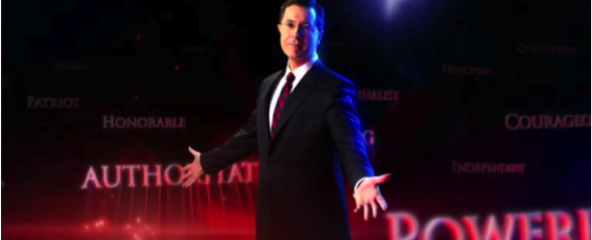
Tongue in Cheek: Visual Rhetoric and the Opening Sequence of The Colbert Report by Bridget Malaney

With the rise of the digital age and this time of one-hundred-plus TV channels, the ways in which TV shows compete for viewers is constantly evolving and heavily dependent on visual strategies of persuasion. Print and online advertisements, billboards, and TV commercials all attempt to engage audiences in ways that “mobilize symbols to influence diverse publics” (Olsen 9). One particularly interesting area in which visual rhetoric is used to attract and retain viewership is the opening credits of a television show; sometimes these credits have a residual identity—especially in terms of pop-culture—that far surpasses the show itself. Read more of this post

A Closer Look at the San Pasqual Battlefield by Briana S. Brigham

This paper will focus on various aspects of the San Pasqual Battlefield, located in Escondido, California. The notion of public memory, which emerges from the intersection of official and vernacular cultural expressions, will be explored through the history the San Pasqual Battlefield portrays (Bodnar 13). At a California State Park, such as the San Pasqual Battlefield, it is fair to say that visitors expect an unbiased assessment of the battle between the Californios and the Americans. Read more of this post

Confessions of a Blogagogue: Rethinking Cultural Studies, Technology, and Composition by Marcy Leasum Orwig

Abstract: The field of cultural studies has a long and varied history. It was estab-lished in the 1930s by scholars associated with the Frankfurt School. The tradition was continued by Stuart Hall and others at the Birmingham School of Cultural Studies in Great Britain. By the late 1980s and early 1990s, the field of study exerted an important influence on American composition theory and practice. Today, a re-newed interest in cultural studies is linked to the use of technology. Scholars such as Steve Jones and Stephanie Kucker (2001) discuss how “we [should] examine the Internet as another media technology situated in routine social practice and every-day life” (212).  But are the recent interpretations that link cultural studies to tech-nology justified? This article argues that such interpretations are justified and uses cultural studies as a way to rethink a specific aspect of new communication tech-nology: the current phenomenon of the blogosphere.  More specifically, this article will focus on whether or not students can apply critiques to culture through an eth-nographic study of composition blogs and will end with the implication of how new “democratic” technology can still potentially reinforce a hegemonic perspec-tive.     .

Introduction: Computer Technologies and Student Awareness of Culture
Cynthia Selfe and Susan Hilligoss, in Literacy and Computers, explain that scholars in the field of rhetoric and composition need to understand “how computer technologies, literacy, and culture are connected” (13). This statement puts into perspective the focus of my article.  I am most interested in how computer technologies, literacy, and culture combine to influence composition pedagogy.

Specifically, I am skeptical of the idea that computer technologies will automatically increase student literacy and their awareness of culture. As Clayton Pierce states, “Historically, technology within the sphere of educa-tion has always been a means by which to shape and enhance the transmis-sion of knowledge and information . . .Yet this relationship between educa-tion and technology has in official policies also been one of passivity and adaptation” (131).  Pierce’s point might seem pessimistic, but I agree with him that the acceptance of technology in education needs to be actively dis-cussed.

For example, overly optimistic statements like the following one by Mark Poster in “Consumers, Users, and Digital Commodities” is, for me, troubling: “In blogs, massively multiple online games, and peer-to-peer file-sharing programs, consumers are transformed into users, creating content as they download it.  In these contexts, the passive individual consumer of mediated industrial capitalism evaporates, and new figures of mediated practices are born” (249).  While I agree that students (as consumers) are often transformed into users, I disagree that the idea of capitalism will “evaporate” with the use of new technology. To further understand the topic of computer technologies, literacy, and culture, I begin my article with a short historical disciplinary context of cultural studies theory.
Disciplinary Context of Cultural Studies: Beginnings of Cultural Studies in the Composition Classroom
Cultural studies first emerged in composition theory and practice in the late 1980s and 1990s.  Diana George and John Trimbur explain in “Cultural Studies and Composition” that the Reagan-Bush years prompted a sense of urgency about the rightward direction of the country with its “back to ba-sics” attacks on the “permissive” 1960s.  Such a political turn in rhetoric and composition can be seen, according to George and Trimbur, by the late 1980s in a new emphasis on multiculturalism, the politics of literacy, and the implications of race, class, and gender for the study and teaching of writing (72).  In particular, James Berlin in Rhetorics, Poetics, and Cultures (1996) argues that it is impossible to separate literary and rhetorical texts from political life.  He states, “As the lived experiences and everyday lan-guage of citizens become more and more diversified . . . It is no wonder that the meaning of culture and its role in English studies are urgent issues to-day” (xx).  Later, Berlin presents his concept of “social-epistemic” rhetoric within refigured English studies.  He explains, “Social-epistemic rhetoric is the study and critique of signifying practices in their relation to subject for-mation within the framework of economic, social, and political conditions” (77).  Berlin acknowledges that such a concept is dense, but later explains the central role of ideology in the framework.  In other words, a social-epistemic rhetoric studies and critiques cultural signs and ideology in rela-tion to conditions based on the economy, society, and politics.

Cultural Studies in the Composition Classroom Today
Today, scholars such as Bruce McComiskey in Teaching Composition as a So-cial Process urge “writing teachers to incorporate social-process methodolo-gies into their existing composition curricula, not neglecting the linguistic and rhetorical levels of composing, but rather strengthening and reinforcing them with attention to the social contexts and ideological investments that pervade both the processes and products of writing” (134).  In other words, he encourages composition instructors to use cultural studies in their class-rooms, and he offers an example of rhetorical inquiry and cultural studies methodologies with his cycle of cultural production, contextual distribution, and critical consumption.  For the first part of this cycle, cultural produc-tion, he believes that students need to understand ways in which individu-als inscribe texts with “preferred readings” (25).  The second part of the cy-cle, contextual distribution, helps students examine the connection between context and culture.  In the third part of the cycle, the analysis of cultural values produced in texts and their “distributing media to the subjectivities who encounter the produced and distributed values” comes to the fore (29).  With new advances in communication technology, McComiskey argues that it is more important than ever for composition instructors to use such frameworks to show students how to critique culture.

I strongly agree with what McComiskey is calling for, and using cul-tural studies in composition pedagogy is, as Berlin also argued, an impor-tant undertaking for instructors.  Indeed, Nick Stevenson in Cultural Citizen-ship contends, “From the importance of ‘culture’ in determining the com-petitiveness of the modern economy, to the increasingly symbolic nature of political protests, we are currently living within a cultural society unlike any other” (16).  However, not everyone agrees with such a stance.  For ex-ample, during a 1997 College Composition and Communication Conference (CCCC) roundtable response to Berlin’s work, Susan Miller worried that “the content of such courses is not writing—is not persuasion to assume the positions of those whose acts of writing are interventions.  Nor is it system-atic demonstrations of how to write—not ‘well,’ but powerfully, to subvert . . . conventional subject positions” (499).  In other words, Miller is concerned that writing courses rely too heavily on cultural studies critiques.  Further, Diana George and John Trimbur respond to her in “The ‘Communication Battle,’ or Whatever Happened to the 4th C?” by writing, “We are sympa-thetic to Miller’s concern that media analysis, or more generally what’s be-come known as the ‘cultural studies approach’ to teaching writing too often winds up being a hermeneutic rather than a productive activity” (696).  The problem of using cultural studies in the composition classroom stems, I think, from the fact that cultural studies did not originally come from the field of rhetoric and composition.

The Background of Cultural Studies
Henry Giroux has called on instructors everywhere to include cultural stud-ies in the classroom.  He writes that “Culture now plays a central role in producing narratives, metaphors, and images that exercise a powerful pedagogical force over how people think of themselves and their relation-ship to others” (62). For this reason, Giroux argues that cultural studies connects knowledge to everyday life (meaning to the act of persuasion), schools and universities to broader public spheres, and rigorous theoretical work to effective practice that students can use in their relationships with others and the larger world (66).  Giroux explains, “This seems especially important at a time when new electronic technologies . . . as a primary edu-cational force offer new opportunities to inhabit knowledge and ways of knowing that simply do not correspond to the longstanding traditions and officially sanctioned rules of disciplinary knowledge or of the one-sided academic emphasis on print culture” (67).  While Giroux is certainly a pro-ponent of cultural studies, he also discusses some problems with using it as a pedagogical framework.  For example, he argues that it is often too far removed from other cultural and political sites where the work of public pedagogy takes place (71).  However, he asserts that cultural studies is about “Stepping out of the classroom and working with others to create public spaces where it [cultural studies] becomes not only to ‘shift the way people think about the moment, but potentially to energize them to do something differently in that moment,’ to link one’s critical imagination with the possibility of activism in the public sphere” (77).  While Giroux presents captivating and inspiring scholarship on cultural studies, he doesn’t give specific examples of how it might be used in the classroom.  His lack of concrete examples of how it might be used in the classroom for interactive student learning is due, in part, I think, to the very beginnings of cultural studies and its inception by highly theoretical intellectuals.

The Frankfurt School of Cultural Studies
The first work in cultural studies was done by a group of German intellec-tuals.  These scholars included, among others, Theodor Adorno, Max Hork-heimer, and Herbert Marcuse who were collectively associated with the Frankfurt School.  This school was established in 1923 and following the coming to power of Nazism in Germany in 1933, it moved to New York.  John Storey in Cultural Consumption and Everyday Life explains that, “The experience of life in the United States had a profound impact on the School’s thinking on the production and consumption of culture” (19).  For example, Adorno wrote about the culture industry in 1944, and his work critiques the emergence of mass media like films and radio.  He states:

Amusement and all the elements of the culture industry existed long before the latter came into existence. Now they are taken over from above and brought up to date. The culture industry can pride itself on having energetically executed the previously clumsy transposition of art into the sphere of consumption, on making this a principle, on divesting amusement of its obtrusive naivetes and improving the type of commodities.

In other words, Adorno claims that mass media are culture industries that manipulate the population into consuming widely produced messages.  These messages are then spread using technology, and here is where Her-bert Marcuse had his greatest influence because he relentlessly studied the role of technology and its impact on civilization.  Marcuse saw technology as anything but neutral as it contributed to and accelerated the decline of the individual’s potential for achieving a critical perspective concerning the existing conditions that constitute advanced society.  For example, he wrote that dissent against the status quo in such a context fades into the back-ground through the increased importance that technology plays in the pro-duction process of the technological society (11).

The Frankfurt School Continues with the Birmingham School
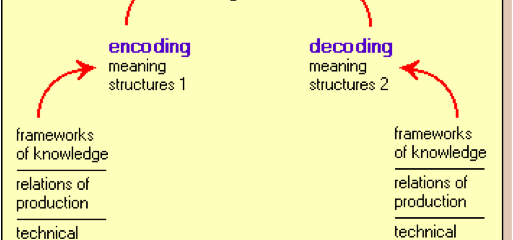
The tradition started by the Frankfurt School was continued by the Birmingham School of Cultural Studies.  In particular, Stuart Hall’s “Encod-ing/Decoding” (1973) proposed a model of mass communication that em-phasized the importance of active interpretation of messages in his “circuit of communication” (see figure to the right – Hall’s “Encoding/Decoding” [1973]).   Within this circuit, he explains that there is a progression from encoding (producing messages) to the actual discourse (the published text or broad-cast) to finally decoding (consuming messages).  Hall claims that mass communication is given to a diverse audience which then reacts diversely to the original message. He names three distinct categories of reactions: domi-nant (i.e. hegemonic view), negotiated (i.e. bargained view), and opposi-tional (i.e. counter-hegemonic view).  I will explain these categories in more detail later in my article when I analyze student writing.  While these cate-gories are helpful, Hall warns against an oversimplification of the audience reactions.

Extending the Cultural Studies Conversation
Hall’s article deals mainly with analyzing television discourse, but can his concepts of encoding/decoding also apply to new communication tech-nologies?  As mentioned earlier, McComiskey urges composition instructors to apply cultural studies to new technology.  Similarly, Pamela Takayoshi (1996) and Barbara Blakely (2000) also use Hall’s categories to analyze com-puter literacy. So, in order to extend this conversation, I present a sample analysis of one particular aspect of technology: the blogosphere.

The word blog was first used in 1997 to describe journalistic entries put on a personal website. Today, maintaining a blog is quite easy since there are interactive websites that allow anyone to do it: All you need to get started is a name, a password, and an e-mail address.  The most popular of these blog websites is blogger.com, which was started in 1999.  Its popular-ity is based in part on its ease of use and the fact that it allows users to per-sonalize their web addresses. Given the ease with which blogging can be practiced, the increasing popularity of the personal blog is not surprising. For example, today there is a proliferation of blogs and the blog search en-gine called Technorati recently found that 1.4 blogs are created every sec-ond of the day.

While there are many blogs, I will specifically analyze student blogs since my article has a pedagogical interest.  I, a self-proclaimed blogagogue, hope to begin a starting point for further conversation on the specific topic of student blogs while also encouraging composition instructors to think about how to best incorporate such blogs into their own classrooms.  As Cynthia Selfe and Gail Hawisher in Literate Lives in the Information Age write, “Culture plays a critical role in shaping values regarding the literacies of technology and that, at the same time, the literacy values and practices of people and groups also shape cultures” (126).  I contend that, within our field, this sentence sums up quite nicely why such further conversation is needed on the topic: at stake is cultural and rhetorical literacy for our stu-dents.

Encoding My Story: A Methodological Pun on Hall’s Theory
From a cultural studies perspective, one of the primary goals of literacy in-struction is to help students “read” the messages they receive from mass media. Interestingly, Hall notes that such a message must first become “a story before it can become a communicative event” (167).  So, to present my analysis of student blogs, I will “encode” the data into a “story.”  My sam-ple of student blogs comes from my experience of teaching a foundation communication course with 26 students at a large Midwestern university from August to December 2008.

I conducted my research by using ethnographic methods in an effort to analyze student blogging in the form of a case study.  I realized that a qualitative approach would be useful in gathering the data for my analysis because, as Denzin and Lincoln explain, qualitative research situates “activ-ity that locates the observer in the world. It consists of a set of interpretive, material practices that make the world visible” (4).  Specifically, I needed a method that would render a discourse community “visible” for my analysis and student blogs certainly fit the definition of a discourse community as they generate conversation.  Ethnographic researchers have been “drawn to discourse communities in order to gain a better understanding of the mean-ings that community members generate through conversation” (LeBesco 63).  Although there are many different approaches to qualitative research, I chose to use phenomenology for my study, which Creswell defines as re-ducing “individual experiences with a phenomenon to a description of the universal essence” (58).  Phenomenology, then, seeks to describe what par-ticipants have in common as they experience a phenomenon.

The rest of my article will begin with my “story” of student blogs, where I explain how blogs were used in my classroom and how my stu-dents responded to the assignment.  The article continues by using Hall’s concept of decoding to analyze my “story.”  I conclude with implications of applying Hall’s concepts to student blogs and what it might mean for in-structors of composition.

My Story: A Blogging Narrative
As I typed up the blogging assignment sheet, I had a hard time deciding what sort of topics my students should focus on.  Should I open it up to any topic?  Or, should I set a specific one?  Both options seemed viable to me, but I decided to ask students to blog about a topic related to all of their ma-jors: business.  By having my pre-business students write about this topic, my intent was that this would lead to them to write about some aspect of culture.  I also set a timetable so that my students wouldn’t procrastinate writing their five required blog entries.   I grouped these five required blog entries into three main rounds of blogging.  Since this was my first semester using blogs in the classroom, I wasn’t sure how it would go but I was curi-ous to see what would happen.     As the (fall 2008) semester progressed, I began to worry about having my students blog.  Unlike other traditional assignments where only I read their papers, their blogging would be available to anyone online.  As Selfe and Hilligoss write, “Writing that appears on a screen seems more public.  In contrast to the privacy of paper documents, the screen displays texts for all to see” (12).  Indeed, even though my students’ blogs would be marked as private, the potential for others outside of our class to haphazardly come across them and read what my students had written was still there.  Per-haps more important to me was the thought of what my students would blog about and how others would react to their blogging.  As my students progressed through the blogging assignment, I de-cided to project their entries onto the overhead screen during class and I had everyone share what they had written.  Not surprisingly, I found that most of my students were more vocal on their blogs than in a classroom dis-cussion.  For example, one student wrote what was supposed to be an analysis of a local Best Buy in town:

Being a Best Buy customer has a very good feeling because of the reputation that they have. They have one of the best productivity in the nation. Best Buy is very well known everywhere. They are basically an electronic store. They sell TV’s, stereos, and other house appliances.  The name Best Buy mean simply this: when buying products from them you get the “best buy”. I always think that when I go, I am getting the best buy when I buy the products.  Best Buy is my favorite place to shop for elctronics. I really encourage all my friends that are looking for appliances to go shop at Best Buy. Just like the name says you get the best buy when you are shopping for their products.

However, when I tried to get him to talk in class about his post on Best Buy, the discussion basically went something like this:

“Why did you choose this store?”
“I don’t know.”
“Well, you describe in your blog entry that you often go to this store.  Maybe this is why you chose it?”
“Yeah, maybe.”
And so on . . .

Most of the other students were the same way.  I would click on the stu-dent’s blog and up on the overhead screen there would be a substantive post about their chosen store.  However, when I tried to get them to talk about it in class, most of the students didn’t want to share.  Of course, even if they didn’t want to talk about their topic, I got them to talk eventually (however briefly).  Most of the students fell back on what they had written about in their post and so perhaps this made sharing a little easier.  I noticed that I would ask the student questions about the writing topic, but when I left it open for others to ask questions, there was silence.  With this experi-ence in mind, I wondered how they would be motivated to make comments on other each others’ blogs.

While the remaining student blog posts and comments, in general, were not very noteworthy, a good example from my class of a blog entry with corresponding comments came from one particular student who posted an entry about Mustangs (the car).  He started his entry with some general background information such as when it was launched (April 17, 1964) and how much the car originally cost.  He ended his entry with:

I have always wanted to drive a Shelby GT-500 Mustang.  Its looks are a thing of beauty, this vehicle is a mans car.  It featured special quarter-panel windows and rear air scoops on each side and an optional automatic transmisson.

I wasn’t expecting the rash of comments that his entry generated.  Within a day or two, his entry had generated eight comments.  It started with this one:

  1. Mustangs are one of my favorite cars. I have always wanted to drive on to. My friend had a musting but he sold. I wish i had the chance to drive one.        Then it continued with others:
  2. ooohh man shes a beauty. do you have a Shelby? personally i kind of like the Cobras a little more, but the mustang is definitely a great car and have made some awesome body styles over the years.
  3. I have wanted a mustang since I started playing with barbies.
  4. I personly think mustangs are poorly made…
  5. Really I thought that the car was named after a horse. I personally like mustangs because of the design of the car.
  6. I love Mustangs too. My friend had a white mustang and we were going out to eat somebody ran a red light and hit us. It didnt make it through.
  7. I always wanted a mustang for some reason. I think that it’s because they have so many styles and designs.
  8. Mustang is pretty much every teenage boy dream. All you think about is taking a girl out, or racing it. I will love to own a mustang. Its like a need, just like peanut butter and jelly.

After reading this student’s post and the following comments about it, I wondered if my students were going in the right direction with blogging.  In other words, I had imagined a very different response to the blogging assignment and perhaps I was too idealistic in thinking that they would just automatically assume a critical eye when using the technology.

To be fair, I had asked them to just write about business topics and I had not prompted them to think critically.  Another example of a student entry demonstrates the lack of a critical eye:

In an article i read, it talked about how blackberry is coming out with a new phone, The Storm, which is supposed to be the  competitor against iphones. The storm is said to be a better business phone over the iphone. i personally have a blackberry. I have the blackberry pearl through sprint. Blackberrys are compatible with many different carriers such as, at&t, t-mobile, verizon, and sprint. When at&t got their hands on the iphone and know that they are the only carrier to have the iphone, the other carriers decided to come up with a new phone to compete against it. Verizon made the dare and sprint made the instinct.

This particular entry had only one comment:

I think that its really good that blackberry is making an all touch screen phone. I love blackberrys and touch screen makes it even better! Indeed, it seemed like all my students were doing was writing about big box corporations, whether or not they liked Mustangs, and how cool the touch screen is on a blackberry.

Decoding My Story: Reactions to My Narrative
While there could be many different reactions to my “story,” as Hall would argue, I will present a decoded version of my reaction here (see figure – Hall’s “Encoding/Decoding Updated).  To begin, as mentioned earlier, his concept of the “circuit of communication” describes how messages are produced and then understood. For example, in the first part of the circuit (encoding) Hall was concerned with how mass media produce messages.  But, in the case of student blogs, instead of mass media it is the student who produces the message.  For example, the student who wrote about Mustangs “encoded” his message by implying that it is a “man’s car.”  Second, in the circuit, is the actual discourse (i.e. a book, an article, a television broadcast, etc).  However, technology such as blogs makes producing a message so easy that all this student had to do was hit the “publish” button on his computer.  At that moment, his post was able to be seen not only by the audience of his classmates, but also by anyone else who stumbled across it.  The last part of the circuit deals with decoding, or consuming, the messages that mass media give us.  With the example blog post, the student’s original meaning was certainly decoded by his other classmates.  In fact, we see a diverse reaction from the implied meaning of a Mustang to be a “man’s car” to the other meaning of a girl wanting one ever since she was “playing with Barbies.”

These diverse reactions fall into Hall’s three distinct categories of read-ing (as explained earlier): dominant (i.e. hegemonic view), negotiated (i.e. bargained view), and oppositional (i.e. counter-hegemonic view).  In the case of the Mustang blog entry, we could view the comments of it as a “man’s car” and “every teenage boy’s dream” as dominant, or hegemonic.  Other comments are harder to classify, such as the one discussing how they thought it was named after a horse or how they ran a red light which re-sulted in a smashed Mustang.  But, the one comment by a girl wanting a Mustang since she was “playing with Barbies” could be, I think, considered negotiated because she had a different reading of the original message.  While these reactions are interesting, what I find disheartening is that none of the students openly questioned the reputations of Best Buy, the value of a high-end car, or changing technology.
Differences between Traditional Cultural Studies and Today’s TechnologyWhat I find most interesting about all of this is that while Hall’s concepts still apply to the blogosphere, there is something else happening here as well. In other words, the concepts of encoding/decoding were originally focused on analyzing mass media such as television shows which were part of what Adorno would have called the “culture industry.” But what we have with the blogosphere is different in that there are fewer “gatekeepers.” For instance, bloggers can be anybody who is able to read and write (and who has access to a computer). They don’t have to be part of the “culture industry” the way a television producer or newspaper editor is. However, some might say that being able to read and write (as well as having access to online technologies) is now part of the culture industry.

Certainly Althusser, from a cultural philosopher’s point of view, would agree that students who learn to read and write become part of the workings of the culture industry. He asks, “What do children learn at school? They go varying distances in their studies, but at any rate they learn to read, to write and to add – i.e. a number of techniques, and a number of other things as well, including elements (which may be rudimentary or on the contrary thoroughgoing) of ‘scientific’ or ‘literary culture’” which are directly useful in the different types of production jobs.  He continues:

Thus they learn know-how . . . But besides these techniques and knowledges, and in learning them, children at school also learn the ‘rules’ of good behaviour, i.e. the attitude that should be ob-served by every agent in the division of labour, according to the job he is ‘destined’ for: rules of morality, civic and professional conscience, which actually means rules of respect for the socio-technical division of labour and ultimately the rules of the order established by class domination.

He concludes by explaining the “reproduction of labor power requires not only a reproduction of its skills, but also, at the same time, a reproduction of its submission to the rules of the established order” by reproducing the submission to the ruling ideology for the workers, and a reproduction of the “ability to manipulate the ruling ideology correctly for the agents of exploi-tation and repression, so that they, too, will provide for the domination of the ruling class ‘in words.’”  For example, with the case of student bloggers, if students are taught that Mustangs are a “man’s car” and can then also read and write about it they are unconsciously reproducing the dominant ideology.  I’m sure that Ford would have loved this student’s post because, as marketers know, word-to-mouth advertising is the best possible form of promotion.

Follow-up to My Study
I asked my students at the end of the blogging assignment about their per-ceptions of the process.  So, a few weeks before their last round of blogging was due, I canceled one week of formal classes and held conferences with my students.  During conferences, I learned that a few of them had previous experience blogging. But, otherwise many confessed that the first blog entry was the hardest because they were unsure of what a blog actually was.  One student told me that I was “turning him into one of those people” he didn’t like.  In other words, he didn’t like bloggers and he felt like I was forcing him to become one.  But he mentioned towards the end of our discussion that he now doesn’t mind blogs as much.  Another student commented that he had “always heard about blogging, [but I] wasn’t sure how to do it, I like it [the blogging assignment] and the structure of topics.”  Finally, one other student told me that she didn’t “like writing, but now [it’s] not so bad be-cause I like business topics, [I] wouldn’t have found [such topics] other-wise.”  Similarly, another student told me that she never watches the news or reads newspapers and that now because of blogging she is forced to pay attention to such information.  She said she felt that it was a good thing be-cause otherwise she wouldn’t have cared.  Finally, one student shared that it helped him express his opinions when compared to writing normal pa-pers because he felt like he had a larger audience.  These comments made me realize two things.  First, my students were taking an active part in their learning process.  But, second, using technology (in the form of blogging) did not make that learning process automatically critical, as Poster suggests.

I think that my students have shown where the real work comes into play for instructors of composition who might use blogs in their own class-rooms. More specifically, my students have demonstrated that new tech-nology will not just make them critical thinkers, in fact, it may reinforce a hegemonic perspective. Instead, as composition instructors, we still have the arduous job of helping students see how culture affects their discourse while also helping them see that more “democratic” technology can still po-tentially reinforce a hegemonic perspective.  Therefore, I think this exten-sion of the conversation on cultural studies and new technology is impor-tant. As Selfe and Hilligoss note, “If computers require students to learn new habits of reading, they also change the way students write and think of writing” (14). More specifically, with new technology like the blogosphere, it is more important than ever for students to understand why they think in a particular way. Their ability to “read” culture is critical because otherwise they are just reproducing the same ideological stories.

Implications/Conclusion: Blogging in the Composition Classroom
Certain questions arise from my “story” such as “Are students able to apply critiques to culture through blogging?”  and if so, “How?”  I think, through my article’s discussion, that the answer to the first question is both yes and no.  As mentioned before, my students were able to write about business (an aspect of culture) but they did not apply any real critiques.  If I were to try this activity again, I would work to revise the assignment sheet to elicit more critical blogs.  My second question “How?” is much more difficult to answer because, as mentioned before, my students did not just assume a critical eye when using the new technology.  Therefore, it is here that there needs to be further conversation.

To continue the conversation, I argue that instructors need to find ways to help students understand the process of decoding and encoding in their own work.  At this point in history, analyzing traditional mass media like print ads or television shows are useful, but so is analyzing writing that they can produce for a wider audience (such as blogging).  I once heard that instead of mass media today, there is media for the masses.  A survey con-ducted by Educause Applied Research (2007), shows the following facts:

  • University students spend 18 hours/week on the internet
  • Technology is first about communication for students
  • Many students (59%) prefer a “moderate” amount of instructional technology in their courses
  • Many students (60%) say instructional technology has improved learning in their courses

Such survey results show that, as Selfe and Hilligoss explain, “We see computer networks as a means for students to acquire literacy; that is, the networks can function as localized forums for acquiring the written literacy of a discourse community.  As students write, interpret, and negotiate texts via computer networks, they are participating within a context that pro-motes active learning” (89).  Thus, there is a real challenge that composition instructors have in incorporating technology into the classroom to help stu-dents analyze culture.

While I don’t have exact answers on how to help students analyze culture within the blogosphere, I hope my small study and resulting con-versation will encourage composition instructors to use and modify my ideas.  Also, I suggest here further resources for composition instructors to review and adapt into their own classrooms.  For example, George and Trimbur suggest two collections on how to integrate a more deliberate use of popular culture and media studies into the composition classroom with: Cultural Studies in the English Classroom (Berlin and Vivion, 1992) and Left Margins: Cultural Studies and Composition Pedagogy (Fitts and France, 1995). Additionally, they list textbooks associated with cultural studies including Rereading America (Colombo et al., 2007) which focuses on a series of dis-tinctly American myths and Reading Culture: Contexts for Critical Reading and Writing (George and Trimbur, 2006) which relies on semiotics to teach close readings of popular culture texts. George and Trimbur note that the popu-larity of cultural studies in the composition classroom may be attributed to the fact that the topics allow instructors to retain “two commonplace prac-tices: To begin student writing with a topic close to the self and to teach close reading and interpretation of texts” (“Cultural Studies” 82).  All in all, I believe that using cultural studies in the composition classroom is impor-tant and can lead to students thinking about the possibilities of “democ-ratic” technology, such as blogs.

Appendix—Blogging Assignment Sheet
Writing for the Web: Class Participation Assignment

Introduction:
This assignment asks you to practice writing for the web by maintaining a blog through wordpress.com.  We will be setting these blogs up in class.  Only me, your instructor, and your fellow classmates will be able to view your blog.  According to our textbook, Writing: A Guide to College and Be-yond, a blog is a source of public opinion (574).  Keep this in mind as you begin your assignment.

Assignment and Purpose:
You will post (or put on your blog) a total of 5 entries where you will write about current topics in business.  The first topic you will discuss will tie into your visual analysis paper.  Other topics that you could blog about include other topics related to material we discuss in class or material that you dis-cuss in another business oriented class.  Additionally, you can blog about current topics in business and these topics could be focused on something that you read in a magazine or newspaper, hear on the radio, or see on tele-vision.  Also, you can write about a past experience you might have had in a business situation.

It is completely up to you what you will blog about.  But, remember that the point to blogging is to form an opinion about a topic and then write about why you feel this way.  By doing this type of exploratory writing, you will not only learn about business topics, but you will also practice writing.  As our textbook says, “Along with learning to write well, learning to think critically is the most important skill you will gain in college because your success in your professional and public life will depend on it” (12).

In addition to posting 5 entries, you will respond to your classmates’ entries by commenting on what they write about.  During the course of the semes-ter, you will make at least 5 comments.  Keep in mind that what you write will be seen by everyone in the class and that we will periodically look at examples from the class.

Planning:
As you think about starting this assignment, read pages 12-13 in our text-book.  Reading these pages will help you plan what you want to say in your blog entries.  As you post your blog entries, keep in mind the following out-line in addition to concepts discussed in class about what makes a “good” blog:
1. introductory paragraph explaining post
2. paragraph covering material you will discuss/blog about
3. paragraph with concluding remarks

Evaluation Criteria:
• Required amount of blog entries per semester (5 total, 5 comments)
• Blog entries demonstrate the thoughts and opinions of the blogger (you, the student)• Blog entries are on business topics
• The entries contain few grammar/spelling errors
• Blog entries refrain from profanity or inappropriateness

Schedule:
Thursday, Sept. 25 1st blog entry with three pictures of your sign/logo
Thursday, Oct. 23 2nd & 3rd blog entries on topics of your choice and also 2 comments on other blogs
Thursday, Dec. 4 4th and 5th blog entries on topics of your choice and also 3 comments on other blogs

By Marcy Leasum Orwig, Iowa State University

REFERENCES
Adorno, Theodor and Max Horkheimer.  The Culture Industry: Enlightenment as Mass Deception. 1944. <www.marxists.org>. Online.

Althusser, Louis. Ideology and Ideological State Apparatuses. 1970. <www.marxists.org>.  Online.

Blakely, Barbara. “Critical Computer Literacy: Computers in First-Year Composition as Topic and Environment.” Computers and Composition 17 (2000): 289-307. Print.

Berlin, James. Rhetorics, Poetics, and Cultures: Refiguring College English Studies. Urbana, IL: National Council of Teachers of English, 1996. Print.

Creswell, John W. Qualitative Inquiry & Research Design. London: Sage Pubs, 2007. Print.

Denzin, Norman K. and Yvonna S. Lincoln. “The Discipline and Practice of Qualitative Research.” Strategies of Qualitative Inquiry 3rd ed. New York: Sage, 2007. 1-43. Print.

George, Diana and John Trimbur. “The ‘Communication Battle,’ or Whatev-er Happened to the 4th C?” College Composition and Communication 50.4 (1999): 682-698. Print.—. “Cultural Studies and Composition.” A Guide to Composition Pedagogies. New York: Oxford U P, 2001. Print.

Giroux, Henry. “Cultural Studies, Public Pedagogy, and the Responsibility of Intellectuals.” Communication and Critical/Cultural Studies 1.1 (2004): 59-79. Print.

Hall, Stuart. “Encoding/Decoding.” Culture, Media, Language. Ed. Stuart Hall, Dorothy

Hobson, Andrew Lowe and Paul Willis. London: Hutchinson, 1980. Print.

Jones, Steve and Stephanie Kucker. “Computers, The Internet, and Virtual Cultures” Culture in the Communication Age. Ed. James Lull. London: Routledge, 212-225. Print.

LeBesco, Kathleen. “Managing Visibility, Intimacy, and Focus in Online Critical Ethnography.” Online Social Research: Methods, Issues & Ethics Ed. Mark D. Johns, Shing-Ling Sarina Chen, & G. Jon Hall. New York: Peter Lang, 63-80. Print.

Marcuse, Herbert. The One-dimensional Man: Studies in the ideology of Advanced Industrial Society. Boston: Beacon, 1964. Print.

Miller, Susan. “Technologies of Self-Formation.” Journal of Advanced Communication 17 (1997): 497-500.  Print.

McComiskey, Bruce. Teaching Composition as a Social Process. Logan, UT: Utah State U P, 2000. Print.

Pierce, Clayton. “Democratizing Science and Technology with Marcuse and Latour.”

Marcuse’s Challenge to Education. Ed. Douglas Kellner. Lanham, MD: Rowman and Littlefield Pubs, 2009. Print.

Poster, Mark. “Consumers, Users, and Digital Commodities.” Information Please: Culture and Politics in the Age of Digital Machines. London: Duke UP, 2006. Print.

Selfe, Cynthia and Gail Hawisher. Literate Lives in the Information Age. Mahwah, NJ: Lawrence Erlbaum Associates, 2004. Print.

Selfe, Cynthia and Susan Hilligoss. Literacy and Computers: The Complications of

Teaching and Learning with Technology. New York, MLA, 1994.  Print.
Stevenson, Nick. Cultural Citizenship. Berkshire, England: Open University, 2003. Print.

Storey, John. Cultural Consumption and Everyday Life. London: Arnold P, 1999. Print.

Takayoshi, Pamela. “Writing the Culture of Computers: Students as Technology Critics in Cultural Studies Classes.” Teaching English in the Two-Year College 23.3 (1996): 198-204. Print.

A Christian Athens: The Rhetoric Of Pope John Paul II And The Political Transformation In Poland 1979-1989 by Cezar M. Ornatowski

“… I think of an Athenian Poland, but of an Athens immensely perfected by the greatness of Christianity” (19-year old Karol Wojtyla, in a letter to a friend in 1939, on the eve of World War II. Quoted in Shulz 108).

NOTE:  This is a draft manuscript; please do not quote.  Work for this project was supported through a Fulbright Senior Scholar Research Grant, a grant from the Polish Institute for Scientific Research, and through residency at the Culture Study Unit of the Institute for Philosophy and Sociology of the Polish Academy of  Sciences, as well as through a sabbatical grant from San Diego State University.  The author thanks the foregoing institutions for their support.

INTRODUCTION

John Paul II played a critical role in the political transformation in Poland. His visits to Poland between 1979 and 1999 marked the last decade of communism and the first decade of democracy in Poland. The visits not only punctuated one of the most dramatic periods in modern Polish history but also constituted critical events in that history.

In his study of the rhetoric of political transition in South Africa, Philippe-Joseph Salazar points out that the political transition in South Africa was characterized by a “rhetorical conjunction of sacred and secular” which “will long remain a fundamental feature of the South African democratic deliberative modes” (41). This is in contrast, he points out, to “traditional European democracies, rooted in eighteenth-century free thinking,” where “the exercise of the public mind, and the achievement of reasonable participation in the exercise of power, is carefully separated from religion, which is often perceived as a fossilized remnant of a pre-democratic system of deliberation” (41).  He suggests that South Africa stands alone “as an example of a Western-style democracy taking shape in the aftermath of the Cold War under the auspices of religious oratory,” with the possible exception of Poland.

Salazar is absolutely correct about Poland. John Paul II’s rhetoric played a major role in the manner of communism’s demise, as well as in the emergence of democracy in Poland.  His election to the throne of St.Peter in 1978, and his first visit to Poland in 1979, served as catalysts for the popular mobilization that resulted in the “Solidarity” movement. His portrait hung on the gate of Gdansk shipyard during the groundbreaking strikes of the “Polish August” of 1980. The words he spoke, such as the famous “Let Thy Spirit descend and renew the face of the land, this land!” spoken in his very first homily as Pope on Polish soil, became a source of inspiration and symbols of struggle, hope, and, ultimately, victory to millions. His subsequent visits in 1983 and 1987 helped Poles endure the hardships of martial law and helped pave the way for, as well as shaped the character of, subsequent political changes. And, all through the 1990s, his visits helped shape the new political scene, provided a mirror for the emerging democracy, and exercised profound influence on the perceptions and feelings of the Polish people.  According to General Jaruzelski, the last leader of communist Poland and first president [for a brief, largely symbolic, term] of post-communist Poland, “the role of the Pope was enormous in the transformations that occurred in Poland and, following in Poland’s footsteps, in the whole [communist] block” (quoted in Szulc 388).

An adequate analysis of the scope of that influence, and of the rhetorical resources John Paul II employed to exercise it, would be beyond the scope of an article. Altogether, John Paul II visited Poland seven times as Pope: first visit between June 2-10, 1979; second visit between June 16-22, 1983; third visit between June 8-14, 1987; fourth visit between June 1-9 and 13-16, 1991; fifth (unofficial) visit on May 22, 1995; sixth visit between June 4-10, 1997; and seventh visit between June 5-17, 1999. The following discussion will focus only on John Paul II’s communist-era visits to Poland. While analyzing the rhetoric of the papal visits, I will focus especially closely on the “conjunction of the sacred and secular” — on the complex relationship between religion and socio-political reality as that relationship was mediated in John Paul’s oratory, performance, and other less apparent aspects of his visits. It is John Paul II’s astonishingly adroit manipulation of this conjunction that accounted for his rhetorical appeal and his enormous influence on the unfolding of events in Poland through the critical decade of the 1980s.


CONTEXT FOR THE ANALYSIS OF PAPAL RHETORIC IN POLAND

An analysis of John Paul II’s rhetoric must take under consideration at least four complementary, and often overlapping, contexts.

First, John Paul II’s messages in Poland may be seen as an aspect of his more general message as head of the Catholic Church. As a Polish observer noted, “his teaching in Poland is part of the cathehesis he has spread in all parts of the world, on all continents. This general catholic cathehesis is the context to which we must refer in our efforts to understand and explore [his] thought communicated to the Poles” (Czekanski 8). From this perspective, John Paul II’s performances in Poland may also be regarded in an aspect of what Margaret Melady referred to as the “rhetorical papacy,” that is, the increasing reliance of the modern papacy on persuasive discourse to lead the church and make the church relevant to the affairs of the contemporary world and to people’s lives (Melady 17).

The second context is the internal socio-political situation in Poland to which the Pope responded, which he addressed, and in which he intervened.  Papal visits anywhere always represent an adjustment of the more general message of the Church to the demands of a specific locale, audience, situation, and problematic. As Melady has observed, the overseas visits of John Paul II “represent movement toward the local churches” and are “specifically designed to communicate the universality or all-embracing nature of the church from the point of view of geography and cultures” (Melady 32). This adjustment includes a specific theme for each visit, a theme that represents a deliberate engagement with the specificity and problematic of the locale, often an adjustment of the dominant scriptural message; the use of symbols comprehensible to the audience and appropriate to conveying the papal message; and moments of spontaneity that represent both a response to and an orientation toward, the specificity of particular settings, audiences, and times.

In the case of the Pope’s visits to Poland, however, this adjustment takes on a uniquely particular and deliberate character. The efficacy of the Pope’s rhetorical intervention in the Polish context was due not only to the fact that he was head of the Roman Catholic Church, but also to the fact that he was a Pole, a very patriotic one, who, in view of his age and functions, shared and participated in most of the significant events that had shaped Poland since World War II. From this perspective, the Pope’s visits to Poland and his messages to the Polish people must be considered not only in light of the changing social, political, historical, and cultural situation, but also of John Paul II’s own biography and his unique relationship to Poland. To put it bluntly, while his performances in, for example, the United States or Mexico may be regarded more readily in terms of adjustment of the general message of the Church to local contexts, his appearances in Poland cannot but be regarded as, at least in part, a calculated intervention in the concrete socio-political and cultural situation by a figure who stature left no doubt, to him or to anyone else, that whatever he does will have an enormous, potentially history-changing impact on that situation. The transcripts of government-Polish Episcopate negotiations concerning the papal visits (of which more will be said below) leave no doubt that such was the case.

The third context critical to the analysis of the papal visits, at least during the communist period, were the complex and delicate negotiations that preceded his visits. These negotiations, concerned, and to an extent determined, what places he visited, where and to whom he spoke, and how his messages were interpreted. The preparatory negotiations — the deals and arrangements worked out there as well, as the assumptions, premises, anxieties, expectations, and hopes they revealed — help us better understand and interpret what John Paul II said and did.

Finally, the fourth context was the international situation. As the transcripts of the preparatory negotiations make clear, what was said and done during the papal visits, and how it was interpreted, especially by those at the highest levels of the regime and the Church, was shaped not only by the specific internal socio-political situation (which changed with each visit), but also by the changing international situation. For each visit, the Polish government had an agenda that depended both on the internal and external political situation, and so did the Church.

PREPARATORY NEGOTIATIONS

Each of the Papal visits to Poland during the communist period (1979, 1983, 1987) was meticulously prepared through protracted, delicate, and secret negotiations between the regime, the Polish Episcopate, and the Vatican. These negotiations begun before the official invitation to visit Poland was even issued.

This is how the process worked. The Polish Episcopate, through internal discussions and in communication with the Vatican, would arrive at a general plan for a Papal visit to Poland for an ostensibly religious occasion. The Episcopate would then begin to “feel out” the government’s position and attempt, in so far as possible, to force the government’s hand by presenting it with a fait accompli, that is, by hinting of the Pope’s intended visit in such a way that the government’s prestige, both internally and in the international arena, became connected to the expectation of the visit.  The Episcopate’s strategy is summarized briefly but explicitly in an internal memorandum preceding the 1987 visit, under the significant heading “Molding opinion”:

“1. Molding opinion.
“a. The Primate Cardinal Jozef Glemp, in occasional public speeches, informed the Polish people and the world that the Holy Father will come to Poland in 1987 on the occasion of the 2nd Eucharistic Congress
“b. The Secretary of the Episcopate, basing on these statements, informed the state authorities about the intentions of the Episcopate and about the invitations sent to the Holy Father by specific bishops.” (quoted in Raina 260).

It is important to bear in mind that the invitations by the bishops were non-binding (the Pope always had invitations from more dioceses than he could visit), and that they were largely instigated by the Episcopate. Neither, technically, could the Episcopate on its own invite the Pope to come without the government’s concurrence. Announcing that the Pope was “invited” was a ploy to stir up public expectation and put the government in a position where seeming to have “refused” to receive the at the last minute would be more embarrassing than taking all the political risks attendant on receiving him.  After the government finally agreed to the visit, the authorities would be asked to issue an official invitation (together with the Polish Episcopate; the invitations were typically issued in the name of both) and to officially “announce” the Papal visit to the expectant nation and the world, in tandem with a simultaneous announcement by the Vatican). The simultaneous announcement was calculated to put further subtle pressure on the communist authorities; the bishops hinted several times during the negotiations that the Vatican might just slip up and announce the visit on its own, which would put the Polish authorities in the extremely uncomfortable position of having to act play diplomatic “catch up” and thus appear  incompetent, or worse, out of control.  Thus, the negotiations began as soon as the Episcopate requested that the Pope be invited, and continued to cover every aspect of the visit, ending with a final debriefing only after the Pope had gone.  Of course, the Vatican was consulted at every step. The vehicle for the negotiations was the Joint Government-Episcopate Commission, created during the preparations for the first visit in 1979.

The negotiations consisted of a painstaking working out of every aspect of the visit, from the general “conception” (that is, occasion, timing, and the related message) of the visit and its possible ideological ramifications and implications, to the itinerary and its potential symbolism, and “technical” matters such as media coverage and financial arrangements. In reading preparatory documents and transcripts of preparatory talks for the Papal visits, one appreciates at once the extreme delicacy of the negotiations, their unprecedented character (as well as the unprecedented character of the events which they helped prepare), and the unrelenting pressure the Polish Church, and the Pope indirectly, applied in their dealings with the communist regime.

It is important to note that during the preparatory negotiations the Church never asked the authorities for “permission” for the Pope to visit, or for permission for anything else; that word was never used, since one of the major assumptions appears to have been that the Pope is an autonomous agent and does not need anyone’s “permission” for anything. In fact, many times during the negotiations the government side would propose conditions or make suggestions that sounded as if they were not going to “permit” something or other connected with the visit (for instance, they refused to “permit” John Paul II to visit Gdansk in 1983 or to meet with Lech Walesa), and the Church side would invariably counter that any implication that the Pope’s moves or words are subject to anyone’s “permission” or control is out of the question. The matter would subsequently be negotiated in a manner that suggested other kinds of considerations at play than “permission.” Yet, reading the transcripts of the Joint Commission negotiations in tandem with the Pope’s pronouncements and with the scripts for his visits leaves little doubt as to the extent of the influence of these negotiations on what the Pope said and did. In fact, it becomes a measure of John Paul’s rhetorical prowess to observe how skillfully he would go around, bend, reinterpret, incorporate, or even occasionally openly defy (sometimes with devastating yet always containable and “deniable” effect), the various conditions negotiated in regard to his visits. In this respect, the preparatory negotiations — the expectations, interpretations, assumptions, and arrangements they articulate — help us appreciate even more the complexities of the rhetorical situation to which John Paul II responded during each visit.

An example will illustrate this. During the mid-1980, the authorities imposed a ban on Church construction in Gdansk as a way of trying to force the Church to dismiss the Prelate of St. Brigida’s Church in Gdansk, the notorious Father Henryk Jankowski. St. Brigida’s church was located next door to the Gdansk shipyard and Father Jankowski was Walesa’s priest and confidante, known for his fiery anti-communism, pro-”Solidarity” sympathies, and his general support of political opposition.  During the negotiations preceding the Pope’s 3rd visit in 1987, the government demanded the removal of Father Jankowski as a precondition for letting the Pope visit Gdansk. The Episcopate rejected any possibility of “removing” anyone and of such blanket conditions in general, but had to give in on other fronts (for example, the Bishops had to agree to additional Papal visits–not planned by the Episcopate–to the World War 2 monument at Westerplatte near Gdansk and to the Majdanek concentration camp in Lublin) as the price of including Gdansk on the Pope’s itinerary, and of keeping Father Jankowski.

From a rhetorical point of view, including Gdansk on the itinerary provided the Pope the setting and occasion to say things that he would either not be able to say elsewhere or that he would have to say otherwise, without the symbolic props and interpretive aura (including the pre-interpretive aura of expectation and speculation), provided by Gdansk as the forum. On the other hand, having to visit and speak at Westerplatte or in Majdanek or Auschwitz, sites imposed upon him as a result of negotiations (“The Pope cannot come to Krakow and not notice Auschwitz,” a government negotiator irresistibly suggested), disrupted his original design for the visit, forced adjustments in the theme or at least its execution, introduced new symbolic material that had to be worked with, and provided opportunities to say other things, otherwise.

Each papal visit to Poland during the communist period took place in a different socio-political situation; in fact, the visits mark out a certain pattern of development and evolution of that situation, an evolution that the visits not merely punctuated but increasingly, as time passed, helped along and shaped. The transcripts of the Joint Commission negotiations show that each visit took place not only in a different context of actual events, but in a different context of changing interpretations of events; the transcripts show the changes in the assumptions, issues, expectations, and concerns that constituted these interpretations over time. The Papal visits, and especially the preparatory negotiations for them, became, by 1983 and even more so by 1987, rhetorical occasions for working out interpretations of current events. In this fashion, the Papal visits became (not just in themselves as rhetorical events, but through and along with the mediating deliberations of the Joint Commission) a major factor in shaping their own socio-political context and influencing unfolding events. Beyond the inevitable bombast, posturing, and gamesmanship, both parties to the negotiations were increasingly aware of the literally “history-making” nature of their deliberations and decisions.

As events began to unfold, especially in the mid and late 1980s, at a speed that surpassed not only anybody’s ability to control them but also to force them into preexisting interpretive frameworks, the Joint Government-Church Commission, hammering out the agendas and arrangements for the papal visits, became in a very real sense the de facto — although strictly behind-the-scenes — governing body of Poland, the forum at which decisions were made on issues (such as where the Pope would visit, who he would meet with, what he would say, and how it would be reported) that had the potential to influence events and their interpretations, and thus the future of the country.

After the political transition of 1989, the Joint Commission ceased to exist, and preparations for the papal visits were made primarily by the Polish Episcopate and the Vatican, with mainly instrumental assistance from the government and local authorities. There were no ideological negotiations; the Episcopate and the Vatican decided what would be done and worked to organize the necessary resources. A comparison illustrates the difference well. In the published transcripts of the preparatory negotiations and official documents connected with the papal visits in Poland, the preparations for the 1979 visit take up 116 pages, for the 1983 visit 98 pages, and for the 1987 visit 72 pages, while the preparatory documents for the 1991 visit take up 4.

PAPAL VISITS AS RHETORICAL EVENTS

John Paul II’s visits to Poland derived their “rhetorical power” partly from the Pope’s masterful oratory, but partly also from the complex nature of the visits as religious ceremonies, historical and political events, and public performances. Their unique (and history-making) suasive power and emotional impact thus came from the combined power of oratory and the complex intersections of the contexts, associations, and experiences this multiple nature brought together and awakened.

In spite of their almost frenetic pace and varying itinerary, John Paul II’s visits to Poland had a formulaic and predictable character.

Each papal visit to Poland, officially referred to as a “pilgrimage” by the “pilgrim Pope,” was attached to a specific (always ostensibly religious) occasion. The occasions, however, were so selected, or, if need be, stretched, that, besides the official religious messages, they contained also significant historic and political messages (examples will be given below, in discussions of each visit). Each visit also had a theme (again, always ostensibly a religious one and, like the theme of the individual homilies, taken from Scripture). But the themes were also double-edged (religious-political) and suited to the tenor and needs of the historical moment. They complemented the “message” of the occasion in such a way that the entire package added a strong implicature — a potential for ambiguity in a specific direction — to all that was said and done. Each visit also had a major message, a general sentiment or leading thought, for instance, “renewal” for the 1979 visit, “hope” for 1983 and 1987. Finally, each visit had a slogan, which was a short sentence or aphorism from the Scripture (sometimes the slogan was contained in the text of the theme).

Each visit consisted of a peregrination to selected cities, towns, or sites (again always ostensibly religious ones and/or with strong religious associations with the occasion for the visit, although most happened also to be loaded with other symbolism, incidentally also fitting the historical moment).  At most places he visited, the Pope celebrated (typically public) mass and delivered a homily as part of it. On some occasions (such as meetings with government officials, university professors, members of religious orders, or members of the Episcopate) he delivered a short speech. The subjects were again always ostensibly religious, and in keeping with the conventions of the genre (for instance, homilies were based on a theme supported by two readings, from the Old and New Testaments, fittingly amplified; speeches were topical to the audience and occasion). Yet, the themes, although presumably selected according to the liturgical calendar, also happened to have profound implications for the historical moment and socio-political situation, while the amplification masterfully exploited all the available resources of place, occasion, situation, and spectacle to deliver a ringing and poignant political statement.

The papal visits to Poland thus constituted a specific kind of ritual spectacle; their “unofficial” character (that is, not communist) automatically made then into “counter-rituals” in relation to the usual communist-era rituals of party rallies, official celebrations, or first secretary of the communist party peregrinations around the country. The mass, celebrated publicly, openly, and typically out of doors, in the middle of a communist country, constituted the heart of this (counter)political counter-ritual.

The full rhetorical impact of the papal visits was a function of their ritual character, the cultural and historical symbolism of the visited sites (which any Pole would be sensitive to and which was especially significant in a situation where certain things could not be said in so many words), the symbolism of the occasions for the visits (including the specific occasions for visiting particular places), the elements of spectacle “framing” each papal appearance (altars, setups, costumes, pageantry), and, in the center of it all (and masterfully drawing on all of these elements), the masterful oratory of John Paul II.

The fiction (enthusiastically promulgated both by the authorities and by the Polish Episcopate, but for radically different reasons) that the Pope’s pilgrimages to Poland were purely religious events, amplified, rather then concealed, their political impact. One must remember that this was happening in a political context where a major source of satisfaction was to publicly engage in, or see someone else engage in, and get away with, ambiguous or downright forbidden activities or discourse under a transparent, but effective, cover (the more transparent but effective the cover, the greater the thrill).  That is exactly what John Paul II did, with deadly accuracy, unflinching dignity, and devastating effectiveness, always walking the very edge of the possible, to the glee and delirious applause of most of his compatriots.
JOHN PAUL II’s COMMUNIST ERA VISITS TO POLAND

The First Visit: June 2-10, 1979

John Paul II was elected Pope at a critical time in Polish post-war history. In the mid 1970s, opposition to the prevailing political-economic system and ideological dogma began to gain energy and take new forms. It was broader and cut across a wider social spectrum than previous social protests of 1956 (local workers in Poznan), 1968 (students), or 1970 (workers on the coast). In 1976, a protest by workers at the Ursus tractor plant in Radom ignited the entire city and forced the government of the heretofore all-powerful Edward Gierek to rescind the announced price hikes. The protest was crushed with a brutality and on a scale that shook Poland and provided the direct impetus for the creation of the Workers’ Defense Committee (KOR), the first country-wide, grass-roots civic self-help organization that united intellectuals, students, and workers. Through 1977 and 1978, the worsening economic situation led to first widespread shortages of basic foodstuffs and progressive rationing. By 1979, it was clear that the country — and the system — were in a deepening and permanent crisis. The activity of KOR and other groups began to provide seeds for the emergence of large-scale organized opposition. That emergence needed a direction, a focus, a source of energy, a unifying symbol, and the language to articulate the people’s disaffections and aspirations. John Paul II’s first visit to Poland as Pope in 1979 provided all of these elements.

The occasion for the visit was the 900-year anniversary of the martyrdom of St.Stanislaw: patron saint of Poland, who died at the hands of his king after he opposed the king’s immoral and corrupt rule. The implicit message of the occasion was the relationship between morality and authority, and resistance to secular authority in the name of higher values. This message was so clear, that the communist authorities balked at the “timing” and what they called “the slogan” of the visit, and it was only after prolonged negotiations through the Joint Government-Episcopate Commission that the visit came to pass at all — although at a time different than originally proposed and with other conditions attached, one of which was to deemphasize St.Stanislaw’s figure and symbolism.

At this point, it is instructive to observe the summation of the government’s position, offered during the final round of the preparatory negotiations for the visit, by the leader of the government’s negotiating team, member of the Central Committee of the Polish United Workers’ Party, Stanislaw Kania (later, in the early 1980s, elected first secretary of the party). Kania’s remarks give a sense and flavor of the negotiations as well as of the close relationship between religion and politics, liturgy and policy, in the pressure cooker of a communist state under siege. They also illustrate the careful attention paid to the international situation and broadest implications of everything the Pope could say and do. In his statement, Kania said:

Concerning our attitude toward St. Stanislaw, it is not a matter of our attitude toward one of the important Polish saints, but of social meaning. Nobody today gets very excited about the essence of the quarrel between the king and the bishop. We will not raise the issue of interpretation of Anonym’s text [the anonymous medieval author of the chronicle that contains the story of St.Stanislaw] concerning what today cannot be proven, whether he was a rebel or a traitor. Even if the majority of scholars had agreed that he [St.Stanislaw] was a traitor, today that has a different meaning, in any case such matters cannot be decided through a vote. The material point is that it was the most significant quarrel between the State and the Church in our history. It has a different meaning on the scale of a diocese, and quite a different one if it were connected to the first in history visit of a Pope to Poland. In essence, the date, May 8, 13, or June 2 [for the papal visit] is not important; what’s at stake is the impulse for further coexistence between the state and the Church. We have difficulties, exacerbated by the [severe] winter. The international situation is heavy with threats, China has invaded Vietnam, and against this background evil forces have awakened in West Germany. (quoted in Raina 28-9)

During the visit, the Pope did not let the authorities off the hook; he poignantly mentioned St.Stanislaw and the occasion for the visit at every step, emphasizing the fact that this was the patron saint of the nation.

The scriptural theme for the 1979 visit were the words of Christ: “Do not be afraid.” The leitmotif was renewal, expressed most emphatically in John Paul’s dramatic call: “Let Thy Spirit descend and renew the land, this land!” The words, spoken on Warsaw’s Victory Square at the conclusion of John Paul’s first homily on Polish soil, galvanized the demoralized nation and became the most famous quote of this visit, and, arguably, of all his words ever spoken on Polish soil (a quote he himself returned to again and again subsequently).

In his homilies and speeches, John Paul II employed a range of rhetorical strategies.

One of the main ones was to recontextualize Poland and the Polish situation politically, geographically, historically, and temporally.  Everywhere he went, the Pope emphasized the thousand-year history of the Polish Church, of the country, of the  surrounding churches, castles, and towns, and of the institutions and traditions they represented. He never tired of repeating the number of 35 years, the duration of post-war Poland, while, for instance, standing next to the 1000-year old Gniezno Cathedral, even while appearing to be saying positive things about the regime, such as thanking the government for building the new but already patently dilapidated housing projects for workers standing nearby). He spoke in terms of the sweep of centuries and of the broad panorama of European history, as well as the geographical panorama of the continent. He spoke of that which changed and that which did not. He transformed the very time in which he spoke into “sacred” or “mythic” time, the time that partook of Christ and the apostles, of saints and kings and bishops, and mythical conflicts between good and evil, God and Satan.  The ancient cathedrals, castles, and oaks amid which he spoke bore witness to that other time and to the sweep of centuries, in the context of which the present moment became puny and fleeting, a bare mosquito bite on the canvas of history. In these terms, the 35 years of communism, the Iron Curtain, the Soviet block, food lines, and the drabness of daily existence shrunk to insignificant proportions, mere shadows on the vast stage of history, mere incidents in the proud history of the nation and of Christianity (the Pope always placed the two side by side) that he invoked.

In this way, John Paul pulled Poles out of their isolation, made them feel part of the larger international community and of European culture and heritage, made them feel like important players on the arena of history (even in their present plight), restored a sense of dignity and pride, bridged artificial divisions and borders (East-West), and revealed the working of a Providence (or at least of historical processes, for the less religious) vaster by far than the puny and futile machinations of the 35-year-old regime of former grocery clerks and party hacks. This was a complete contrast to the usual propaganda of the regime, which stressed the historical inevitability of communism, the permanence of the East-West division, the cultural and geostrategic distance from the alien West, and the history- changing importance of the system. The overall effect of the papal strategy, combined with the symbolism of the places visited and the rituals enacted (the gorgeously appointed papal train, the ancient symbolism of the Mass, attendants dressed in knightly armor and historical costumes — ostensibly passed off as patriotic manifestations) made the communist regime seem marginal (historically and substantively), and alien to Poland, its traditions, its culture, and its people.

In his vast historical recollections of Polish history (under the guise of talking ostensibly only about the history of the Church), the Pope also made explicit and public many aspects of the “collective countermemory” silenced by the regime, as well as de-falsified history.  He said things such as, “We cannot forget the sacrifices of so many Polish men and women,” ostensibly speaking about World War II but skillfully including the post-war period in the context. In this way, he spoke in the same breath also about the victims of communism, thus paying them public homage and including them in the litany of martyrs for the country. Nobody could object to that, at the cost of seeming to denigrate the official heroes of the great patriotic war, so cherished by the communist regime, which vested a large part of its legitimacy in the cult of World War II and the memory of “victims of fascism.” This rhetorical strategy also incidentally and implicitly put communism and fascism on one plane.

Another strategy for undermining the legitimacy of the communist regime was through enthymemes, such as the one he used in the very face of the regime, in his welcoming speech to the authorities:  ”That the raison d’etre of a state is the sovereignty of the people, the nation, the Fatherland, we, Poles, have always felt deeply. We have learnt that through our entire history, and especially through the hard experiences of the last few centuries” (16). Since all Poles, even committed communists, knew that communist Poland had at best very limited sovereignty, the words implied that this Poland in fact has no reason to exist (but nobody would dare say it, because the entire edifice of falsifications and mystifications on which the system was built would collapse).

The Pope also de-falsified language. One of his strategies for that was “turning” the meanings of words, recuperating, rescuing the meanings that had been encrusted through official ritual discourse and rendered no better than slogans. For example, in his speech to the authorities, the Pope said: “Peace and rapprochement between nations can only be built on the principle of respect for the objective rights of every people, such as the right to existence, to freedom, to social and political agency, to the creation of their own culture and civilization” (17). Again, since there was obviously no such respect for “agency” in communist Poland, and especially not at that historical moment, all talk of “peace” (a word the President of the Council of State used repeatedly, in his welcoming speech to the Pope, in the official communist sense of something presumably endangered by the designs of American and capitalist “imperialism” and desired and defended by communist countries) was shown to be merely an artifact of propaganda.  Another strategy used for rescuing language was always appending such modifiers as “authentic,” “real,” “actual,” “true” to words that have been appropriated by official ideology and made into little more than slogans (“peace” “freedom,” “democracy,” “progress,” “work,” “sovereignty,” “human relations,” “society,” “the people,” and so on).  The adjectives made one look twice at words that had been rendered virtually useless and meaningless by years of official use in purely ritual and propagandistic contexts.

While skillfully avoiding openly antagonizing the Communist authorities and calling for civil disobedience (which would have provided ammunition for official propaganda and strengthened repression against the budding opposition), John Paul II systematically de-falsified major aspects of national, social, and political life and exposed the fabric of mystifications, lies or half-truths, unspoken assumptions, empty slogans, and false language on which the entire edifice stood. He also provided the discontented with a language they could use to talk about their experiences and to challenge official dogma without immediately overstepping the boundaries of the “sayable”: a language of human dignity, of authenticity, of individualism drawn from the Scriptures or rescued from official propaganda.

The Pope’s first visit to Poland was a national awakening, a festival of reality, “nine days of freedom” (Czekanski 16) that prepared the ground for everything that happened over the next twenty years.  The crowds that attended the papal masses went beyond anyone’s expectations; the first public mass in Warsaw’s Victory Square was attended by 300,000 faithful (Czekanski 15). The Church spilled out of the buildings to which it had been confined for forty years and spread out over the country wherever there were people singing, carrying pictures of the Pope, papal flags, crosses, and other symbols that normally would have been unthinkable in the streets of Polish cities. The Polish people began to see their strength in numbers and spirit. In spite of the communist facade, Poles discovered that most of them thought and felt alike; it was an awakening of national pride and a renewal of a sense of collective identity, an identity quite different from that fostered by four decades of communism, centered around different values, different history, and a different time. At his departure, John Paul II asked the Poles “to accept this entire spiritual heritage that is called Poland with faith, hope, and love. . .” (205).

The Second Visit: June 16-22, 1983

By 1983, in the wake of the brutal imposition of martial law in 1981, there was a political standoff. Although many of the most drastic provisions of martial law had been relaxed, many of the interned were still in captivity. The ruled and the rulers were tired and wary; underground political activity was building steam, but there was no visible solution or end to the economic and political crisis. Neither the opposition nor the government side had any clear sense of the future nor significant ability to control events. In the trigger-happy, tense atmosphere, Poland seemed to be ruled by accidents. In May 1983, Grzegorz Przemek, a high school student and son of an opposition activist, was beaten to death at a Warsaw police station. In July, martial law was formally repealed, but the reality of most people’s lives changed little. In August, there was a confrontational meeting of Lech Walesa and shipyard workers with vice-premier Mieczyslaw Rakowski in Gdansk shipyard.  In October, Lech Walesa got the Nobel Peace Prize, but was not allowed to leave the country to received it.

This is how General Jaruzelski, at the time the virtual dictator of Poland, saw John Paul’s rhetorical position as he arrived in Poland:

[He was] in a very difficult position, under pressure from the crowds that almost expected him to lead them to the barricades. I appreciated that. On the other hand, as our guest, he did not wish to do anything that might have disturbed peace and stability. He did not want to awaken any premature hopes. On the other hand, he was convinced inside that he must support this movement ["Solidarity"] and all these national and social aspirations, that he must keep them alive, and reinforce this hope in some fashion, but without crossing certain frontiers. (quoted in Szulc 395)

The occasion for the visit was the 600-year anniversary of the Black Madonna of Czestochowa. The image of the Black Madonna is an icon of religious patriotism, housed in the Jasna Gora monastery. The monastery, and the image of the Madonna, are connected with perhaps the most famous siege in Polish history, when overwhelming Swedish forces, which had overrun the entire country, were defeated in 1655 by a small crew of defenders after a prolonged siege of the monastery — an event popularly considered to have been a miracle attributed to the Madonna, patroness of Poland. The message of the visit was unity (implicit: solidarity, but the very word was illegal). The scriptural theme was, “I was sick, and you visited me; I was imprisoned, and you came to me.” The leitmotif was hope; the 1983 visit was frequently referred to as “the pilgrimage of hope” (Czekanski 29).

On his arrival, John Paul II said: “Peace be with you, Poland! My Homeland! Peace be with you!” (214). To General Jaruzelski and other members of the government, he announced: “I come to be with my countrymen in this especially difficult period of Polish post-World War II history. At the same time, I continue to hope that this difficult moment can pave the way to social renewal, the beginning of which is constituted by the agreements made between the authorities and the representatives of labor” (223) (The reference is to the Gdansk accords of August 1980, signed between “Solidarity” and the government, the accords the government broke when it delegalized “Solidarity” and declared martial law.)  In the rest of his speech, John Paul declared that the only way out of the political and economic crisis was to respect the demands of the people as represented by “Solidarity.” Through masterful use historical enthymemes, whose final implications remained unspoken but obvious, John Paul also chided the present government — as well as the entire communist period — for ineptness, incompetence, and ruining the country economically, politically, and morally.

In his homily in Warsaw, the “major” homily of every visit, John Paul II built on his 1979 call for renewal to emphasize individual and national spiritual “inner” renewal. By building a series of analogies and enthymemes beginning with Christ’s suffering and eventual victory over death, he suggested that just as individual inner renewal leads to victory, so collective spiritual renewal leads to national victory, a victory of spirit over the forces of darkness. “A Christian is called on in Jesus Christ to victory,” the Pope declared. “This kind of victory is inseparable from toil, even suffering, just as Christ’s resurrection is inseparable from the cross” (237).  He recalled chapters in the nation’s history that showed how through faith in God and persistence in the face of suffering the nation was resurrected and conquered its enemies.  As an example, the Pope cited the wars with the Turks — the “infidels” and their defeat at Vienna by Poland and her Western allies, before they could complete their conquest of Europe. By implication, this placed the communist martial law authorities in the role of “eastern” infidels in the act of conquering the civilized world, alien to the collective Christian body of Poland and of Europe. Furthermore, the implication refigured Poland as part of the Christian West, as its bulwark, in fact, suffering another incursion by barbarians from the east, as was the case so many times in Poland’s history.

As in his homilies in 1979, the Pope also used the strategy of speaking in broad historical panoramas, in the context of which the present moment appeared as but speck amid the eternal sands of time and the complex and unknowable designs of Almighty Providence. This change in perspective diminished present suffering, renewed hope, and motivated to action — spurred by historical examples of national calamities longer and greater than the 40 years of communism, followed by collective resurrection and national greatness. The precondition for such resurrection and greatness was faith, unity, and moral renewal; external victory over adversities can only be achieved through internal moral victory, to which Christ paved the way.  ”The desire for victory, noble victory,” John Paul declared, “a victory achieved even through defeat — belongs to the Christian design for human life. National life as well. (…) The nation must “alone achieve this victory which Divine Providence assigns it at a given stage of its history.  We all know that we are not talking of military victory — as three hundred years ago [reference to the battle of Vienna against the Turks] — but of moral victory. Such victory is the essence of the frequently called-for renewal” (239). It is characteristic of the sometimes almost incredibly fine-grained rhetorical fabric of John Paul’s oratory and performance that all this talk of “victory” through Christ even through defeat could not but remind Poles that four years before he celebrated mass on Warsaw’s Victory Square and declared, in a great voice,  ”the holiest Sacrifice of Christ on Victory Square” — words through which he forever joined the name of the square with the idea of resurrection, hope, and eventual victory over communism.  In this way, John Paul touched, “renamed,” and changed, figuratively and in fact, the places — and eventually the entire country — he visited. The 1983 pilgrimage continued this work of changing and  ”renaming.”

In the 1990s, General Jaruzelski remembered the rhetorical power of John Paul’s touch:

We, the authorities, began to discern certain disturbing things, which might destabilize the situation [in the country] . . . . The Pope, of course, never said anything that might have actually created a controversy with us. But he knows how to speak so splendidly, to modulate the mood, and to create perceptions in such a way that a word spoken at random could open the way to a situation that might be hard to control. (quoted in Szulc 394)

The 1983 visit came at an even more difficult time in Poland than the 1979 visit. Yet, even more people attended the papal masses and the authorities seemed almost resigned. The massive propaganda of discouragement, random cancellations of busses and trains so people could not attend papal masses, and other difficulties, so characteristic of 1979, were rare. It is as if the communist government began to realize, although warily, that this massive movement, and the charismatic figure that was its focus, may yet bring some new hope to the politically deadlocked and economically bankrupt country. (By 1987, that had clearly become the case; by that time, the negotiations of the Joint Government-Episcopate Commission had become to a large extent the medium of de facto shaping the country’s course.)  Already in 1983, opinion about how to approach the Pope’s visits was increasingly deeply divided within the Central Committee of the Communist Party, where reformers and hard-liners increasingly vied for power (Paczkowski). What the Pope said and did was not completely unrelated to these shuffles in the inner corridors of power, nor was John Paul unaware of these shuffles. Thus, by that time, what the Pope said and did during his public performances was not solely calculated for the people, but also played out at higher levels. How it played out at both levels went a long way toward nudging Poland on a specific historical course.

Third Visit: June 8-14, 1987

The third papal visit to Poland came at a time of deepening economic crisis, with Solidarity operating almost openly (in spite of its continuing illegality) and with many Poles beginning to realize that the regime was on its last legs. However, how long it could still last and how much damage it could still do was anybody’s guess. It was a time of standoff. The regime could no longer effectively govern the country, nor did they have ideas for meaningful change; the opposition was not yet strong enough, or ready, to assume power, but was strong enough to paralyze the country and to forestall any effort directed against its interests.  Many historians (Skorzynski, Paczkowski), as well as the transcripts of the Joint Commission, suggest that by that time many at the top levels of the regime began to realize that something, anything, must be done and that the unthinkable (negotiations with the opposition, a fundamental reform of the system) was becoming thinkable. It was time to prepare for various, perhaps unexpected, eventualities.  In this situation, the Pope was no longer an alien force to be feared and contained, as in 1979 and to a lesser extent in 1983, but increasingly a potential powerful partner in addressing the country’s problems with whom it was necessary, even desirable, to talk to try to influence the course of events.

The occasion for the 1987 visit was the 2nd Eucharistic Congress. The message was the Eucharist and its implications (the message was suggested by the Polish Episcopate following a discussion within the Main Council of the Episcopate). The theme was “He loved them to the end” from the Gospel of St. John, combined with Christ’s words “I am with you.” The leitmotif, just as in 1983, was hope.

The relationship between the message (the Eucharist), the theme, and the leitmotif (hope), was articulated in John Paul’s welcome address at Warsaw airport: “I salute you, my compatriots, who know the joy and bitterness of living in this land. I invite you to join a community — that community which Christ has been shaping for generations. He ceaselessly returns Meaning to man exhausted, lost, who suffers, who loses the sense [of existence]. The Eucharist is the sacrament of this great Meaning. It helps in rebuilding faith in true ideals, the will to live, in rebuilding hope” (372).

During the 1987 visit, the Pope openly supported the still-illegal “Solidarity.” In his welcoming speech to the authorities, he explicitly articulated the cornerstone of “Solidarity’s” political program: the concept of “agency” of the citizen. “In the name of … dignity, everyone and all rightly attempt to become not only the object of the workings of authority, of the institutions of the state — but to be an agent. And to be an agent means to participate in the decision-making concerning the ‘public matter’ [res publica] of all Poles.” (384)  The expression “public matter of all Poles” contains a complex and very sly reference to the name of the communist Polish state: Polish People’s Republic. The Polish word for “republic” is a literal translation from Latin “res publica” and means “public matter,” as well as “popular matter,” “popular” and “public” being the same word in Polish, with its old meaning also connoting “common.” Through ambiguities, extensions, and plays on words so characteristic of his rhetoric, John Paul thus pointed out that the “People’s” in the name of the communist state is a sham, the pretensions to being a “commune”-ist state are a sham, as are pretenses of being “popular” (with the people, and for the people). Thus, the entire state is a sham, and dishonest to itself, ergo immoral to boot.  He also quoted the statement from Vatican II: “Praiseworthy is the behavior of these nations in which the largest number of citizens participate in public life under conditions of real freedom” (385). Finally, he also paraphrased the provisions of Vatican II to the effect that: “Correctly we may surmise that the future fate of mankind lies in the hands of those who can give the coming generations motivation for life and hope” (385). It is, he emphasized many times during the 1987 visit, this provision of “motivation for life and hope” that constituted the central underlying premise for all his visits to Poland.

The highlight of the 1987 visit was John Paul’s homily during his “Mass for the working people” in Gdansk-Zaspa (the district of Gdansk where Lech Walesa lived). In this homily, delivered on “Solidarity’s” and Walesa’s home turf, John Paul II spoke openly to delirious applause: “There cannot be a struggle more powerful than solidarity. There cannot be an agenda for struggle above the agenda of solidarity” (494). (Note the characteristic ambiguity: solidarity or “Solidarity”? Is he speaking religion or politics? Is he talking about moral or political struggle?)  After an interval of deafening applause, he added the most famous words of this visit, which also rank among the most famous of all his words: “That’s exactly what I want to talk about, so let the Pope speak, since he wants to speak about you, and in some sense for you” (494). In his visits to post-communist Poland in the 1990s, John Paul referred to these words several times as expressing one of his main missions during his earlier visits: to give voice to the silenced nation, to speak what they could not and to speak in their name to those who would not talk with them, as well as to the world at large. Later in the same homily, referring to the theme of the visit (“He loved them to the end”), John Paul said: “There is no justice without love.” (496).

Following this homily, in a follow-up ad lib talk, the Pope gave an unusually candid, for a public address in what was still a repressive communist country emerging from martial law, commentary on his own political and rhetorical agenda.  He said, among other things: ” I have tried in my words to speak about you and to speak for you. That is because I am deeply convinced that what has begun here, in Gdansk and on the [Polish] coast, as well as in other workplaces in Poland, is extremely significant for the future of human labor. And not only in our land, but everywhere.” (497)  And further:

Let this day remain the day of our common prayer for human labor in Poland, for solidarity ["Solidarity"?], for all the issues that are so important for you, working people, for your families, for the entire society, for our Homeland, that constitute the motives for hope about which I spoke already on the first day after my arrival in Poland. (. . .)

(. . .)  I pray for you every day, there in Rome and wherever I am, every day I pray for my Homeland and I pray for the working people, and I pray for this specific, great heritage of Polish “Solidarity.” I pray for the people who are connected with this heritage, and in a special way for those who had to or have to be victimized for this cause. And I will not stop praying, because I know that it is a great cause. Thus, my dear brothers and sisters, I end, I end with this promise of prayer, of an inner link with my Homeland and with you, with working people, with all those righteous and noble aspirations, which aim to make human life, through labor, more human, more worthy of a human being, in order to “renew the face of the land,” our Polish land [in Polish, the word for "land," "earth," and "soil" is the same, which gives the Pope's call an ambiguity difficult to render in idiomatic English], as I prayed already during my first pilgrimage on Victory Square in Warsaw, asking the Holy Ghost to come down and renew the face of the land, this land. I am asking you that you also remain in solidarity with the Pope in this prayer and in this “thinking-ahead” [the Polish word used here by John Paul II is also a neologism, apparently made up for the occasion]. One must  look into the future and preserve the strength of spirit and body for the future. (497-98)

At the end of the visit, in his farewell remarks at Warsaw Airport, the Pope called again for dialogue between the government and the governed: “What is still needed is dialogue, patient perseverance, long-range thinking, courage in taking up and solving new problems . (. . .)  Difficult issues demand the cooperation of everyone, the authorities and the people” (552).

During the 1987 visit, the Pope spoke more openly about “Solidarity” and more openly about politics in general, than during his previous visits.  While the core of his mission remained firmly religious, and he never stopped emphasizing that, the follow-up remarks in Gdansk, the farewell remarks, and many other things he said, indicate that he regarded the time as ripe for more concrete and direct political action, for concrete talks, concrete plans for reform or political compromise. In this sense, the Pope was clearly slowly entering into another role, that of a statesman and not just a religious leader, a major partner [along with the government, or at least its reform faction, and the opposition] in shaping of the political future of Poland.

Even more interestingly, there is evidence that he may have already been preparing the ground for another role for himself altogether (the role he fully assumed in his first visit in 1991 to post-communist Poland): that of the stern shepherd and guide through the challenges, temptations, and labyrinths of freedom and liberal democracy. In his homily at the Royal Castle in Krakow, for example, the Pope spoke about the shared responsibility of every Pole for the “problem of freedom — what it means, that we are free, how we are to be free, how do we want to and in what manner we want to be free” (449). This is a new element in his rhetoric, and one that clearly anticipates his major agenda for his post-communist visits to Poland: dealing with the moral challenges and dilemmas of freedom, and his preoccupation with the moral dangers of liberal democracy. Similarly, in his  welcome address at Warsaw airport, he greeted children, “including also those still living under their mother’s hearts” (372), i.e. the unborn — a reference that, like so many others, got lost in the general focus on the political, anti-communist meaning of the Pope’s visits, but one that also prefigures one of his major preoccupations in his post-1989 visits to Poland.  It is as if, anticipating the coming changes, John Paul was already preparing the Poles for the challenges and dilemmas of a new epoch.

On the other hand, it is possible that these elements were always there, but they were overlooked or interpreted in light of the pressing needs of the moment. Certainly, reading all of John Paul’s output from the perspective of two decades, one gets the impression of amazing continuity and consistency in his agenda, but also of extension in complexity and reach, as if all of his visits and speeches were part of a grand rhetorical plan for the overthrow of communism leading to an eventual reevangelization of Poland and Central Europe, and through them, of Europe.

POST-1989 VISITS

Because of the radically changed political conditions after 1989, the character of the Papal visits changed as well. Marek Czekanski has captured the general spirit of the post-1989 visits well in suggesting that John Paul II was in general answering the implicit question how to live in the new, and for most people incomprehensible, confusing, and difficult, reality, how to adjust to changed circumstances, how to find oneself in the new world that was gradually opening up.  Hence, the Pope came with the message of a return to the foundations of faith and the moral life, the Decalogue (1991); a call for increased moral consciousness in public life (1995); with the message that real freedom can only be based on truth and the Eucharist (1997); and with the more general and global call for a “new re-evangelization” of Poland and Europe and the creation of a “civilization of love” (1999).

The Fourth Visit, June 1-9 and 13-16, 1991

The fourth Papal trip to Poland was undertaken in diametrically different circumstances and in a significantly transformed socio-political and global context than his previous visits. Communism fell in Poland and across Central/Eastern Europe, the Iron Curtain had fallen, and the Cold War appeared to be over. The first post-communist, democratically elected government was in power in Poland. As John Paul II put it in his welcoming address, he came this time to a “sovereign nation and people” (559).

Ironically, however, the newly won sovereignty made the Church less relevant politically than it had been in a time of turmoil and strife. Many Poles were less enthusiastic for the Church than they had been when the Church served as a bulwark of tradition, a symbol of integrity and patriotism, and a de-facto leader of the struggle against the unpopular regime. The attempts in the early 1990s by the Church — or by factions in parliament ostensibly representing its interests — to aggressively promote religion and catholic values in public life, from mandatory religious education to anti-abortion legislation “Christian values” in textbooks, in the media, in legislation, and even in the constitution, and even proposals for abolishing all contraception, appeared to many Poles to go too far and to lead toward  a “clerical state.”  The Pope thus came to not only politically but also culturally very different country.

The occasion for the visit was the opening of the Second Plenary Congress of the Polish Church — a several-years-long effort at soul searching and deliberation whose object was to rethink the mission of the Polish Church in view of the challenges presented by the political and cultural transformation of the country. Another occasion was the 200th anniversary of the landmark May 3rd Constitution of 1791, a constitution that was one of the most progressive for its time and that constituted the historic high-water mark of Polish republican parliamentarism.

In his welcoming address, John Paul II reiterated the most famous words of his first 1979 pilgrimage to Poland: “Let Your Spirit descend and renew the face of the land. This land!” But, he added, “Today, I repeat this call at the beginning of a new period in Polish history: ‘Let Your Spirit descend! And renew the land.’ Let Him renew it! This land very much needs renewing: renewing in the power of the spirit of Truth, because ‘The Spirit comes for succor to our weakness’” (561). This time, however, the call for renewal had a different meaning than in 1979.

Its dual thrust of the visit was, on the one hand, to root out any “liberal” residues of communism in Polish culture (such as sexual permissiveness, freedom of abortion, the rights of women, or the absence of religion from the official framework of the state and from public education) and, on the other hand, to resist the impending temptations of freedom and of consumerist culture.

Freedom, John Paul II insisted, must be learned and earned; it is not automatic or easy. Freedom does not mean one can do what one wants; freedom implies moral responsibility. “[t]here must be education for freedom, there must be mature freedom. Only on such freedom can a society, a nation, all domains of its life rest, but one cannot create an illusion of freedom, which supposedly liberates man but actually enthralls and degrades him. On that score one must an examination of conscience on the threshold of the Third Republic” (Homily in Kielce 617).

In fact, the 1991 pilgrimage turned out to be a great collective catechism, a public examination of conscience at the “threshold of the Third Republic,” as John Paul II announced in his opening homily at the airport in Maslowo near Kielce.  Appropriately, the theme of the visit was the Decalogue. Its slogan was “Beware of losing your heritage/inheritance” (in Polish, the word for “inheritance” and “heritage” is the same and thus the Pope’s call contained, characteristically, a subtle potential ambiguity). The words, equally characteristically of the subtle rhetorical design of the Pope’s visits, echoed those spoken in his homily in Krakow during his first visit to Poland in 1979, where he asked Poles: “. . . before I leave, I ask you to accept this entire spiritual heritage that is called Poland with faith, hope, and love. . .” (205).

The thread of “inheritance” connects the political, historical, and moral lessons of the Pope’s homilies. In his homily in Bialystok, John Paul II declared: “If in the wake of the so-called past period [Polish] society inherited a deep economic crisis, then together with that goes an equally deep ethical crisis.  What’s more: the later to a significant extent is the condition of the former” (645).

And further,

 Do not let us, in our efforts to shape a new economy, a new economic order, take shortcuts and omit moral signposts. “What benefit does man obtain, if he gain the whole world but lose his soul’ (Matthew 16, 26).” (646)

With the Decalogue as the overall theme, each homily was based on a particular Commandment. Especially interesting is the way John Paul II reinterpreted the Commandments in view of the intersecting contexts of his perception of the needs of the specific historical and socio/cultural moment, his changing agenda in relation to the emerging Polish state, and his overall messages as head of the Catholic Church.

In his homily in Koszalin, John Paul II suggested that real humanism can only exist under the condition of faith in God. Therefore, he argued that the First Commandment (“Though shalt not worship any gods before me”) articulates the fundamental precondition for humanism and human morality.

The relation to the Third Commandment (“Remember to celebrate the holy day”), he suggested that human life must have some dimension of the sacred, so that one can “be” more (as opposed to merely “having” more), and thus realize one’s humanity more. The distinction between being and having then became the foundation for a warning again consumerism and the moral dangers it brings, and, finally, for a call to build a Christian community of the spirit, rather than just building democracy and capitalism: “The economic reform in our country should be accompanied by a growth in the collective spirit, increased care for the common good, noticing of those who are poorest and most needful, as well as sympathy and understanding for foreigners who come here for bread” (597).  At the same time, the Pope warned against the advent of the modern secular state, the “religiously neutral state.” He also called for preserving the (catholic) cultural and religious heritage which constituted the essence of Poland’s national character and thus should, according to John Paul II, be central to a fully sovereign Poland that is again finding its historic roots. This became the general sense of the call “Give thanks to God [for victory over communism], do not extinguish the Spirit” (Bogu dziekujcie, Ducha nie gascie”), that became the refrain of the 1991 visit (600). The “spirit” may be the spirit of renewal for which John Paul called in his dramatic 1979 appeal. Not incidentally, the call not to extinguish the spirit coincided with the beginning of the controversy concerning the rewriting of Poland’s constitution, and thus defining the character of the emerging country.

The 5th commandment (“Thou shalt not kill”), the Pope connected to the sacredness of the family, its importance as the foundation of civic and national life, and, be extension, to the necessity to protect the lives of the unborn and thus to abortion.  He also connected abortion to the history of genocide in the 20th century. “To this great cemetery of victims of human cruelty in our century,” he said in his homily in Radom, “is joined another cemetery: the cemetery of the unborn, the cemetery of the defenseless, whose face even their own mother never got to know …” (622). Finally,  by calling for “the movement of social solidarity with the conceived child and its parents” (623), he connected abortion, or rather his opposition to abortion, to the idea of solidarity and thus to the Polish struggle against communism.

His interpretation of the 6th Commandment (“Thou shalt not commit adultery”), the Pope connected to the proliferation of sex and pornography in commercial culture and its reduction of the human person to an object of desire, as well as to the resulting weakening of the family and of the sacrament of marriage

The 7th commandment (“Thou shalt not steal”), the Pope interpreted in a broader economic sense and in the context of nascent capitalism by suggesting that capital formation, private ownership of the means of production, and personal wealth are morally justified only if they contribute to the greater good. Personal property and wealth should provide, the Pope emphasized, fair employment, just wages, dignified working conditions, protection of the environment, and the accumulation of capital necessary to ensure continual economic expansion and general welfare. Property and wealth are immoral and against the Christian faith if they result from and feed private greed and consumerist one-upmanship that leads to the impoverishment of many at the cost of gain for the few.

The 8th commandment (“Thou shalt not bear false witness”) John Paul connected with the need for truth, decency, and humanity in public life and in the media. “Freedom of speech is not worth much if the word that is spoken is not free,” he said in his homily in Olsztyn. “If it is bound up with egocentrism, falsehood, trickery, even perhaps hate or contempt for others — for those, for example, who are different nationally, religiously, or ideologically” (667).  Here, the Pope was actually referring mostly — although indirectly — to the perceived sidelining of Catholics and Catholicism in the newly Westernized, secular, democratic Poland. Later, in a speech directed to the Catholic laypersons of the Olsztyn diocese, the Pope called for the abolishment of the “Catholic ghetto” –the situation in which Catholics feel excluded from the mainstream of political and cultural life.  In a country where 99 percent of the population is officially Catholic, such a call can be interpreted as de facto calling for complete religious control of public life; such interpretations made many Poles wary of the ambitions of the Church in the early 1990s.

In general perception, John Paul II’s first visit to post-communist Poland did not repeat the resounding success of his prior visits.  The crowds that turned out were smaller and many criticized his visit as out of touch with the times and the mood of the country. Many Poles expected the Pope to provide “operating instructions” for the young Polish democracy (Filas 24). But his warnings about the sinful nature of man and the dangers of freedom and consumerism — in a country where most people aspired to a Western lifestyle and were tired of moral lessons coupled with empty stores — were in disharmony with the prevailing social consciousness.

But that first pilgrimage to the new Poland turned out to set the stage for a larger vision, continued in subsequent visits: of a “reevangelization of Christian Europe,” as John Paul II suggested during his talk to diocesial synod in Bialystok (652). The seeds of this vision lay already in the Pope’s most famous words on Polish soil: his 1979 call “Let the Holy Spirit come and renew the land, this land.” The Pope repeated these words often in 1991, as he did during most of his other pilgrimages to Poland, but now he began to give them a new, evangelical sense; this gradual extension was most apparent the “love” homily in Warsaw, in which John Paul said: “I remind you once more: Victory Square, 1979, this call of a then still young Pope, which I want to repeat today … ‘Let the Your Spirit come down and renew the face of the land. This land!’ This Polish land, this European land, this entire land!” (756). (Remember that in Polish the word for “land” and “earth” is the same.)

In a speech to the diplomatic corps, John Paul suggested that in the radically changed political circumstances after 1989, there is a need to “work out, in the East and in the West, a vision of Europe as a spiritual-material unity” (732). And in his homily in Wloclawek, he suggested that “The world needs a redeemed Europe” (692). That, of course, implies also a redeemed Poland.

Thus, John Paul II’s larger agenda for the 1990s, as it began to emerge during his 1991 visit, was no less than a millenarian and evangelical crusade to redeem Poland, and, through Poland, Europe and the world. This agenda was elaborated through his subsequent visits in 1995 and 1997.

Fifth visit (unofficial): May 22, 1995

The slogan of the Pope’s one-day trip to Poland on May 25, 1995 was “Poland calls today for people of conscience.” He warned that “the trial of Polish consciences continues,” and called on Poles to preserve their consciences from “demoralization” and resist the “currents of moral permissiveness” coming from the West. He also noted that “Under the calls for tolerance in public life and in the media there is great, perhaps even increasing, intolerance” for Catholics (XXX).  At a time of growing polarization of the political scene and of the country, and political turmoil (the post-communists returned to power in 1993, their mortal enemy, Lech Walesa, was president, and that Fall a post-communist president would assume office), he said: “Wisely and persistently continue solving today the social and political problems the country is facing. Let concord and authentic care for the good of the Republic ["public weal" in Polish] reign.” (XXX)

Sixth visit: June 4-10, 1997

The occasion for John Paul II’s sixth visit was the 46th International Eucharistic Congress, held in Wroclaw. The slogan for the visit were words from the letter to the Hebrews: “Jesus Christ yesterday and today, the same for ever” (Hebrews 13, 8).  ”I come in the name of Jesus Christ — He who is ‘yesterday, today, and for ever’” John Paul announced in his very first words on Polish soil (welcome address at Wroclaw airport, 862). The theme for the visit was “The Eucharist and Freedom.” “What is freedom worth without love,” the Pope asked?

During that visit, the Pope was less of a stern teacher and moralist than during his 1991 visit. He praised Poland’s progress in the “difficult process of ‘learning democracy,’ the gradual consolidation of democratic structures and the law-abiding state” (welcome address at Wroclaw airport 862). At the same time, he noted, continuing “problems and tensions, often very painful ones, which, through a common and solidary effort of everyone must be solved with respect for the rights of everyone, especially of those who are defenseless and weak” (862).  He also continued to emphasize the need to strengthen Poland’s Christian and spiritual roots in the face of rapid westernization: “Take care not of the nourishment that passes but of that which lasts forever” (John 6, 26-27, 865).

On the other hand, during this visit John Paul II became even more of a millennial prophet and world statesman, issuing a powerful call for christian unity (“ut unum sint”) as a fundamental element of his wide-ranging program of the “new reevangelization” of Poland and Europe at the threshold of the approaching new millennium. “A great hour is striking,” John Paul II announced in his speech.

“Our answer should be on a par with the greatness of this moment of God’s particular kairos. Here, in this place, I want to say: tolerance is not enough! Mutual acceptance is not enough. Jesus Christ, He who is and who is coming, expects from us a visible sign of unity, expects a joint  testimony.” (…)  In the name of Christ, I ask for a joint Christian testimony. The West very much needs our living and deep faith at this historic stage of building a new system of multiple points of reference. The East, spiritually devastated by years of compulsory atheization, needs a strong sign of faith in Christ.” (870).

John Paul’s speech to the Eucharistic Congress was, in effect, his “state of the earth” (statio orbis) address, built around four fundamental scriptural elements: the centrality of the Eucharist, the symbolism of bread (which John Paul II used to discuss the problem of world hunger), the nature of freedom, and the dignity of man.

The Seventh Visit, June 4-14, 1999

John Paul’s spectacular visit to Poland in 1999 (widely expected to be his last) was one the most, if not the most, significant political and spiritual events of the post-communist decade. It was also John Paul II’s most extensive visit to Poland, encompassing twenty one cities in twelve days. John Paul II himself described this visit in his speech to the Conference of the Polish Episcopate in Warsaw as “the crowning of all my pilgrimages to Poland” (1094).

The occasion for the visit was characteristically manifold. One occasion was the conclusion of the Second Plenary Synod of the Polish Church (begun in 1991) — a Synod whose task was to rethink the mission of the Polish Church in view of the challenges presented by the political and cultural transformation of the country.  Another occasion was the 1000th anniversary of the creation of the Gniezno diocese — the first diocese and bishopric in Poland and, symbolically, the cradle of Polish Christianity.

The visit was, as John Paul remarked in his welcome address at the Gdansk airport, a “continuation” of his 1997 pilgrimage, a continuation that carried the fundamental message of the Gospel and of the symbolism of St. Wojciech’s martyrdom to other parts of Poland, an especially to Gdansk — the cradle of “Solidarity” (1013).  The theme for the visit was the Gospel of Eight Blessings from the Sermon on the Mount. The slogan for the visit were the words of St. John the Evangelist: “God is love.” In John Paul’s words: “Love is a ‘perfect fulfillment of the Law” (Romans 13, 10). ‘Love in its double dimension of love for God and for brothers is the synthesis of the moral life of a believer” (Tertio Millenium Adveniente, 50, 1094). “The future cannot be built,” John Paul emphasized, “without reference to the source of all love, to this source which is God … (1019). At the end of the mass in Gdansk, the Pope said: “Build your future on truth, freedom, and solidarity, which has its source in love” (1021). The rest of his pilgrimage was in large part devoted to laying and explaining the foundations for a “civilization of love,” basing on the qualities contained in the Gospel of the Eight Blessings.

The most concise articulation of the message of the 1999 visit, and perhaps of all his visits in the 1990s, was given in the homily delivered in Krakow. “We need to ask ourselves: What has our generation done with this great heritage [of the Krakow Church but also of the Polish Church and Polish Christianity]? Do the people of this Church still live by the tradition of the apostles, the mission of the prophets and the blood of the martyrs? (…) Let it not turn out that the treasure of faith, hope, and love, which our fathers protected through struggle and passed on to us, this generation will lose while asleep, not, as in Wyspianski’s The Wedding, through a dream of freedom, but through freedom itself” (1161). [In the well-known 19th century patriotic play The Wedding by Stanislaw Wyspianski, guests at a wedding await the arrival of a messenger with a magical golden horn, whose sound will be the signal for a national uprising against a tyrannical enemy who occupies the country. However, the revellers, stupefied by alcohol and dazed by the mirage of imminent freedom, which they had already been celebrating, fall asleep, the messenger loses his horn, and the brief moment of hope vanishes.]

The highlight of the visit was the Pope’s unprecedented appearance in the Polish parliament on June 11 — the first appearance by a Roman Pontiff in any parliament. The occasion for the speech to parliament was the tenth anniversary of the historic June 1989 parliamentary elections. His speech to parliament provided a dramatic climax not only to the 1999 visit but to all of his visits to Poland since 1979, as well as a symbolic climax of the post-1989 decade. It was also a moment that came perhaps closer than any other to providing symbolic closure to the political transformation of the country. Along with his historic homily on Warsaw’s Victory Square two decades earlier, John Paul II’s speech to parliament constituted, arguably, two most important rhetorical moments in his papacy in terms of the Polish transformation. The two speeches provide a rhetorical frame for the historic events that changed the face of Poland and of East/Central Europe.

In his speech in parliament, John Paul offered an interpretation of the events of the past two decades, an interpretation that avoided either excessive triumphalism or the moral critique that dominated his 1990s visits. Instead, his speech attempted to reconcile conflicting versions of collective and personal histories and the spiritual and practical dimensions of life in a democracy through a fully mature version of Christian practical humanism.

The opening of the speech provided the framing reference to the 1979 homily and its historic call that continued echoing through all of John Paul’s oratory since then:

“Twenty years ago, during my first pilgrimage to the Fatherland, together with the masses gathered in the community of prayer on victory Square, I called on the Holy Ghost: ‘Let Thy Spirit descend! And renew the face of the land. This land.’ Asking with trust for this renewal, we did not know yet what shape the Polish transformation would take. Today we know.” (1080)

The speech followed a pattern characteristic of many of John Paul II’s major addresses in Poland: it placed the current challenges of building a democratic order in the larger historic context of both the struggle against communism and the two centuries of struggle for national independence preceding the First World War. In this historical larger context, John Paul placed the Polish Church as leading the fight for justice, freedom, and human dignity; then, he emphasized that the Church remains in the vanguard of the struggle over the shape of the emerging new nation and over the shape of the emerging Polish democracy.  This struggle, he made clear, is not over. On the contrary, the struggle for an “ethical” social order now faces new challenges, and it is against these challenges that the Church now rallies its followers.

Echoing throughout John Paul II’s speech was the call to parliamentarians, politicians, and ordinary people to assume “responsibility for freedom” (this call had been the refrain of all of John Paul’s post-1989 visits to Poland). “The place where we find ourselves,” he pointed out (implying perhaps both the physical place, Parliament, and the place in history: at the threshold of a new era in Polish history), “compels a deep reflection on the responsible utilization in public life of the gift of freedom regained, as well as on the need to work together for the sake of the common good” (1082).  This “common good,” as the Pope defined it through a selection of quotations from Guadium et spes, the constitution of Vatican II, “includes the sum of these conditions of social life thanks to which individuals, families, and associations can more fully and more easily attain their own perfection. (…) The social order … should thus be ceaselessly oriented toward the good of the human persons, since on their arrangements should depend the arrangement of things, and not the other way around. (…) This order … must be supported by truth, built on justice, and animated by love …” (1083).

The work for this “common good” ought to be founded on the three qualities that comprised the famous (and by that time in Polish politics largely mythical) “ethos” of “Solidarity”: unity, solidarity, and faith — values that, as John Paul emphasized, should not disappear from the Polish political scene. It is for that reason that Poles should not forget the struggle against communist totalitarianism and the moral lessons of this struggle (this is another of John Paul II’s characteristic rhetorical moves: the transformation of history into a moral lesson for the present). And in words that brought the longest and most thunderous ovation of the day, John Paul II concluded: “History teaches that democracy without values easily metamorphoses into open or concealed totalitarianism” (1085).

Next, John Paul II reiterated his vision for a spiritually united Europe, reinvigorated by the new evangelical spirit emanating from its eastern flank. “The events in Poland ten years ago created a historic opportunity for the European continent, finally overcoming ideological barriers, to find its way to unity,” John Paul suggested. Referring to his frequently repeated metaphor of the “two lungs,” the western and the eastern, with which Europe should breathe, he drew a grand vision of a “great European Community of the Spirit,” which must be built “on the spiritual values that had once shaped it, taking into account the wealth and diversity of cultures and traditions of individual nations” (1086).  At the end of the speech, the Pope called once again for the building of a “civilization of love,” based on the “universal values of peace, solidarity, justice, and freedom” (1086). To this enterprise, he suggested, Poland can contribute its “historic experience” of struggle against totalitarianism and its “spiritual and cultural wealth”: its religious tradition and its historic bond with the Catholic Church.

John Paul II’s visit to parliament was hailed as one of the most important political events in modern Polish history. According to Prime Minister Jerzy Buzek, the Pope’s visit to parliament will have a critical influence on how Poland will develop and in what directions in will develop.

The general effect (one hesitates to say intent, but that is quite likely) of the 1999 papal visit was to offer a moral and spiritual summation of the first ten years of Polish freedom and to put this somewhat chaotic and uncertain time in the broader contexts of the struggle against communism and of the larger sweep of national history — and, through John Paul’s vision of the “new evangelization” of Europe and his sense of the role Poland was to play in it, European history.  Throughout the visit, the Pope offered repeated retellings of Polish history (adjusted to each particular location in which he spoke) that demonstrated the continued integral presence of the church, as well as the centrality of a moral element, in that history. Such retellings then served as points of departure for reflections on the general need for a moral element in history, including reflections on the presence (and centrality) of such a moral element (and of the church as its embodiment), in the history of the decade and on the need for such continued presence in the political and social life of the country in the future.

This overall rhetorical purpose was supported by symbolic aspects of the visit, especially the frequent consecration by the Pope of the various monuments to the version of Polish history (a non-communist version) that was slowly being written by the new order.  Rituals such as the blessing of a new monument to the Home Army struggle again nazism (and communism) just before the Pope’s speech in parliament, or the blessing of the monument to the victims of the Soviet invasion of Poland in 1939, legitimated the emerging non-communist version of national history. They also legitimated, and in a sense consecrated, “made real” and “moralized” the history that had been written daily over the past decade, and thus also gave sense, and moral justification, to the struggle of not just political leaders but of millions of ordinary Poles whose lives had been thrown into turmoil by events and changes they neither completely willed nor fully understood. In a sense, it may perhaps be said that papal consecrations of monuments to the forgotten, erased, and new events and figures of history “wrote into stone” the moral element of which John Paul II spoke so frequently, that it rendered history, including the most recent and emerging history, moral — for the past as well as for the future.  It is perhaps this writing of the moral (and thus spiritual and religious) element into the nation’s history (or perhaps writing it back in, after the interval of “immoral,” “godless” communism) that was the foundation of the overall rhetorical design of John Paul II’s last visit to Poland — truly a crowning moment of his papacy as far as Poland is concerned.

CONCLUSIONS

The legacy of the manner in which Poland regained its sovereignty and democracy, the unique blend of religion, politics, and patriotism, of tradition and modernity enacted in the spectacles of John Paul’s visits, will long remain an important feature of Polish political life. To what extent it is the legacy of John Paul II’s oratory and presence, as opposed to having always been a part of the country’s political tradition, is debatable.  Certainly, however, there is no doubt that John Paul II remains the spiritual father-figure of the country, while his political legacy is increasingly becoming a matter of democratic bickering. In was instructive that while the 1999 papal appearances garnered record crowds and featured pageantry and media attention on a scale unknown ever before, the subsequent presidential elections in 2000 showed a country more divided, the political spectrum more fragmented, and electioneering rhetoric more cynical and populist than ever. It could be that, under conditions of democracy, and in spite of John Paul’s ferverent pleas, spectacle has begun to separate from substance, nostalgia from relevance, faith from self-interest, and practical politics from ostensibly professed principles. In view of this, John Paul II’s visits to Poland in the 1980s, in the unique context of a failing totalitarian regime in a ferverently catholic country (the Pope’s own country at that), and in the rapidly changing geopolitical landscape, mark perhaps a brief return to the heroic era of rhetoric in Greece and Rome, where masterful oratory, combined with undeniable moral authority and mass appeal, and under conditions of extreme existential urgency,  had the power to change the fate of nations and the world.

By comparison, the post-1989 visits were less rhetorically dramatic and less history making, although they inevitably continued the play an important role in the country’s internal politics.  The exception may be the spectacular 1999 visit, but its profound emotional impact and the tremendous crowds and enthusiasm it generated may have had less to do with its real impact on the country’s course than in a nostalgic outpouring of collective spirit and support for the man who dominated the spiritual, moral, and political life of the country and who was a beacon of hope in the most difficult and significant decade in its recent history and certainly in the life of most members of the present generation of adult Poles — regardless of their religious beliefs.


REFERENCES

Czekanski, Marek. Pielgrzymka Ojca Swietego do Ojczyzny, Czesc Pierwsza. [The Holy Father's Pilgrimage to the Fatherland] Krakow: Wydawnictwo M, 1999.

Filas, Agnieszka. “Swieta Dyplomacja.”  Wprost, June 13, 1999, pp. 20-25.

John Paul II. Pielgrzymki do Ojczyzny, 1979, 1983, 1987, 1991, 1995, 1997, 1999: Przemowienia i Homilie. [Pilgrimages to the Homeland, 1979, 1983, 1987, 1991, 1995, 1997, 1999: Speeches and homilies]  Krakow: Znak, 1999.

Melady, Margaret B. The Rhetoric of Pope John Paul II: The Pastoral Visit as a New Vocabulary of the Sacred. Westport, CT: Praeger, 1999.

Paczkowski, Andrzej. Od Sfalszowanego Zwyciestwa do Prawdziwej Kleski. [From Rigged Victory to Real Defeat] Krakow: Wydawnictwo Literacki, 1999.

Raina, Peter. Wizyty Apostolskie Jana Pawla II w Polsce: Rozmowy Przygotowawcze Watykan–PRL–Episkopat. [Apostolic visits of John Paul II in Poland: Preparatory Talks Vatican--People's Poland--Episcopate]  Warszawa: Ksiazka Polska, 1997.

Salazar, Philippe-Joseph. An African Athens: Rhetoric and the Shaping of Democracy in South Africa. Unpublished munuscript.

Skorzynski, Jan. Ugoda i Rewolucja: Wladza i Opozycja, 1985-1989 [Agreement and Revolution: Authorities and Opposition, 1985-1989] Warszawa: Presspublica, 1995.

Szulc, Tad. Pope John Paul II: The Biography. New York: Scribner, 1995.

Wnuk-Lipinski, Edmund.  Demokratyczna Rekonstrukcja: Z Socjologii Radykalnej Zmiany Spolecznej. [Democratic Reconstruction: On the Sociology of Radical Social Change] Warszawa: PWN, 1996.